January 2006
Dear friends and colleagues,
This has been a month of transition, of medicine, and of reshaping the Israeli political map. The transition was from the Sharon era, to the Olmert era. We learned a lot about strokes, what causes them, what is the right treatment for them, medication for the heart and for the blood, their side effects, especially as Sharon is concerned. "Likud" and "Labour" had their primaries which did not bring significant new voices, or faces (apart, maybe, of the introduction of Ami Ayalon, who enjoys my high esteem, to the leadership of "Labour", and Avishai Braverman who did a terrific job for Ben-Gurion University). "Meretz-Yachad" and "Shinui" had their internal elections. The forecast for each party is 5 seats or less. Apparently they will continue to serve in the opposition. "Shinui" is at the risk of evaporation, and I will certainly not shed tears.
Attack on Tel Aviv; Suicide Murderers; Sharon; Ehud Olmert; "Kadima"; Peretz; Politics, Media and Ethics; Hamas; Crossing Borders; Australia and New Zealand; New Books
Attack on Tel Aviv
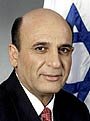
On January 19, 2006 I was in Tel Aviv. In the afternoon I went to visit my uncle who was hospitalized at Ichilov Medical Center. As I was approaching the hospital, there was unusual commotion. Ambulances were screaming their way into the hospital; all entrances were blocked, clearing the way for the injured people who were rushed into the emergency room. There was yet another terror attack, this time at the old Tel Aviv Central Bus Station, just a few miles away. Thirty-one people were wounded in this suicide bombing. An Islamic Jihad cell in Nablus claimed responsibility. Defense Minister Shaul Mofaz accused Iran of funding the attack and Islamic Jihad headquarters in Damascus of ordering it.Haaretz reported that Palestinian Authority Chairman Mahmoud Abbas condemned the attack, calling it a "despicable act of terror that was carried out outside the Palestinian consensus."
Mofaz noted that the blast occurred while Iranian President Mahmoud Ahmadinejad was in Damascus meeting with Syrian President Bashar Assad - a meeting that he termed "the terror summit." Following the meeting, the two convened a press conference at which they issued a joint statement reiterating their support for Palestinian terror. "Continuing the resistance is the only way to restore the legitimate rights of the Palestinian nation and put an end to the occupation of holy Islamic lands," the statement said."Damascus is the only place where the Iranian president is still welcomed," Mofaz commented. "The Iranian-Syrian terror axis is not Israel's private problem."After consulting with security officials that night, Acting Prime Minister Ehud Olmert decided that Israel's response to the bombing would be limited to stepping up arrest operations in the West Bank, particularly against Islamic Jihad operatives, and tightening the closure on Nablus.The murderer - 22-year-old Sami Antar of Nablus - blew himself up in a shawarma restaurant at the corner of Solomon and Neveh Sha'anan streets at about 3:45 P.M. According to eyewitnesses and the police's initial investigation of the incident, he wore a long black overcoat and posed as a peddler selling razor blades to passersby. Since dozens of peddlers roam that area of Tel Aviv, he did not arouse any suspicions.It is not known how Antar entered Israel, but he is presumed to have slipped through the gaps in the separation fence around Jerusalem, like the perpetrators of other recent attacks have done.Over the last few years, there have been a few suicide bombings near Tel Aviv's old central bus station, including one in January 2003 that killed 23 people. As a result, police said, a sizable force is stationed permanently in the area. But local residents and merchants said that they were unaware of any such force.
In Israel, the abnormal is normal. Yet we are expected to behave as a normal nation. Each time we experience another national trauma. We will never get used to this kind of horror. We have to live, and die, with it.
Suicide Murderers
The Intelligence and Terrorism Information Center recently issues its comprehensive report on Suicide bombing terrorism during the current Israeli-Palestinian confrontation (September 2000 – December 2005). I thank Dr. Reuven Erlich for passing on the information. Here are some of the main findings:
Since the end of September 2002, the Palestinian terrorist organizations have been waging a campaign of terrorism against Israel, unprecedented in scope and ferocity. They have carried out 146 suicide bombing attacks. They caused the deaths of 518 Israelis, the overwhelming majority of whom were civilians – that is, approximately half of the 1,080 killed so far by terrorist attacks. The largest number of suicide bombing attacks was carried out during the first four months of 2002. Since then there has been a slow but noticeable reduction, principally as a result of IDF actions against terrorist centers in the West Bank after Operation Defensive Shield (April 2002) and of the building many sections of the security fence.
There was fewer suicide bombing attacks in 2005 because of the following reasons: effective Israeli security force measures; the positive influence of the security fence; the decrease in legitimacy among the Palestinians, especially in the Gaza Strip. It was influenced by the opposition of the Palestinian Authority (PA) under Mahmoud Abbas (Abu Mazen) to suicide bombing attacks. However, such attacks continue to be carried out and are still supported by parts of the general Palestinian public, and sometimes are even indirectly tolerated by the PA.
Hamas has carried out the largest number of suicide bombing attacks of all the Palestinian terrorist organizations: 58 attacks, or about 40% of the total. The Palestinian Islamic Jihad (PIJ) has carried out 39, or about 27% of the total. The various Fatah factions have carried out 33, or about 23% of the total. The Popular Front for the Liberation of Palestine (PFLP) has carried out 8 attacks. Eight attacks were joint operations between two or more terrorist organizations, including between Islamic and secular organizations. Only one suicide bomber attempted to carry out a suicide bombing attack on his own initiative.
Syria and Iran are the most important patrons of the terrorist organizations carrying out suicide bombing attacks. They support them in a variety of ways: Syria allows Hamas and the PIJ to act from its territory. The headquarters of these two organizations are established in Damascus and they use Syria as a base from which to orchestrate their terrorist activities, including suicide bombing attacks, and transmit know-how and weapons to the PA-administered territories. Syria and Lebanon also allow the organizations’ terrorist-operatives to train in their territory. Iran allocates funds to encourage terrorism which it then either transmits to the terrorist organizations directly, or through the Iranian Revolutionary Guards
[1] or through Hezbollah.
Syria and Iran have provided military aid and political support for Hezbollah, which has played a central role in encouraging Palestinian terrorism (including suicide bombing terrorism), throughout the current violent Palestinian-Israeli confrontation. Since Israel withdrew from Lebanon (May 2000), and more so since 2003, Hezbollah has handled Palestinian terrorist infrastructures in the PA-administered territories, especially Fatah/Tanzim/Al-Aqsa Martyrs' Brigades. Hezbollah orchestration and support include instructions for carrying out attacks of mass destruction inside Israel, mediation between operatives in various centers, transmission of large sums of money and the upgrade of the terrorist infrastructures’ weapons and terrorism capabilities.
Among the Palestinian terrorist organizations, the PIJ’s dependence on Syria and Iran is especially evident. Syria allows the organization’s leadership, headed by Dr. Ramadan Shalah, to operate from its territory and from its headquarters in Damascus to orchestrate terrorist activities in the PA-administered territories. Iran, the organization’s principal patron, provides generous financial support and in fact funds most of its budget. Through their massive support of the organization, Syria and Iran have fostered the organization’s dependence on them and have thus acquired the capability to escalate (or, should they so choose, to deflate) the terrorism in the PA-administered territories without being directly involved.
The financial rewards given to the families of suicide bombers has played a considerable role in increasing suicide bomber motivation and can be added to the factors listed above. During the confrontation, immense sums of money have been transferred to the terrorist organizations in the PA-administered territories and to their civilian infrastructures (da’wah) through a variety of channels: the terrorist headquarters “outside” (chiefly those operating in Syria) are conduits for money from Iran and other sources; funds are transferred from Hezbollah in Lebanon directly to the terrorist infrastructures in the PA-administered territories; Arab financial support for the so-called intifada comes primarily from Saudi Arabia and the Gulf States; large amounts of the contributions from funds, foundations and charitable societies abroad are channeled into the Hamas civilian infrastructure.
Some of the funds have also found their way into the bank accounts of terrorist-operatives, mostly suicide bomber handlers and dispatchers, and of the families of suicide bombers after their deaths. Suicide bombers who agreed to sacrifice their lives knew that the terrorist organization that sent them out would take care of their families financially. Their families did in fact receive significant financial support, generally sums much higher than those received by the families of “ordinary” shaheeds,
[2] to say nothing of the prestige of being related to a suicide bomber. The money served as an incentive for others to join the ranks of the suicide bombers.
[3]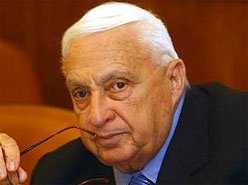
Sharon
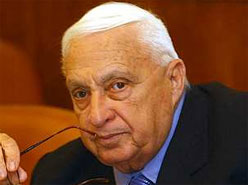
On January 5, 2006 Prime Minister Ariel Sharon was rushed to hospital in order to stop new bleeding detected in his brain. He suffered a "far-reaching" stroke and a massive brain hemorrhage.In the first detailed announcement on Sharon's condition, Professor Shlomo Mor-Yosef, director of the Jerusalem hospital, said that the prime minister had been taken back to the operating room following a CT scan administered after more than six hours of surgery."We are in the continuation of this operation," Mor-Yosef told reporters. "There are additional areas that must be treated." Since then Sharon underwent few other operations. I think the hospital has resorted to all possible means to keep him alive. For weeks he is now in a state of prolonged unawareness. We do not know the extent of damage to his brain, and to what parts of the brain. The media slowly lost interest. It was ridiculous at first to hear that "Sharon moved his finger" or opened his eyes for a short while. One thing is quite certain: Sharon will not return to politics. I wish him and his family the very best possible wishes for people in this condition. It is not easy. It is sad to see Sharon ending in this way. Very sad.
Ehud Olmert
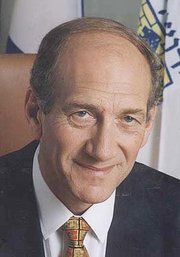
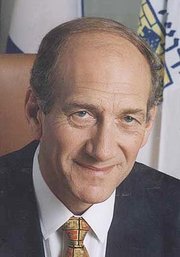
Many have asked me what I think about Olmert and about his chances to become prime minister. Olmert, 60, the son of a Revisionist family, grew up in Nahlat Jabotinsky, near Binyamina. His father, Mordechai, was a Knesset member who represented the Herut movement in the Third and Fourth Knessets. Thus Olmert was considered a "prince" - a second-generation member of the Herut leadership.
Olmert broke into the political arena at a very young age. In June 1966, when he was 21, he took the Herut movement convention by surprise by demanding the resignation of omnipotent party chairman Menachem Begin, due to his failure to beat the ruling government in no fewer than six election rounds.
When he was 23, after completing a B.A. in psychology, philosophy and law, Olmert took a job as a parliamentary aide in the Free Center party, headed by Shmuel Tamir. Olmert kept the job until 1973, when he was elected at age 28 to the Eighth Knesset as part of the Free Center, which was by then a division of the Likud. As members of the Knesset's subcommittee on sports affairs, Olmert and Yossi Sarid came out against leaders of the sports establishment, including the Israel Football Association, and forced them to carry out structural changes and set new norms. Their activity led, among other things, to a freeze on team demotions from divisions of the soccer league - a decision that in part resulted in the non-demotion of Betar Jerusalem to the second-tier Artzi League.
In the mid-1970s, Olmert launched a major campaign against organized crime, which he feels was his most important achievement in the course of 25 years of parliamentary activity, from 1973 until 1998. "It was the first time an MK got up and took advantage of all the power that parliamentary immunity grants him, in order to raise an important subject on the national agenda," he said. "It is no coincidence that this led to the establishment of a state commission of inquiry that investigated organized crime."
In the early 1980s, Yitzhak Shamir who has many faults prepared the ground for the Likud's future leadership. Unlike many politicians who see only themselves and do not care about the future, Shamir had put his trust in the younger members of his party: Dan Meridor, Ronny Milo and Ehud Olmert. All three of them capable politicians; all three smart with original thinking. Shamir, with his sharp eye, brought them close to his table. They learned a lot from him during his days in the prime minister office.
In the early 1990s, when Bibi Netanyahu was paving his way to the prime minister's office, the princes of the Likud moved in other directions. They never liked "the new kid" who was brought by Moshe Arens from the USA to tell "the natives" what to do. They disliked his arrogance, and distrusted his decision making capabilities. With growing dismay they watched how Bibi was taking over the party, and slowly but surely paved his way to the prime minister office. They did not wish to be part of this. Milo left national politics to become Mayor of Tel Aviv. Ehud Olmert left for Jerusalem to compete against the legendary Teddy Kollek. He won. He was the mayor of Jerusalem from 1993 until 2003 and expanded the city a great deal, building Jewish neighbourhoods all around Jerusalem, taking over land that was inside the occupied territories and evoking a lot of criticism from Arafat, the Arab countries, the United States, and the Israeli peace camp. Olmert's then hawkish worldview brought him to establish the controversial Har Homa, and to create a Jewish neighborhood in Ras al-Amud. Olmert was also involved in the 1996 decision to open the Western Wall tunnel, and acted to close Orient House, the seat of Feisal al-Husseini, in East Jerusalem. During his mayorship Olmert was indicted in the "fictitious receipts" affair related to "Likud" financing. He was accused of fraudulent entries in corporate documents, using fraud, guile and deceit, receiving goods by fraudulent means and knowingly giving a false statement. A year later in September 1997, he was found innocent of all charges.
Even Olmert's rivals - and there are many - admit that he is a talented man and a quick learner. Conversely, many assert that he is arrogant and patronizing, a hedonist who frequently travels around the world, and an aficionado of good cigars and fine restaurants. His links with tycoons raise many questions. Several billionaires helped finance his election campaigns for Jerusalem mayor, including Ron Lauder, Arnon Milchan and Yuli Ofer.
Acquaintances declare that Olmert does what is best for Olmert, and does not know the meaning of loyalty. When it was good for him, he joined Shmuel Tamir in Free Center. When he had enough of Tamir, he joined Eliezer Shostak in La'am. When Yitzhak Shamir was prime minister, Olmert was his ally, and was at Shamir's side throughout the major political battles with Ariel Sharon. Since the start of the 21st Century, Olmert allied himself with Sharon against Bibi Netanyahu and the "Likud" hawks.
In 1999, Olmert was interested in returning to the center of the political stage, and ran for the party leadership against Ariel Sharon. But he was driven back, receiving only 29 percent of the vote. In 2003 he joined Sharon, who promised to appoint him deputy prime minister and minister of industry, trade and tourism, even though Olmert had been shunted to the margins of the Likud's Knesset list and had been assigned 32nd place. Sharon did not care for the low placing of Olmert and abided by his word, making Olmert his deputy above the heads of all "Likud" leaders who were ranked much higher than Olmert. As you can imagine, they had little appreciation for this move. As expected, Olmert's arch rival was, as ever, Bibi Netanyahu. Their dislike for each other surpassed the dislike Sharon had felt for Bibi.
Because Olmert had lost charm with members of the "Likud" Center, he pushed Sharon to resign and establish "Kadima". This was a risky move as "Likud" is a prestigious name in Israeli politics. After much deliberation, which lasted months, Sharon agreed and established a catch-all, centrist party, in Israeli politics. The major casualties were "Likud", and also "Shinui", whose place as a center party was taken by "Kadima". "Shinui" has many problems, but as its future in history is in past terms, there is no need to say more about this failing organization at this stage.
It is difficult to say for sure what triggered the dramatic shift in Olmert's diplomatic stance. When did he turn from being a hawk who vehemently opposed the Camp David Accords to the individual who was sent by Sharon to be the first to voice the idea of a unilateral disengagement and withdrawal from all the settlements in Gush Katif and northern Samaria. Yossi Sarid says that in all the years he worked with Olmert in the Knesset, "He had hawkish views in the diplomatic sphere, and there were no signs of any preparedness for territorial compromises."
A few of Olmert's acquaintances believe that the leftist opinions of members of his close family have also influenced the shift in his political positions: His wife, Aliza, supported Peace Now, and his son Saul refused to serve in the territories, and identified with the Yesh Gvul movement. Olmert is a sports fan who is especially keen on football. His favourite team is Beitar Jerusalem. He crowned many owners and managers for the team, and is their most valuable supporters. His greatest sacrifice, if he will become prime minister, will be his inability to attend the games. With the elaborate security considerations, he will do everyone a favour and remain at his home or office, surely watching the games on television.
Olmert is a smart, capable politician. He has vast experience, ability to take tough decisions, pragmatic eye, and analytic mind. His behaviour during the past month, while Sharon's life hinges on a nail, was faultless. He has a great chance to become prime minister, and I hope he will continue what Sharon had started in the way of ending the occupation. He has the ability and support of the people to do this. Presently, polls envisage for "Kadima" more than 40 seats in the Knesset, a comfortable leadership position in the House.

"Kadima"
As said, "Kadima" is a centrist party. Since Sharon's hospitalization people who hesitated between "Kadima" and "Labour", or "Kadima" and "Likud", are now saying that they will vote "Kadima". The floating votes move to the center. How to explain this?
- Act of last mercy, consideration and compassion for Sharon.
- Confidence in the person Sharon had chosen as his no. 2 and in the catch-all party he had listed.
- Trust in Sharon's way – understanding that the only way to achieve peace and tranquility is by ending the occupation, withdrawing settlements, and helping the Palestinians to establish a state alongside Israel. The writing has been on the wall for many years. Rabin who started the process was murdered. His successors until Sharon lacked the ability to deliver, either because they lack leadership qualities, or did not enjoy the people's trust. Sharon, on the other hand, was conceived as a doer who could change things for the better, and Olmert is seen as a worthy successor.
If Olmert will conduct affairs prudently, won't make major mistakes, satisfy the potential spoilers - Shimon Peres, Tzipi Livni and Shaul Mofaz - his chances to become the next prime minister of Israel are very good.
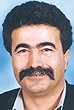
Peretz
Since the 1990s, the major parties identify themselves with their leaders. It started with Rabin who symbolized the "Labour" Party and was thought to have the leadership to take the entire party on his back. For a period of time, this identification worked for "Labour", and of course it magnified Rabin to an untold measure. The dual election vote, for the party and for the prime minister, increased this trend. Bibi Netanyahu and Ehud Barak, head to head, symbolized their respective parties. The dual election vote did not last for long, I am happy to say, but the leaders liked to have the limelight directly on them. Peres, Mitzna, and Sharon had very individualistic campaigns that focused on them.
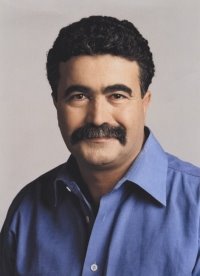
Now Amir Peretz wants the same. The slogan picked for the "Labour" Party is: "Amir Peretz. Because its about time". What a hollow, meaningless slogan. Time for what? Well, apparently, vote and then you will see. The problem is that people are reluctant to vote for a person who, in a short time after beating Shimon Peres, made so many mistakes. Even Napoleon could not afford being Napoleon, and he had charisma and reason to brag. Peretz has behaved in arrogance and poor judgment, and since the high polls of 28 seats in the Knesset immediately after his election to leadership, "Labour" has been suffering a steady decline to 18 seats, less than what the party has now. Netanyahu, who started the campaign with 13 expected seats, climbed for a while to 17 expected seats. The directions are unsteady and volatile: on the week of January 15, 2006 "Labour" was down; "Likud" was up. Last week polls envisaged "Labour" 22 seats and "Likud" 15 seats.
To strengthen "Labour", I advised Eitan Cabel, Secretary General of "Labour", to conceal this slogan, and replace it with a meaningful slogan that will shed light on teamwork. "Labour" has some capable people who should strike out and accompany Peretz. Peretz apparently fears that they might overshadow him, but if he wishes to achieve something in this elections, his ability alone will not suffice. This time, for this coming election, he may enjoy all the light of the media spots. But this will be short-lived. He will not last long after the failed elections. My advice to him: If you wish to last, share the glory. This is the only hope for you, and for "Labour". Otherwise the steady decline will continue.
I presume I was not the only person to criticize Peretz's hollow campaign. On January 18, 2006, immediately after the "Labour" primaries, the slogan had changed to "It is time for a new leadership", featuring Peretz among those elected to the party's list for the coming Knesset.
"Labour" should shed light on popular people: Yitzhak Herzog, Ofir Pines-Paz; Avishai Braverman; Ami Ayalon and Shely Yechimovitz. These personalities are not necessarily the best, but for the assignment ahead – winning the elections or at least finish second best – the campaign should concentrate on them, at least to the extent it concentrates on Peretz.
As for campaign topics: I'd like to hear about "Gaza First, West Bank Second"; ending the occupation; concrete steps to fight terrorism; reduction of air pollution, especially in the Haifa area, notorious for its polluted environment; women's rights (including right over their bodies, i.e. abortion); allowing civil marriage so couples need not travel to Cyprus for this purpose; increasing budgets of Arab municipalities; recognizing equal religious status of the reform and conservative movements; allowing public transportation on Shabbat; helping single mothers; enlargement of the medication basket; increasing teachers' salaries substantially; reducing army compulsory service to 2.5. years for men, 1.5. years for women, and monitoring radiation of cellular phone antenna. To become a normal nation, we should address everyday issues, not only security.
Politics, Media and Ethics
On December 29, 2005 I was invited to deliver a lecture to members of the Professors Circle for National Strength, a circle of academics identified with Likud. They asked me to speak on media ethics. What prompted the invitation was a lecture by Lior Horev, Sharon's strategic adviser, in which Horev said that his role is to advise journalists whatever will serve the prime minister's interests, notwithstanding whether the information is true or false. They sought a media ethics expert, and found me.
An audience of some twenty people, all of them with academic qualifications (physicians, lawyers, engineers, scientists, etc.) listened carefully to what I had to say. At the end of my lecture they raised questions that were hardly related to my lecture, but very much related to Israeli politics. Then I realized what I suspected when I received the invitation: they were looking for ways to shut the mouth of the Israeli leftist media, and I was supposed to deliver the goods. I failed miserably.
What did I learn on that evening: the Israeli media are subjective, leftist, lack principles, and support giving away the Land of Israel; this includes Channel 1, sponsored by the government and taxpayers' money; they don't wish to pay this tax anymore because Channel 1 betrays national interests. I was supposed to tell them how they could refrain from payment, providing the legal and ethical justifications. Many people in the audience explicitly said all leftists are stupid, incoherent, irrational with a defeatist worldview; "Kadima" is left. Yigal Amir did not assassinate Yitzhak Rabin. The SHABAC did; the media did not report this because they cooperate with the government and are not interested in the truth as such, just in the truth that coincides with the government's and/or leftist views. There was more, but I will spare the details. Time and again I refused to answer political questions, saying that I was invited to speak about media ethics, not about politics.
Politics sometimes is so boring and expected. I knew what was coming, but still went because I appreciate volunteer work of people who invest much of their time for common interest. Prof. Lang, the organizer of this circle had organized more than 100 lectures in the past 13 years, voluntarily and without payment (so he claimed). His opinions are remote from mine east from west, but I deeply appreciated his relentless energies to advance his agenda, providing a forum for discussion, and sort of entertainment to the revisionist elderly of Haifa, some of them vividly recall meetings with Zeev Jabotinsky and, more obviously, Menachem Begin, their eyes sparkling when they speak of those meetings. Honour is a key figure of speech, at least when discussing Jews… Arabs are in a different category. Different species. They deserve suspicion and uprooting.

Hamas
Following Hamas' sweeping victory in the Palestinian parliamentary elections, Palestinian Authority Chairman Mahmoud Abbas said on Thursday, January 26, 2006 that he remained committed to negotiations with Israel and that he'll start immediate consultations to form a new government: "I am committed to implementing the program on which you elected me a year ago," he said in a televised speech. "It is a program based on negotiations and peaceful settlement with Israel." Abbas also suggested that future negotiations with Israel would be conducted through the Palestine Liberation Organization, a possible bypass to a Hamas-led government.Hamas officials said the organization would seek to hold talks on forming a coalition, but Fatah officials rejected for the time being the possibility of joining a Hamas-led government. Final results released on Thursday Jan. 26, 2006, by the Palestinian Central Election Commission showed Hamas won 76 seats in 132-seat parliament, with the Fatah garnering only 43 seats. The thirteen remaining seats went to several smaller parties and independents. All forecasts had failed miserably. Apparently, the public did not reveal its real intentions in the exit polls.
The Popular Front for the Liberation of Palestine, or PFLP, won three seats. Badil, a coalition of small PLO factions, won two seats. Independent Palestine, a party headed by human rights campaigner Mustafa Bargouti, got two seats. The Third Way, a party led by former Finance Minister Salam Fayyad, won two seats. Four independent candidates, including three backed by Hamas, were also elected. Wednesday, January 25, 2006 election was split into a vote for 66 seats for local districts and 66 for a national ballot. According to figures obtained by Haaretz, Hamas won 45 out of the 66 parliamentary seats available on the local districts lists. Fatah obtained only 17 of the seats.In the West Bank, Hamas won all nine seats in the Hebron district, four of the five seats in Ramallah (the fifth seat is reserved for a Christian delegate), and captured the majority of seats in Nablus, Jenin, Qalqilyah, Tul Karm and Salfit. In the Gaza Strip, Hamas was the sole victor in the northern, Gaza City and Dir al-Balah districts. The group won four of the five seats in Khan Yunis, where Fatah candidate Mohammed Dahlan apparently won the fifth seat. Fatah won the majority of seats in Rafah.
According to Haaretz,
Hamas leader Ismail Haniyeh said he has called Palestinian Authority Chairman Mahmoud Abbas, requesting a meeting so that they can decide on the future of the Palestinian government. "We want to meet with him to consult about the shape of the political partnership that we can achieve," Haniyeh told reporters as he received well-wishers in the garden of his Gaza home. "Hamas will cooperate with everybody for the benefit of all the people."
"We are convinced we will be partners with the other factions," said a Hamas official. "We will study the issue of forming a government after consultations with the Palestinian leadership."Hamas overall leader Khaled Mashaal called Abbas from Syria, where he is in exile, to discuss the outcome of the vote, and told him that the Islamic militant group is ready for a political partnership.The results show that Hamas has captured almost all of the 16 constituencies in the West Bank and Gaza, in particular the Jerusalem district, where Hamas won all four seats allocated for Muslim candidates. Two seats are also reserved for Christian delegates in Jerusalem.As news of the results started to trickle in, Hamas senior officials began outlining the organization's policy as the ruling Palestinian faction. Senior Hamas official Mahmoud al-Zahar said Thursday he was ready to maintain a cease-fire with Israel forged last February if Israel does likewise, but that the Islamic group will respond to Israeli attacks: "If they are going to continue commitment to what is called quietness, then we will continue," he said in an interview with The Associated Press Television News. "But if not, then I think we will have no option, but to protect our people and our land."Asked if a Hamas-run government would enter peace talks with Israel, Zahar said there that even prior to his party's apparent election success, there had been no movement toward peace and therefore, there is no point to hold dialogue at this time."We have no peace process," he said. "We are not going to mislead our people to tell them we are waiting, meeting, for a peace process that is nothing."Zahar said the fact that senior Hamas officials, many of them in Gaza, would be unable to cross Israeli lines to reach Palestinian government headquarters in the West Bank town of Ramallah would not prevent them from taking part in decision-making, as many members of the outgoing parliament had been in the same position: "They are running an administration through video-conferencing," he said. "We are going to continue this policy." He promised a complete overhaul of Palestinian public services and administration: "We are going to change every aspect, as regards the economy, as regards industry, as regards agriculture, as regards social aid, as regards health, administration, education," he said.
Members of the Palestinian Cabinet submitted their resignations Thursday in the wake of the Hamas victory, Prime Minister Ahmed Qureia's office said. "This is the choice of the people. It should be respected," Qureia said. "If it's true, then the president should ask Hamas to form a new government." The resignations were in part a formality required after an election, but the timing of the move - hours before the release of official results - was unexpected. Under Palestinian law, Abbas must now ask the party that holds a majority in the legislature to form a new government.As Hamas' victory in the election became evident, the organization reiterated early Thursday its vow to maintain its struggle against Israel: "On one hand, we will maintain the agenda of resistance," Hamas spokesman Sami Abu Zuhri said from Gaza. "On the other hand we seek to make change and reform in the Palestinian arena."
Hamas leaders will soon have to decide where they are heading: to terror and violence, which would crash the Palestinian Authority, or to the negotiation table and international recognition. With public offices comes responsibility and accountability for the Palestinian people. I am optimistic. More infra.
Crossing Borders
I took upon myself to participate in a series of meetings at Tel Aviv University, designed to promote understanding between Palestinians and Jews. In the first meeting, two Palestinian academics -- Dr. Salim Tamari (Institute of Jerusalem Studies) and Dr. Nazmi Al-Ju'beh (Bir Zeit University) -- spoke of Political-Historical Narratives to a group of some fifty Israelis who wish to enhance their knowledge and understanding of the other. The second meeting, on January 2, 2006, dealt with Political Institutions and Processes. The speakers were Dr. Mahdi Abdel-Hadi (The Palestinian Academic Society for the Study of International Affairs) and Dr. Abdul Rahman Al-Haj (Al-Quds University). Here are some highlights.
Al-Haj said that there were 100 settlements prior to Oslo (1993). Now there are 180 settlements in the West Bank. For the Palestinians, nothing of substance has changed for the better since Oslo. Quite the opposite. The Oslo "peace process" had worsened their condition. Al-Haj lived many years of his life in Poland, where he did his doctorate. He explained that the west had contributed to Poland 7 billion dollars to bid farewell to communism. This is a huge sum of money that was extremely influential in the transition period of Poland. In Palestine, the west had poured between 1993 and 2000 6 billion dollars. There is no comparison between Poland and Palestine in terms of size of land and populations. In Poland, the investment was successful. In Palestine, there was no substantial positive change in the infrastructure. One assumes that security took a large part of this sum. Yet, where did the rest of the money go? Corruption ate the money with a large spoon.
Al-Haj drew an analogy between the Palestinian people behind the wall, and the Jewish life in the Warsaw Ghetto. Soldiers open and close gates at will, determining whether people will go to work or not, whether pregnant women will reach hospitals or not. Soldiers decide whether Palestinians will receive water, electricity, food. Later in the discussion, after some protest from the audience, Al-Haj withdrew from this analogy.
Al Haj forecasts that the Hamas will gain 40-50% of the popular vote in the January 2006 elections. Many vote for Hamas not because they espouse its views, but because they oppose the Fatah, the old corrupt establishment.
Abdel-Hadi gave a provocative lecture. According to him, the Palestinian leaders did not oppose the UN Partition Plan. His research revealed that the Mufti had sent Nusseiba to London to accept the Plan, realizing that the British were about to leave Palestine, and he wanted to gain something from the process. However, the British conceived the Mufti as a Nazi, and declined talking to Nusseiba. This piece of information was new to me. I would like to see the document.
Abdel-Hadi also explained that the 1987 intifada erupted by young people who wished to co-exist with Israel, who wanted to change their situation for the better while recognizing Israel. Well, I can testify that many Israelis, including myself, never realized this. It was quite a revelation to hear this statement. A strange way indeed to express desire for co-existence.
Abdel-Hadi also spoke of the Palestinian corruption, explaining that Oslo brought lots of money to Palestine. NGOs were established, but nothing was invested in the grassroots, nothing for the people. All resources went to the corrupt elite.
Abdel-Hadi blamed Sharon for crippling everything in the Palestinian society. There are 100 check points in the West Bank, creating a culture of prison in many places. In Jenin, there is militia culture. In Ramallah, culture of NGOs and diplomatic missions. Gaza is Hamas Land. Hamas is also very strong in Jerusalem, and in Hebron, especially with the Kiryat Arba settlers in their midst. Abdel-Hadi terms Kiryat Arba "doughnut provocation".
The wall, said Abdel-Hadi, is cutting Palestinian flesh, putting them in cantons, putting them in prison. "We live behind the wall in slums. We are all prisoners. We are all de-humanized. We are all doomed to failure if we don't recognize each other as human beings". The wall will never make peace. It creates hate. It will not stop "any martyr" who wishes to kill himself.
Abdel-Hadi said he suggested Arafat to leave Ramallah and move to Jerusalem. If this is the Palestinian capital, the Rais should reside there. Arafat looked at him puzzled and asked: Do you want me to die? "Survival", explained Abdel-Hadi, "Arafat wanted to survive".
Abdel-Hadi explained that Arafat wanted to be like David Ben-Gurion, an insider, and not like Haim Weizman, an outsider. He wanted to belong and to lead.
According to Abdel-Hadi, Abu Mazen stands for reform, democracy and security. He is the leader of the transition period. One of his great tasks is to unify the many segments of security organizations into three major organs. This is not easy as no one is willing to give up their bastions of power.
Abu Mazen is a man of principles, of ethics. He needs legitimacy. He needs parliament to secure his regime, and his own back.
Abdel-Hadi forecasts that the people who spent time in Israeli jails will win elections and be elected to leadership. It is part of the prison culture and mentality. They want elections because they need legitimacy. The person who had the power to grant, or to take legitimacy is no longer around. In his absence, everyone struggles for recognition.
Arafat had the power to nominate, to pay, and to kill. No one holds this power now. Abu Mazen lacks these leadership qualities and abilities.
Abdel-Hadi thinks these elections will make Hamas part of the system. It is very important to integrate Hamas and make it part of the coalition, part of the regime. Until now they were the spoilers. Once they become part of the government, they will change their strategy. They won't be isolated. They will transform Palestinian society and at the same time transform themselves.
Abdel-Hadi is full of appreciation to Marwan Barghouti. For him Barghouti represents the future. If Sharon was clever, he would release him today, he said. Abdel-Hadi is well aware that Israelis do not share his view regarding Barghouti. To address this, he gave the owl story. He said that while for Israeli the owl represents wisdom and good luck, for the Palestinians it represents death and bad luck. Barghouti is no more terrorist than he, Abdel-Hadi, is.
The owl parable disturbed me a great deal. While I do recognize cultural differences, and do not underestimate the power of symbols, legitimizing terror in such fashion is beyond tolerance. I asked permission to speak and said that terror is terror in all societies, notwithstanding cultural differences. Terrorism is defined as the threat or employment of violence against citizens for political, religious, or ideological purposes by individuals or groups who are willing to justify all means to achieve their goals. Thus, Nathan-Zade, Ami Popper, Baruch Goldstein, Yahya Ayyash, Mohammad Deff and Marwan Barghouti, they are all terrorists. I said for the Israelis what Barghouti did was especially disturbing because he was our partner. He spoke about peace, came to Tel Aviv, took part in discussions with Israeli leaders, received our trust, and then misused the trust to launch attacks on Israel, to send snipers and suicide murderers in our midst, to kill and plant mayhem. Thus I rejected the owl metaphor.
With regard to the wall, I reminded Abdel-Hadi the reasons for its establishment. While we can argue about its exact location and features, Israel began building the wall after much debates and discussions when we were fed up with suicide murderers and decided on separation. While Abdel-Hadi is convinced that it does not stop any "martyr", I said that Israeli generals are convinced the opposite. We should consider their reasoning as well.
The third meeting, held on January 8, 2006, hosted Prof. Khalil Shikaki who is known for the public polls he conducted among the Palestinians (Palestinian Center for Policy and Survey Research, PSR). He said that the golden age of the Palestinian Authority was 1996. Then it enjoyed legitimacy and appreciation of their public. He compared how people assessed Palestinian democracy vis-à-vis Israel, the US and other democracies. The parameters were: PA's ability to supply public needs (legitimacy increases as people are happy with the PA's conduct); corruption, and leaders' popularity.
On democracy
Since 1996, the PA has been losing legitimacy constantly. In 1996, 50% evaluated Palestinian democracy as good or very good, as compared with Egypt 20%, Jordan 25% and Israel 75% (I think Israelis will evaluate their democracy less favourably).
Before Arafat's death, Israel was rated as a good or very good democracy by 75%; USA 70%; Jordan and Egypt 2-25%, and Palestine 16%, a sharp decrease in the PA evaluation.
Since Arafat's death, democracy is evaluated favourably by 35% of the population.
On corruption
In 1996, 51% said there was no corruption in the PA.
Before Arafat's death, 85% said there was corruption.
Under Abu Mazen, 87% say there is corruption.
On leadership
In 1996, 75% supported Arafat.
2003 – 50% supported Arafat.
2005- 44% supported Abu Mazen.
On main parties
In 1996 – Fatah enjoyed the support of 56% of the population. Hamas 13%. Since the eruption of the 2000 Intifada, Fatah popularity went down, until Arafat's death. Then it went up and reached 37%. In December 2004, 41% supported Fatah. In December 2005, level of support of Fatah went up to 49%.
2003 – Hamas is supported by 30%.
December 2004 – 20% support Hamas..
December 2005 – 28% support Hamas.
Israel's assassination policy increased Hamas's popularity.
2003-2004 was the worst year by all indicators. The level of PA's legitimacy decreased significantly. Corruption emerged as a vital consideration.
Most Palestinians believe Israel pulled out from Gaza due to Hamas' violence.
On suicide bombers (Shikaki's term)
In 1995-1996 the Israeli army withdrew from PA cities. The Palestinians saw that democracy is working for them. Only 20% supported suicide bombing. Even during Netanyahu's era, most Palestinians opposed violence. This was true until the collapse of the Camp David talks in 2000.
The withdrawal of Israeli forces was also a contributing factor to belief in violence, a significant driving force to resort to violence.
84% of Palestinians saw the disengagement as a victory for the armed struggle. Before Sharon's disengagement, ending Israel's occupation was no. 1 priority. Now improving the economy is the highest priority. This led to decline in support for violence.
On compromise
July 2000 – 35-40% supported a peace package.
December 2003 -40% supported compromise.
After Arafat's death – 54% supported compromise.
September 2005 – 46% supported compromise.
On refugees
About 50% of Palestinians support compromise on refugees, i.e., solving the refugee problem without insisting on their return to Israel.
On free speech
During Arafat's regime, the newspapers published Shikaki's polls while omitting figures about Arafat's declining popularity, and critique about corruption. Now, during Abu Mazen, no pressures exist to omit certain figures, and the papers publish all data without interference.
Today's main considerations
1. Improving the economy
2. corruption
3. ending Israeli occupation
4. restoring law and order
Shikaki explained that the anarchy we witness in the PA is an organized anarchy. It has a purpose. It is conducted by those who lost their power positions so as to show that Abu Mazen lost control, that he needs them, that there is a need for them to resume their power position. They also wish to postpone the elections.
According to Shikaki, the Palestinian people link two issues: future of settlements, and collection of arms. If Israel will show concrete steps to evacuate settlements, Palestinians will be more willing to disarm. Good will on the part of Israel will lead to good will on the part of Palestine.
Future (remember: This forecast was given on January 8, 2006, RCA)
Shikaki's forecast is that Fatah and Hamas will receive more or less the same no. of seats in the district (municipal) elections. Hamas is likely to win in Gaza and Hebron. Presently, Shikaki thinks Hamas enjoys 40% of the vote. Not as strong as Fatah but the trend is constant: Hamas is gaining popularity at the expense of Fatah.
Shikaki does not foresee moderation of Hamas regarding Israel. If at all, it might moderate on internal social issues. Its willingness to disarm is not great, to use an understatement.
If Hamas will join the government, upon Abu Mazen's invitation, which is very likely, it will try to constrain government's ability to negotiate with Israel. The speed of moves, or the ability to halt moves, depends on the no. of seats Hamas will gain in the elections. The more seats, the more constraints on peace.
The old guard is losing support. Marwan Barghouti and leaders of the streets are popular among the young public. Remember that the Palestinian population is much younger than the Israeli, and young people tend to be more extreme, more supportive of violence.
The Palestinian public believes Hamas is much more capable than Fatah to address corruption. Hamas is conceived as incorruptible. The perception is that Hamas is very good in running social welfare for the poor. However, Fatah is perceived to be more capable than Hamas in achieving law and order, in developing economic prosperity, and in pushing Israel to grant national concessions and withdrawing its occupation. There is a prevailing fear that Hamas, were it gains majority, will not be as democratic as the Fatah.
Shikaki argues that Israel can affect the elections results by constructive steps. If it will release prisoners, the welcome celebrations will increase Fatah's popularity at the expense of Hamas (well, Israel did not release any prisoners, RCA).
Australia and New Zealand
In mid-February I am scheduled to leave for the other side of the planet to deliver a few lectures on a variety of topics. During my three-weeks trip I hope to see as many friends as possible in Australia and New Zealand. Those of you who wish to open calendars and set meetings, please get in touch.
New Books
Mathias Klang and Andrew Murray (eds.), Human rights in the digital age (London: Glasshouse Press,2005).
C.G. Johannsen and L. Kajberg (eds.), New Frontiers in Public Library Research (Devon, UK: Scarecrow Press, 2005).
I urge you to purchase the books.
With my very best wishes,
Rafi
My last communications are available on http://almagor.blogspot.comEarlier posts at my home page: http://lib-stu.haifa.ac.il/staff/rcohen-Almagor
Books archived at
http://almagor.fetchauthor.info/Center for Democratic Studies
http://hcc.haifa.ac.il/~rca/center/[1] For example, the double suicide bombing attack carried out near the central bus station in Tel Aviv on January 5, 2003, was carried out by a Fatah cell from Nablus and funded by the Iranian Revolutionary Guards.
[2] For example, Saddam Hussein’s régime customarily transferred higher sums of money to the families of suicide bombers than to those of “ordinary” shaheeds. To encourage suicide bombing attacks, it provided $25,000 to families of suicide bombers and $10,000 to the families of “ordinary” shaheeds.
[3] For further information see our Special Bulletin "Spotlight on Al-Tadhamun Charitable Society," at
http://www.intelligence.org.il/eng/sib/3_05/charity_2g.htm.
 This past two weeks were dominated by news regarding the Hamas: the organization, leaders' statements, plans, reactions to, preventive actions, you name it. It seems that any substantial piece of news in Israel related in one way or another to Hamas, and the prospects we may have vis-à-vis this organization. Israel is in a state of high alert and caution, while Sharon is in state of prolonged unawareness. As the time is passing, his chances to awake are slimmer.
 Olmert