August 2006
Slogan of the month:
Whether or not the reasons for the Hezbollah War were justified, this war was a most unnecessary one.
Raphael Cohen-Almagor
The Hezbollah War, Nagging Questions, Conclusions, Syria, Human Rights Tools, Interesting Lecture, Trip to Canada, The Fence, Sheikh Sa'ed, a-Ram Village, Mass Murder in China, European Parliament Scolds Companies for Aiding Internet Censorship, Mondial, Suggestions for Improving the Football Game, London Musical, New Books
The Hezbollah War
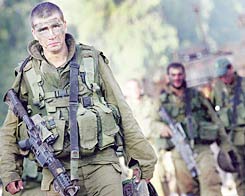 For weeks, Israel hesitated whether to launch a massive ground attack on the Hezbollah. Afraid of losing many soldiers in such a campaign, Olmert and Peretz dreaded taking this option.
On Friday, August 12, 2006, in the afternoon, the Israeli cabinet decided to give a green light to a massive attack on South Lebanon, aimed at taking control of the area, from the Blue Line (the border between Israel and Lebanon) until the Litani River. The generals estimated that we will be able to dismantle 70% of the Hezbollah's missile capability. Dismantling the entire lot would require further expansion of the operation.
A
 n hour later, we learned that the UN Security Council was able to agree on a cease fire resolution. The IDF continued the attack notwithstanding. The Resolution was confirmed unanimously by the Security Council in 3 a.m., Saturday, August 12 (Israel time).
UN cease-fire resolution on conflict in Lebanon, No. 1701
By Reuters
THE SECURITY COUNCIL, ...
Determining that the situation in Lebanon constitutes a threat to international peace and security;
1. Calls for a full cessation of hostilities based upon, in particular, the immediate cessation by Hezbollah of all attacks and the immediate cessation by Israel of all offensive military operations;
2. Upon full cessation of hostilities, calls upon the government of Lebanon and UNIFIL (The UN Interim Force in Lebanon) as authorized by paragraph 11 to deploy their forces together throughout the south and calls upon the government of Israel, as that deployment begins, to withdraw all of its forces from southern Lebanon in parallel;
3. Emphasizes the importance of the extension of the control of the government of Lebanon over all Lebanese territory in accordance with the provisions of resolution 1559 (2004) and resolution 1680 (2006), and of the relevant provisions of the Taif Accords, for it to exercise its full sovereignty, so that there will be no weapons without the consent of the government of Lebanon and no authority other than that of the government of Lebanon;
4. Reiterates its strong support for full respect for the Blue Line (separating Israel and Lebanon);5. Also reiterates its strong support, as recalled in all its previous relevant resolutions, for the territorial integrity, sovereignty and political independence of Lebanon within its internationally recognized borders, as contemplated by the Israeli-Lebanese General Armistice Agreement of 23 March 1949;
6. Calls on the international community to take immediate steps to extend its financial and humanitarian assistance to the Lebanese people, including through facilitating the safe return of displaced persons and, under the authority of the government of Lebanon, reopening airports and harbors, consistent with paragraphs 14 and 15, and calls on it also to consider further assistance in the future to contribute to the reconstruction and development of Lebanon;
(RCA: Not a word about humanitarian assistance for Israel that suffered massive losses. Kiryat Shmona is destroyed; other towns and cities, including Haifa, suffered massive losses.The damage done to Lebanese property by Israeli bombardment is horrendous. The damage done to Israeli property by Hezbollah bombardment is horrendous. Some of you may be aware that the world community, under UN auspices, is planning a "donor meeting", to assemble funds to help rebuild infrastructure damaged in the Israeli-Hezbollah war. However, the proposed agenda concerns Lebanese property damaged by the IDF but not Israeli property damaged by Hezbollah. Given that the mere presence of Hezbollah arms was an unequivocal violation of UN Sec Council Res. 1559, some tens of thousands of people have concluded that agenda to be an injustice, and are collecting signatures for a petition (see below) to correct that injustice.
Link to the petition and to the signatures pages:
http://www.petitiononline.com/IAUN1/petition.html
I have signed and urged you to sign as well).
7. Affirms that all parties are responsible for ensuring that no action is taken contrary to paragraph 1 that might adversely affect the search for a long-term solution, humanitarian access to civilian populations, including safe passage for humanitarian convoys, or the voluntary and safe return of displaced persons, and calls on all parties to comply with this responsibility and to cooperate with the Security Council;
8. Calls for Israel and Lebanon to support a permanent cease-fire and a long-term solution based on the following principles and elements:
* full respect for the Blue Line by both parties,
* security arrangements to prevent the resumption of hostilities, including the establishment between the Blue Line and the Litani River of an area free of any armed personnel, assets and weapons other than those of the government of Lebanon and of UNIFIL as authorized in paragraph 11, deployed in this area
(RCA: By August 17, 2006 it became clear that the UN and UNIFIL will not stop the return of Hezbollah to South Lebanon. Time will tell whether UNIFIL forces will be willing and able to confront Hezbollah, if needed).
* full implementation of the relevant provisions of the Taif Accords, and of resolutions 1559 (2004) and 1680 (2006), that require the disarmament of all armed groups in Lebanon, so that, pursuant to the Lebanese cabinet decision of July 27, 2006, there will be no weapons or authority in Lebanon other than that of the Lebanese state
(RCA: Questions hover regarding the Lebanese army capability to take control over the area. The army will not clean the area of terrorist elements. The army has not been a viable element for some time and needs to rebuild. Thus Israel put its fate in a crippled duck (Lebanese army) and UNIFIL, forces that played little constructive and meaningful role in the region).
* no foreign forces in Lebanon without the consent of its government
(RCA: This is a hint to Syria and Iran. Do you think they understood this?)
* no sales or supply of arms and related material to Lebanon except as authorized by its government
(RCA. You are kidding me. Maybe Russia will fathom the message. I don’t rely much on Syria, Iran and North Korea).
* provision to the United Nations of all remaining maps of land mines in Lebanon in Israel's possession.
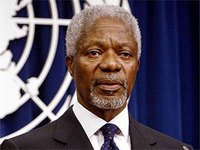 9. Invites the Secretary-General (Kofi Annan) to support efforts to secure as soon as possible agreements in principle from the government of Lebanon and the government of Israel to the principles and elements for a long-term solution as set forth in paragraph 8, and expresses its intention to be actively involved.
(RCA: Mr. Annan is most welcome to come and visit us. He should learn, first hand, of the difficult Israeli situation, especially the destruction in the north).
10. Requests the secretary-general to develop, in liaison with relevant international actors and the concerned parties, proposals to implement the relevant provisions of the Taif Accords, and resolutions 1559 (2004) and 1680 (2006), including disarmament, and for delineation of the international borders of Lebanon, especially in those areas where the border is disputed or uncertain, including by dealing with the Shaba Farms area, and to present to the Security Council those proposals within thirty days.
(RCA: Israel expressed willingness to return the Shaba Farms, but wants something in return. Notice that the Resolution, in the above operative part, does not mention the kidnapped soldiers, or Ron Arad, the pilot that was captured by Iranian forces in the 1982 Lebanon War; his whereabouts remain unknown (see http://www.mia.org.il/ron.html). The kidnapped soldiers are mentioned in the Preamble to the Resolution. Meaning, it is an issue left for direct negotiations between Israel and the Hezbollah. The Hezbollah will not settle for less than release of some Lebanese prisoners, among them the vile murderer Samir Kuntar.
Kuntar, who murdered Dan and 4 year old Einat Haran in Nahariya in 1979, caused also the death of Einat's small baby brother. The mother, Smadar, lost her entire family in that bloody night in Nahariya, 1979. Kuntar is a real, genuine "hero". See http://www.samirkuntar.org/
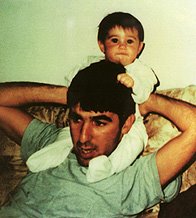 Israel negotiated his release in return for information about Ron Arad. Arad's capturers did not respond.
I imagine Israel will negotiate Kuntar's release for the right prize. The problem is that there is never equality. It is not that they will release two soldiers and Israel will release two prisoners. They always present heavy demands, far weightier than what Israel expects to get in return. In 1987, Israel released 1150 prisoners for three soldiers. Not wise on our part, I must say. We break easily, in comparison to our enemies. I wonder why. Maybe we are simply bad negotiators. Or there is another reason.
Further info on prisoner exchanges at http://www.jewishvirtuallibrary.org/jsource/Society_&_Culture/pows.html)
11. Decides, in order to supplement and enhance the force in numbers, equipment, mandate and scope of operations, to authorize an increase in the force strength of UNIFIL to a maximum of 15,000 troops, and that the force shall, in addition to carrying out its mandate under resolutions 425 and 426 (1978)
a. Monitor the cessation of hostilities
b. Accompany and support the Lebanese armed forces as they deploy throughout the south, including along the Blue Line, as Israel withdraws its armed forces from Lebanon as provided in paragraph 2
c. Coordinate its activities related to paragraph 11 (b) with the government of Lebanon and the government of Israel
d. Extend its assistance to help ensure humanitarian access to civilian populations and the voluntary and safe return of displaced persons
e. Assist the Lebanese armed forces in taking steps towards the establishment of the area as referred to in paragraph 8
f. Assist the government of Lebanon, at its request, to implement paragraph 14
12. Acting in support of a request from the government of Lebanon to deploy an international force to assist it to exercise its authority throughout the territory, authorizes UNIFIL to take all necessary action in areas of deployment of its forces and as it deems within its capabilities, to ensure that its area of operations is not utilized for hostile activities of any kind, to resist attempts by forceful means to prevent it from discharging its duties under the mandate of the Security Council, and to protect United Nations personnel, facilities, installations and equipment, ensure the security and freedom of movement of United Nations personnel, humanitarian workers, and, without prejudice to the responsibility of the government of Lebanon, to protect civilians under imminent threat of physical violence.
 13. Requests the secretary general urgently to put in place measures to ensure UNIFIL is able to carry out the functions envisaged in this resolution, urges member states to consider making appropriate contributions to UNIFIL and to respond positively to requests for assistance from the force, and expresses its strong appreciation to those who have contributed to UNIFIL in the past
(RCA: Indeed, the big question. Israel considers the composition of UNIFIL soldiers as a very significant issue, wanting it to comprise, in the main, European soldiers that have some military training. One can assume that soldiers of Muslim and Arab countries will not be impartial in this crisis. Thus when Malaysia and Indonesia jumped to offer to send their troops, Israel objected, especially when reports showed young people in these countries offered to volunteer to join the Hezbollah. Israel is interested to see Turkish troops in the UNIFIL. Although Turkey is Muslim, its army is secular and its soldiers are known to be good fighters).
14. Calls upon the government of Lebanon to secure its borders and other entry points to prevent the entry in Lebanon without its consent of arms or related material and requests UNIFIL as authorized in paragraph 11 to assist the government of Lebanon at its request.
15. Decides further that all states shall take the necessary measures to prevent, by their nationals or from their territories or using their flag vessels or aircraft,
(a) the sale or supply to any entity or individual in Lebanon of arms and related material of all types, including weapons and ammunition, military vehicles and equipment, paramilitary equipment, and spare parts for the aforementioned, whether or not originating in their territories, and
(b) the provision to any entity or individual in Lebanon of any technical training or assistance related to the provision, manufacture, maintenance or use of the items listed in subparagraph (a) above except that these prohibitions shall not apply to arms, related material, training or assistance authorized by the government of Lebanon or by UNIFIL as authorized in paragraph 11.
16. Decides to extend the mandate of UNIFIL until 31 August 2007, and expresses its intention to consider in a later resolution further enhancements to the mandate and other steps to contribute to the implementation of a permanent cease-fire and a long-term solution.
17. Requests the secretary-general to report to the council within one week on the implementation of this resolution and subsequently on a regular basis.
18. Stresses the importance of, and the need to achieve, a comprehensive, just and lasting peace in the Middle East, based on all its relevant resolutions including its resolutions 242 (1967) of 22 November 1967 and 338 (1973) of 22 October 1973.
19. Decides to remain actively seized of the matter.
 Saturday, August 12, 2006
As said, the government had hesitated with the decision of massive ground attack for a good reason, knowing that it would result in many casualties. The question is: You halted your horses for weeks, but unleashed them on the day that the UN Security Council agrees on a ceasefire. Why? Can’t you say instead: Israeli cabinet will convene immediately after the UN meeting (It is pikuach nefesh, i.e. a question concerning human life, hence more important even than the sanctity of the Shabbat) to decide whether to accept the ceasefire. After a short meeting, the cabinet decides that, as a sign of good will, Israel stops all violence as of now, and calls upon the Hezbollah to do the same.
Israel did not do this. Why? Because then for sure Israel will be unable to declare victory. Because we wanted to bring the Hezbollah to its knees. Because of public opinion. The P.M. and his generals thought: We have to think about public opinion, and the days after the war, when the long and short knives will be taken out of their sheaths, asking for heads. Because of these reasons, the fighting continued, and the blood lingered, massively.
Twenty-four Israel Defense Forces soldiers were killed and another 11 seriously wounded in heavy clashes Saturday with Hezbollah forces in south Lebanon, the heaviest one-day Israeli casualty toll of the war, after the IDF expanded its ground operation in the area.
IDF casualties in fighting included five air crewmen killed when their an Israel Air Force helicopter was shot down by Hezbollah fire. Hezbollah said the helicopter was struck by an anti-tank missile.
Some of the casualties were killed by “friendly fire”. Two soldiers from the Golani Brigade were killed in an accident that occurred when an IDF tank accidentally ran them over in the village of Shakif-al-Amal in the East. Two other soldiers were wounded in the accident, one seriously and the other lightly. Another soldier was killed when troops exchanged fire near the village of Hadata on the eastern section.
As part of the expanded operation, IAF helicopters dropped a large number of Israeli troops deep inside Lebanese territory, in the largest operation of its kind since the Yom Kippur War of 1973.
With the expansion of the ground offensive in Lebanon, four divisions were operating in south Lebanon and most of the activity was focused in areas from where Hezbollah has been firing short-range rockets into Israel. Sources in the IDF General Staff said four to seven days would be needed to complete the occupation of the area.
IDF troops were engaged in heavy exchanges of fire with Hezbollah, as forces thrust northward to the Litani River under cover of intense artillery fire. IDF sources said more than 80 Hezbollah fighters had been killed in the clashes over the weekend.
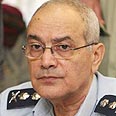
Israel has nearly tripled the number of forces in Lebanon as part of its expanded ground war, and expects to fight for another week, said IDF Chief of Staff Dan Halutz. Halutz said IDF troops would stay in Lebanon until an international force arrives.
UN Middle East envoy Alvaro de Soto told Reuters the UN force could begin deploying in seven to 10 days, suggesting there is still some time before the "immediate cessation by Israel of all offensive military operations," as called for in the resolution.
 Sunday, August 13, 2006
More than 220 rockets were fired into northern Israel, killing one person and wounding 15. Kiriyat Shmona and Ma'alot were hit most often (55-60 rockets), and after them Nahariya, Safed, Nazareth and other population centers. The fatality occurred when a rocket crashed directly into a house in a community near the western Galilee town of Shlomi. A person inside the house was killed.
In Safed, a woman was taken to hospital with moderate injuries and eight more people suffered light wounds in the rocket attack on the town. Air raid sirens were sounded throughout the north for further attacks.
UN Secretary-General Kofi Annan said Israeli and Lebanese leaders had agreed to a ceasefire from Monday and the United Nations was preparing to deploy up to 15,000 troops to help enforce the truce.
In Haifa this was the most difficult day of the war. There were ten sirens from just past 10 a.m. until 8 p.m. Nerve-racking. Dozens of missiles landed on the wounded city. Luckily no one was killed. Dozens of people, in state of shock and panic, flooded the hospitals. It was scary. You sit in your so-called “sheltered room” and feel like a sitting duck. The sheltered room, with its thick walls, would not save you from a direct hit. You know that statistically the chances of such a hit are small. Still, you are afraid. In the next rounds of rockets, you might be the one. After all, a cancer patient does not receive much consolation of statistics showing that only one out of 250,000 people suffer from her cancer. Potentially, you feel like that cancer patient. You can be the one. You sit there, and there is nothing you can do. You cannot run away, because then you increase your chances to take the hit. You sit there and pray.
Monday, August 14, 2006
 7:10 a.m. The damn siren. Your wake up call. Very efficient. Certainly did the job. Still, it was the worse alarm clock I have ever heard in my life. Luckily, no falls in Haifa. At 8 a.m. the shooting and the bloodshed stopped.
From Friday, August 11, 5 p.m. until Monday, August 14, 8 a.m., 33 soldiers and 3 civilians were killed. Totally unnecessary. What a waste. On Friday, the army said that it needs to fight to improve its positions, otherwise it would find it difficult to protect its soldiers. Do you really think that if there was no fighting during those faithless hours, the toll was 36 deaths on our side? What callous and thoughtless decision-making.
In an interview to Sima Cadmon, Yedioth Ahronoth published on August 18, 2006 (“Broken wings”, Political Supplement, p. 6), Dan Halutz was asked whether he regrets sending the divisions on August 11. His answer was simple: No, I believe we did the right thing.
This person does not regret much. What vanity. And in the same interview he said that he is mistakenly conceived by others as vain, arrogant, and conceited. He does not have any idea why. To recall, this is the commander who gave the order to drop a one-tone bomb in a Gaza home in order to kill a Hamas military officer. As a result, 15 civilians, including 11 children, were killed. Halutz was asked what does he feel knowing that his order resulted in such a toll, and responded that he "sleeps very well at night." He added that the only thing he felt was "a slight jolt to the airplane - it was gone within a second." I knew it was the wrong decision to appoint him Chief of Staff, as we need and deserve different sort of commander to lead our army. He needs to be stopped.
I believe Halutz is a decent pilot. El Al can use his services, and he will have more time to devote to his stock shares and bonds without public scrutiny.
156 people were killed in the Hezbollah War. And Israel is in a worse position than it was on July 12, 1006.
Nagging Questions
Re Israel
In the aftermath of the Hezbollah War, we need to ask ourselves some difficult questions. I would like to see the transcript of the government meeting of July 12, which authorized the severe retaliation. What was said there? Specifically:
? Why did Israel decide to attack South Beirut massively in retaliation for killing of four soldiers and the abduction of two others? Was this the right measure to be taken?
Did the government and the army discuss the likely implications of sending the air force to attack south Beirut? What scenarios were depicted? Did they include heavy missile attack by the Hezbollah on the north of Israel, including Haifa?
If the war scenarios included heavy missile attack, how come that the government had knowingly decided to subject 1.5 million people to such an attack, without providing them adequate shelters and defence?
If the war scenarios did not include such a missile attack, someone needs to retire, the sooner the better. This was a major mistake. That person, or those people, should not be in the decision-making loop. Israel paid heavily for that mistake.
Further questions should be addressed:
? Who is responsible for the decision to attack primarily with the air force, thus subjecting northern Israel to continued horror and rocket terror for weeks? Was it the Chief of Staff alone?
? Was IDF Chief of Staff Dan Halutz the right choice to lead the war?
H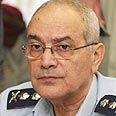 alutz is the first Chief of Staff to come from the air force. I think we learned our lesson. He might be good for a normal, routine period, not for time of war. For war times, we need a general who understands more than air strikes. You need ground forces to capture land. After a week of continued missile attacks, why didn’t we change strategy? Clearly, then it became clear that the air force alone will not do the trick. We waited and waited, until August 11, a few hours before the UN ceasefire resolution. Our sages would call this “Chelem”. A traditional way to say “stupid”.
? Was Amir Peretz’s nomination to Defence Minister prudent?
?  How come Minister of Foreign Affairs, Tzipi Livni, stayed at home during all this crisis? (As far as I remember, it is the first war in which the Minister of Foreign Affairs did not jump between friendly and not-so-friendly capitals to mobilize support and explain Israel’s position). We know about the wrong decision not to send her, when she wanted, to the UN on August 11. But was she comfortable sitting in Jerusalem at such a time, thinking this is the right thing for her to do? If so, why?
? What can be done to ensure Israel from missile attacks? In my perception, the IDF should develop capacity by which each launcher will be located on the spot upon firing a missile, by satellite, airplane as well as by other technology. Israel should cover the entire war zone, and destroy each and every launcher one minute after the missile is fired. See the attached link. This might be tricky when one is using a timer to operate a katyusha, sending a signal from afar via his cell phone.
? What is Ehud Olmert’s responsibility, as prime minister?
On August 17, first sounds were made by respectable journalists (Nahum Barnea, Rafi Ginat), saying what I have been saying immediately after  Peretz’s nomination. Olmert made a mistake by offering him the job, knowing full well that Peretz is not the right person for the job. Nominating him shows his priorities. Olmert did not wish to go to war. This is a very dovish government. Miscalculations and misjudgments, together with flawed decision-making, brought about this unnecessary war.
Amir Peretz made a mistake by accepting the role. He thought that from the Minister of Defence chair he could nicely land in the prime 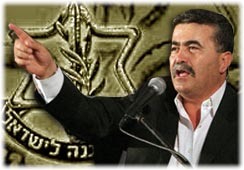 minister chair. He used this opportunity as a spring-board for the next role he envisaged for himself. He, too, did not envisage or want, war. But he had little ability to confront the generals and reject their war plans. My worst nightmares were fulfilled. Peretz was the wrong man for the job. The generals softened him for weeks by flattery, and when they pushed for a heavy attack on Beirut,, instead of saying: “Hey guys. Wait a minute. Not too fast. What can be the repercussions?” he said “OK”. We paid a heavy toll for his initiation.
Here is what I had written in May 2006, after Ehud Olmert composed his coalition:
Irresponsible Politics
Another example of the irresponsibility manifested by Olmert and Peretz concerns the allocation of portfolios. Labour is the most important ally of Kadima and therefore deserves one of the three major ministries: Defence, Finance or Foreign Ministry. Olmert promised Livni the latter. Peretz, who headed the Histadrut and has little experience with army matters wished to have the Ministry of Finance, and rightly so. Olmert insisted that this ministry will be kept for Kadima. Yet again, partisan interests preceded state interests. Peretz, who received the Ministry of Education as compromise, settled for Defence. The outcome is miserable: We have the wrong person in Defense; we don’t have the better person in Finance, and Uriel Reichman, who was designated by Sharon to be the next Ministry of Education retired from politics. This was probably the quickest career in politics Israel has ever known. Reichman was sworn into the Knesset only a week before.
Peretz is unqualified for the post. If Olmert were to really care about state interests, he would not offer him the job. If Peretz were to really care about state interests, he would not have taken this offer or, alternatively, handed over the position to one of his party generals. Ami Ayalon, for one, would have been a very good person for the job. But Peretz wants to keep the honour for himself. This is natural, but not wise.
To add further imprudence to the series of wrong decisions motivated by partisan politics and not the nation’s best interests, Olmert decided there will not be deputy ministers, as the government is the largest per capita IN THE WORLD. Twenty five (for the time being) ministries. China has twenty eight. USA has fifteen. We have twenty seven. There is no justification for this. Pure greed. Consequently, Peretz who understands a lot about social matters, and very little about defence, will be left without a qualified deputy to keep him out of trouble. Clearly, his advisers need to be by far more qualified than him to enable him grasp the vast complexities of this giant ministry. For the first time in Israeli politics, both the prime minister and the minister of defence lack the necessary experience for handling our defence, and the minister will not have a qualified deputy to guard him from making basic mistakes. The citizens of Israel have a good reason to have trouble sleeping.
Olmert, the astute politician, is making all the possible mistakes. In this way, he will not survive eighteen months in office. I hope that Israel, as a country, could afford such wrong decision-making. Defence for Israel is not like defence for Switzerland. I think Peretz is the least qualified person to hold the position in the entire history of our country.
Olmert evokes unhappy memories, reminding me of Ehud Barak who made similar mistakes and did not survive as prime minister for long. I must say that I appreciated Olmert, as a politician, for more than I appreciated Barak, and am puzzled that he chose to establish his government in the way he did.
On July 10 I wrote the following:
1. It is not only that Amir Peretz’s nomination was wrong; it is also that his Ministry projects weakness.
2. It is not only that this nomination endangers Israel; it also endangers the Middle East.3. It is not only that Peretz lacks the capability to carry his job; he also lacks the will. Let me explain each of these claims.
1. Peretz’s nomination stems from the wrong reasons. Olmert wanted the key to Israel’s finance to remain with Kadima, with one of his trusted loyalists. He owed Tzipi Livni a political debt and had to respect her wish to serve as Minister of Foreign Affairs. Hence the only senior ministry he could offer Labour was the Ministry of Defence. I can understand the reasoning. I cannot justify it. Switzerland can afford Peretz as Minister of Defence. Israel cannot. Our security problems are too weighty to entrust such a responsibility in the hands of a person who never held senior security positions. It is not only that he might make the wrong decisions. Israel’s enemies were quick to realize that Israel’s government is weak, and that they can seize the opportunity of having two civilians (Olmert and Peretz), with very little military experience, deciding on security matters.
2. In our volatile reality, things might get out of hand very quickly. King Abdullah of Jordan is afraid of spillover to Jordan, endangering his kingdom. The Hezbollah in Lebanon might exploit Israel’s vulnerability. Israel might not only return to Gaza but also to Lebanon. More soldiers and civilians will be killed. All hard-won gains of the last six years will go down the drain.
3. Israel cannot afford Peretz’s trial period at the ministry. By the time he’ll be qualified, both sides will suffer far too many casualties. Furthermore, a Minister of Defence in our troubled region needs not only to assess situations, analyze opportunities and make decisions, some of which are most unpleasant, but unfortunately he is also required to have a killer instinct. Peretz does not know to assess, analyze and make such decisions, and he lacks the killer instinct. He is the person who needs to balance the Ministry of Defence, not to head it.For all these reasons, Amir Peretz I implore you: Please resign now. The risks are too high. Things might escalate and reach a point of no return, by which war might be conceived as the solution. This is certainly not what you want.
On August 18, 2006, the media reported that Olmert is “contemplating” offering Peretz the Ministry of Finance and nominating a retired general to Minister of Defence. Good idea. Better late than never. Should be done. But this acknowledgment of a mistake is not enough. It requires some personal consequences. People should be accountable for their decisions, especially grave decisions that took many lives.
Re Lebanon
How the Lebanese army will perform in the south, that is, how it will deploy and create an area free of weapons and terrorists, as determined by Resolution 1701, is an open question.
Re UNIFIL
Will UNIFIL be able to control south Lebanon and halt Hezbollah’s likely attempts to retake control?
I wish to bring to your attention the main findings of a recent report compiled by Dr. Reuven Erlich of the IDF Intelligence and Terrorism Information Center (August 6, 2006):
At no time during the past two decades did Israel manage to achieve a lasting peace agreement or other arrangement with Lebanon. That was chiefly because of internal factors in Lebanon and its overwhelming dependence on Syria as well as Hezbollah's close relations with Iran. Israel has had no choice but to use force, and during the past 30 years it has undertaken a wide range of military actions, beginning with targeted attacks on terrorist bases, through comprehensive operations (Litani, Accountability and Grapes of Wrath) and ending with Operation Peace for the Galilee, in which Israel remained in Lebanon for three years. Those operations yielded at best meager fruits in the form of partial, temporary and feeble agreements which did not solve the basic problem of Lebanon-based terrorism.
6. Despite their temporary nature, the agreements, arrangements and understandings reached were, for Israel, absolutely essential (RCA: From my Slogan of the Month you realize that I beg to differ), because they provided a breathing space and periods of relative quiet for the populated areas of the north. They were the necessary replacement for the permanent agreements which were not forthcoming, but their life expectancies were short and they quickly dissolved. Israel learned that the hard way after Operation Litani (1978), two weeks of fighting against the Palestinian terrorist organizations (1981), and Operations Accountability (1993) and Grapes of Wrath (1996). That was also true when Israel took unilateral actions, and the IDF's withdrawal from Lebanon (1985) and from the “security zone” (2000) did not bring about a long-term cessation of terrorist activity.
7. An analysis of 30 years of Israeli policy in Lebanon shows that all the agreements, arrangements and understandings reached had three central weaknesses which led to their erosion and eventual collapse:
A. The basic discrepancy between Israeli and terrorist organization worldviews: Israel regarded the agreements and arrangements as a means of stopping terrorist attacks from Lebanon to enable the residents of the north to live normal, routine daily lives. The terrorists, on the other hand, both Palestinian and Lebanese, regarded them as a response to political and military pressures and a way of getting time to reorganize and improve their preparedness for a renewal of terrorist activities, their only justification for existence.
B. The absence of any binding arrangement leading to effective inspection and enforcement: Because of the basic discrepancy between Israel and the terrorist organizations, effective inspection and enforcement mechanisms had to be created, extremely problematic given the conditions in Lebanon:
1) The Lebanese government: The partner in most of the agreements and the side which was supposed to be focal in enforcing them was unable to do so. That was because of the Lebanese government's (and army's) basic weakness versus internal Lebanese sources of power, versus the terrorist organizations (Hezbollah among them) and versus their sponsoring countries (primarily Syria and Iran). That situation exists despite the fact that in principle, the Lebanese government and the anti-Syrian coalition have a strong interest in enforcing the government sovereignty in south Lebanon and in weakening Hezbollah and the terrorist organizations.
2) Stationing international forces: In the absence of the Lebanese government's ability and desire to enforce its authority, attempts were made support it by stationing international forces. To this day they have been a resounding failure, whether because the United States and France were unwilling to shed the blood of their own soldiers in Lebanon (and therefore, under terrorist pressure, removed their units from the multi-national force) or whether from the beginning, UNIFIL was not given a mandate to take effective action against the terrorist organizations (as a result of the understanding that should such a mandate be given, it might involve the UN soldiers in unending clashes with the terrorist organizations).
3) IDF activity supported in the security zone north of the international border supported by friendly Lebanese militias: In the absence of effective Lebanese or UN enforcement apparatuses, the IDF had no choice but to remain in the area north of the Israeli-Lebanese border for long periods of time (the “security zone” after the Lebanon War and the Christian militias headed by Major Hadad before it), and from there to wage the struggle against terrorism. As a solution it was also extremely problematic, because it involved Israeli casualties and did not provide a solution for the Katyusha rockets fired into Israel from areas north of the zones occupied by the IDF.
C. The opposition of the terrorism-sponsoring countries: Throughout the years, those countries, with Syria in the forefront, proved their ability to hinder and even sabotage agreements and arrangements to which they were not a party and which were contrary to what they viewed as their interests. On the other hand, involving Syria in the Grapes of Wrath agreement, did not prevent its eventual erosion, but it did prolong the period of its enforcement.
8. The longer the current confrontation has lasted, the faster the international community has moved to find a diplomatic solution to end the fighting and change the fundamental conditions which enabled the crisis to occur. The outlines for its solution are similar to those raised during the past 30 years. They center around distancing Hezbollah from the border, enforcing the authority and sovereignty of the Lebanese government, the establishment of security arrangements and the establishment of an international apparatus for effective enforcement of the agreement (with the addition of the release of the abducted soldiers as part of any solution reached) .
9. With all the reservations mentioned concerning the survival of agreements and arrangements in Lebanon, which oblige Israel to have a fairly low level of expectation regarding any agreement reached, in our assessment it is worthwhile to learn lessons from the past likely to improve the quality of the upcoming agreement and prolong its life expectancy. They are:
A. The involvement of the United States: America was involved in most of the agreements and arrangements, sometimes as the only participant and sometimes not, sometimes center stage and sometimes behind the scenes. Significant American involvement is also important this time (despite the face that as stated, it cannot ensure enforcement) even if the UN and other countries are involved, such as France.
B. Significant involvement of the Lebanese government: In the past, as noted, the Lebanese government could not deliver the goods. During the past few years there has been an improvement in its ability to carry out political maneuvers, first because of the IDF's withdrawal from Lebanon (2000) and second because of the eviction of the Syrian forces (2005). Sending the Lebanese army to south Lebanon (which is problematic because it is weak) will at least provide Lebanese legitimacy for any agreement and in our assessment should therefore be central to its success.
C. Stationing international forces: Although that has proved to be problematic, this time as well it will be necessary to station effective international forces to back up the weak Lebanese army. A past lesson is that those forces will need a clear mandate to enforce their authority, and an appropriate order of battle. Otherwise it will be a replay of unsuccessful UNIFIL.
D. The inclusion of Syria or at least the neutralizing of its destructive force (and indirectly that of Iran as well): Including Syria in any agreement is likely to make it easier for the Lebanese government and the international force to function. On the other hand, including Syria (and even more so, Iran), is liable have a political price which might be very high for the State of Israel.
E. Avoiding a long IDF stay in the captured areas of Lebanon: Past experience has shown that when the IDF stays in Lebanese territory for a long period of time it is liable to be exposed to daily Hezbollah attacks in areas where there are large Shi'ite populations, parts of which are hostile to Israel, and to cost the IDF casualties. There is also the possibility that the Lebanese and international community will justify such attacks by representing the Israeli fighting as “occupation.” Therefore, the arrival of the Lebanese and international apparatuses should be synchronized with the IDF withdrawal from Lebanon , according to the most rapid schedule possible.
F. Economic aid to south Lebanon: After the wide-scale destruction in Lebanon caused by the current confrontation, the country will need pan-Arab and western aid to rehabilitate the infrastructures which were damaged. Past experience has shown that such aid is channeled into Beirut and does not reach the economically deprived population in south Lebanon where Hezbollah flourishes. A radical approach to the problem of terrorism necessitates the broad economic rehabilitation of south Lebanon channeled through the Lebanese government and not through Hezbollah's financiers with their Iranian backers. In other words, the Lebanese government will have to demonstrate its economic as well as its military presence in south Lebanon.
G. Israeli maintenance of and support for any arrangement reached: In the past, because of its desire not to rekindle the situation, Israel tended to overlook infringements and violations of the agreements. That created a dynamic of limited violations which quickly eroded the agreements. Thus Israel will be forced to maintain and support (through military action, if necessary) any agreement reached even if it leads to additional incidents, political difficulties and continued coping with the problem of terrorism originating in Lebanon.
I thank Dr. Erlich for this report. Those wishing to have the full report are welcome to contact me and I will gladly send it along.
Conclusions
Israel’s deterrence has been eroded. We are in a worse position than we were in on July 12.
Invest in anti-missile warfare
One F-16 costs 100 million dollars. I would change priorities, investing in anti-missile warfare.
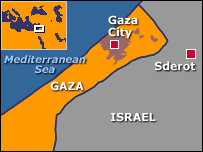
Never again be complacent about missiles, in the north or in the south. Anywhere. No more missiles on Sderot. Expect the Palestinians to be quick in understanding the weaknesses of the Israeli army and society.
The North
Invest resources in the rebuilding of the north. It was massively destroyed. Central Governance in Lebanon
Invest international effort in strengthening central government in Lebanon to see that all or most of its fractions will stay intact, working for the best unified interests of the country.
Occupation
Olmert’s convergence plan is dead and buried. Finally, on July 17, he admitted this, saying now it is the wrong time to discuss the issue. Unilateral steps are not good when we face enemies with missile capability.
I am very sorry about this: For the time being, the occupation will continue. A prudent leader would try to decrease the friction between the Israelis and the Palestinians, and give some more room and freedom to the Palestinians by dismantling some small, isolated settlements. I do not see a grand-plan to evacuate the occupied territories and leaping to settle the Israeli-Palestinian conflict. This is true as long as Hamas is in power, and holds to its present, destructive views.
The leading quartet should resign:
Olmert for his bad decision-making ability, from the nomination of Peretz, for the destruction of south Beirut, for not preparing the north of Israel against the massive attack, and for the inability to find an adequate solution to their suffering.
Peretz, for his hunger for power that blinded his eyes. He was manipulated, in a bad way, by the army generals, and failed to take the right decisions.
Halutz, for his misconduct and bad strategy, his inability to change gear and plans when realizing his grand design that relied heavily on the air force did not work; for the poor preparations of the army for such a war (I will not enter into details. Suffice to say that the reserves who were drafted did not have water, food, and basic fighting equipment on the ground, after entering Lebanon).
Livni, for not doing her job. She continued to sit in Jerusalem, and watched others doing what she needed to do. John Stuart Mill said: No one is a better judge than yourself when dealing with issues that concern yourself.
People in Israel are asking to establish state inquiry committee. This process would take a lot of time. To save this precious time, during which this “leadership” will continue to “lead” and inflict more damage, to save energies and resources, we need to demand the resignation of the quartet now, sooner the better.
Leadership crisis Israel is facing a severe crisis of leadership. Apart of the above four, our President Moshe Katzav is facing police investigation for abusing his powers to force an employee in his office to sleep with him; our Minister of Justice, Haim Ramon, apparently kissed a young soldier on her lips without her consent and until the trial was forced to retire; our Finance Minister, Abraham Hirschson, is suspected for taking unauthorized money from a major health company to sponsor his beloved mission, “Life March” (sponsoring young people to travel to death camps in Poland). The Head of the Knesset Security and Foreign Committee (the most important Knesset committee) is facing charges for political appointments (nice local jargon for bribing people to vote for you). And Shimon Peres has just celebrated his 84th birthday.
 The crisis is so deep that people long for Bibi Netanyahu. Until now, he behaved very well, in a responsible statesmanlike manner. He gained many points in public opinion. He is an excellent propagandanist for Israel, explaining our interests and causes in a most persuasive manner. Bibi is back in business.
Still, I am not convinced he is the solution. My memory is not THAT short. Israel needs new people, new faces, new ideas, new charisma, new initiatives. We need good and capable people, who are willing to step forward and work for their community and society. Many people are simply afraid to make the effort. They lack the necessary zeal for such a demanding job. We are left with only those that see politics as way to advance upward. We need those who see politics as sacrifice.
Who are the short-term gainers in Israel from the Hezbollah War?
Bibi Netanyahu
Ivet Libermann (Yisrael Beiteinu)
The settlers in Judea and Samria.
Iran
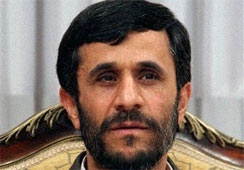 According to IDF sources, Iran sent several dozen Revolutionary Guard fighters to bolster the ranks of Hezbollah. We have witnessed the heavy finger tips of Iran all over the Hezbollah's equipment, infrastructure, strategy, and fighting.
I said time and again that we should not be complacent about Iran. Iran is an international problem, posing an international threat, that needs to be addressed and answered for by the international community. This war has shown, clearly and visibly (as if we did not know), that our enemies have no qualms about hurting civilians, massively, that they will take any measures they have to do just that, that they hate our guts, have no intention to settle for less than Israel’s destruction, and that they are willing to take grave losses to achieve this aim. If the destruction of Israel once and for all, by nuclear power, would require the destruction of a third of Iran, so be it. I want to say this loud and clear: One nuclear bomb at the heart of Israel will be sufficient. Israel cannot and should not take the chance. The risk is too high. I hear Iranian leaders and believe every word they say. Never again ignore what the enemy is saying loud and clear. In 1921-1941 we ignored Hitler. We learned our lesson.
Syria
 Syria continues its dangerous tricks, and should be stopped, soon. Syria continues its efforts to transfer large quantities of war materiel, including rockets, to Lebanon, in an effort to assist Hezbollah.
According to IDF sources, the Israel air force has succeeded in partially stemming the arms transfers, but intelligence shows that supply convoys have managed to continually cross into Lebanon from Syria. Senior Syrian army and intelligence officers are involved in the arms smuggling.
Two specific types of weapons - anti-tank missiles and rockets used to target Israeli civilians - are of concern.
The alert levels of the Syrian army, especially on the Golan Heights, were at its highest levels since the Lebanon War in 1982. The Syrian preparedness is mostly defensive, but the IDF is not excluding the possibility that Damascus will initiate a limited ground operation.
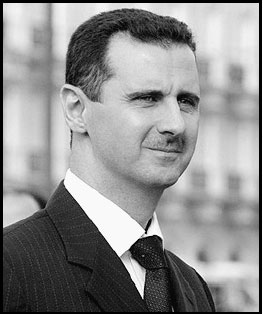
Syrian President Bashar al-Assad has claimed victory over Israel as well as America, whose plan for a "new Middle East," he said, has been defeated by Hezballah's success in fighting Israel. The American plan for democracy, human rights, peace, an end to terrorism, and economic progress failed miserably. Assad claimed America and Israel wanted to dominate the Arab world by destroying Arabism and Islam. In his eyes, Hezbollah’s victory means his victory, and the continuation of the present situation: totalitarian regime, basic rights (food, water, shelter, sex) as opposed to human rights, war, victory of terrorism, no economic progress (if not decline), and victory for Arabism and Islam.
Listening to Bashar it is apparent that we are doomed to further hostility and bloodshed. Frankly, on the Israeli side, I do not see a government willing to withdraw from the Golan at present. More or less, in terms of progressing to peace, there is nothing to talk about.

With the loss of complacency, Israel should keep an open eye on Syrian involvement in Lebanon, and its military maneuvers in Syria. The tension between the countries is high. It is in the direction of explosion. I hope for some external involvement to redeem the situation and stabilize the region. Bush and Rice: Wake up!! Time to re-evaluate your relations (or lack of) with Syria. One way or another, the status quo is bad for the region and world peace. My advice is to explore avenues for common sense. If this fails, explore avenues for severe sanctions against Syria.
Human Rights Tools
Human Rights Tools is a one-stop gateway of news, links and resources on human rights. It includes daily headlines gleaned from top sources, country reports, job notices, and links to human rights law resources.
Visit: http://www.humanrightstools.org/
Interesting Lecture
I received the following link from Sharon Amir who described it as “Exquisitely interesting and funny though long – Sir Robinson speaks about the importance of creativity in education”.
When you have 15 minutes free of work, view the link. I recommend.
http://www.ted.com/tedtalks/tedtalksplayer.cfm?key=ken_robinson&flashEnabled=1
Trip to Canada
 On September 10 I am scheduled to leave for Toronto. I plan to fly to Ottawa on the 16th and return to Israel on the 23rd of September. I will be happy to see as many of my Canadian friends as possible. If you wish me to deliver a lecture in your forum, please get in touch, soon.
The rest of this Newsletter was supposed to be published in July. The Hezbollah interfered with my plan and delayed the publication. It seems I have written this ages ago. The topics, however, are still relevant. Very much so.
Those who sow without sensitivity, bringing tears to the affected, will reap hatred.
Raphael Cohen-Almagor
The Fence
Shlomi Swisa of B’Tselem suggested to show me the fence’s trail in Jerusalem and to see, with my own eyes, some of the problems involved. On Sunday, July 2. 2006 Eliezer Moav came to take me for a guided tour of the fence. The main problems, as I witness them, are:
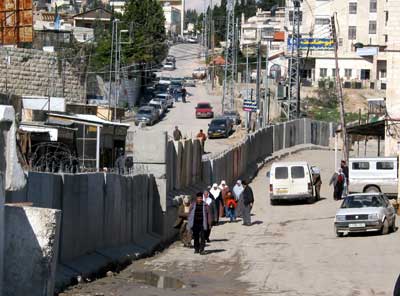 In some parts, the fence separates Palestinians from Palestinians, cutting some people from families, jobs, opportunities.
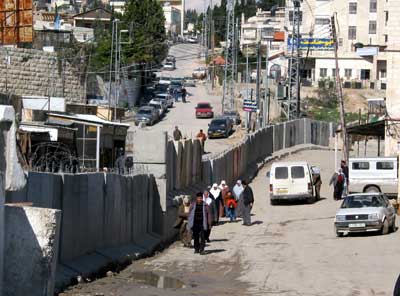
The fence is aimed to settle and determine the permanent boundaries of Jerusalem in a way that serves Israeli interests, and shows little sensitivity to the Palestinian residents of Jerusalem. In Abu-Dis, the wall passes along the 1967 border, right through the village, separating those who carry Israeli IDs from those who do not; between family members; between people and the city. I do not think security played a major role in setting this crude route. It is all about the definition of borders, with little notice of the people whose lives are affected by the erection of the wall in the middle of the village.
Fifty five thousand Palestinians from Jerusalem are left outside the wall, in Palestinian territory. Very little is done to care about their well being.
A few thousand Palestinians are left inside Jerusalem, without Israeli IDs, and without rights. Some of them wish to have Israeli IDs, some do not. To date, Israel has refused to grant all of them citizenship.
Sheikh Sa'ed
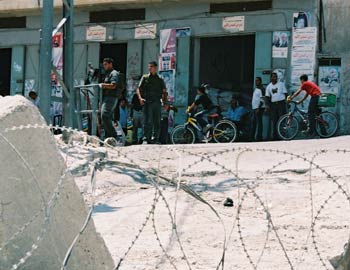 One of the strikingly tragic situations is that of the people of Sheikh Sa'ed. Some two thousand people live in this village, situated on the eastern edge of Jerusalem . Israel did not annex the village into Jerusalem in 1967, and it officially remained part of the West Bank. The dirt path that links it with the rest of the West Bank runs down a steep hill that is not suitable for travel by vehicle. Because of the topography, residents wanting to leave the village have to go via East Jerusalem – even if they want to reach other parts of the West Bank. Also, residents of Sheikh Sa'ed have close family ties with residents of East Jerusalem and receive most services from East Jerusalem. In practice, Sheikh Sa'ed has always functioned as a part of East Jerusalem. However, most of the village's residents hold West Bank identity cards, so they are forbidden to enter East Jerusalem without a special permit from the Civil Administration.
In September 2002, the IDF brought in dirt mounds and concrete blocks and blocked the road linking Sheikh Sa'ed and East Jerusalem. Since then, it has been impossible to enter or leave the village by vehicle. The only way to brings goods into the village is by unloading the goods on one side of the concrete blocks and loading them onto a vehicle on the other side. In late August 2003, Israel approved construction of the separation barrier in the area. According to the plan, the barrier separates Sheikh Sa'ed and East Jerusalem, and thus completely detaches the residents from their center of life. The residents filed suit and, in March 2006, the Magistrate's Court ruled that the route chosen by the state was improper.
A week after the court made its decision, the Border Police placed a permanent staffed checkpoint at the entrance to the village. Village residents who do not hold Israeli identity cards are forbidden to exit the village and enter Jerusalem. Even those who have permits to enter Israel are not allowed to cross the checkpoint. Instead they are directed to the Olive Checkpoint. To get to that checkpoint, they have to negotiate a long descent down the cliff on which the village lies. In fact the siege Israel has imposed on the village leaves those without Jerusalem identity cards with two ways to leave the village: to go along a difficult and, for some residents, an impossible path down the cliff, or to enter Jerusalem illegally.
The siege affects every aspect of the resident's lives. One of the most serious consequences is its effect on access to medical treatment: the village has no medical clinic, so the residents have to go to facilities in East Jerusalem, in most cases to Jabel Mukaber, which lies about 100 meters from the entrance to Sheikh Sa'ed. The villagers have difficulty obtaining essential foodstuffs and other consumer needs. The "back-to-back" method of transporting goods across the checkpoint is no longer an option because the Border Police do not allow vehicles to approach the checkpoint. Therefore, the villagers have to carry the goods by themselves, and sometimes even this is prohibited.
The court ruling of March 2006, referred to above, states that the planned route causes disproportionate harm because it detaches the residents from East Jerusalem. The court rejected the state's claim that the residents constitute a security threat, and held that the state failed to provide evidence to support its security claim. The court recommended that the barrier be erected east of the village, to enable the residents to gain access to East Jerusalem. On 23 May, the state appealed the decision to the High Court of Justice, arguing that the Magistrate's Court ignored the security consequences entailed in the alternate route, and that the court's suggested route would actually increase the injury to the residents. The petition is pending.
a-Ram Village
On June 22, 2005, Israel's High Court of Justice issued a temporary injunction ordering the government to cease construction of the wall south of a-Ram village, northeast of Jerusalem, until arguments for a petition against the wall are heard. Initially, Israel decided to erect this section of the wall along the Jerusalem municipal boundary, as it was fixed following the annexation of the city's eastern part in 1967. However, in response to the petition of several institutions situated in Dahiyat al-Barid (southern a-Ram), Israel elected to shift the route of the barrier northward, which would isolate part of the neighborhood from the rest of the village. The current injunction was issued at the request of the head of the a-Ram village council and a group of Dahiyat al-Barid residents, who petitioned that the neighborhood not be divided from the rest of the village.
A
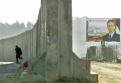 -Ram lies northeast of Jerusalem, just outside the city's municipal border. The village is part of the built-up urban area of Jerusalem: the Atarot industrial zone and the Palestinian neighborhood of Beit Hanina lie to the west, and the Neve Ya'akov settlement borders it on the south. To the north is the Qalandiya refugee camp, most of which lies outside the Jerusalem municipal boundary.
The separation barrier under construction will surround a-Ram on three sides. West of the village, Israel has completed a wall eight meters high, along the main road to Ramallah. To the south, a wall is planned a distance of several hundred meters from the municipal boundary, separating part of the neighborhood Dahiyat al-Barid, in the south of a-Ram, from the rest of the village. The wall will stretch between the residents' houses and the northwest edge of Neve Ya'akov. From there, the barrier will run north and surround a-Ram almost completely from the east, separating the community from the empty space between it and Neve Ya'akov. This section is presently being built. No barrier is planned north of a-Ram, on the cliff on which the community is located, and which overlooks Route 45, the road that links the settlements in this area with Jerusalem (via the Begin Highway) and the coastal plain (via Route 443).
The head of the a-Ram village council estimates that 58,000 people live in the village. More than half of them hold Israeli identity cards. The residents have extensive economic, educational, health and family relations with East Jerusalem residents and institutions. Since the barrier's construction began, several thousand residents with Israeli identity cards have moved to East Jerusalem.
The barrier will severely hamper access to schools. Twenty thousand students, 4,000 of them from East Jerusalem, currently study in schools in a-Ram. Some of the teachers come from East Jerusalem, and others from nearby Palestinian villages. Five thousand students living in a-Ram and holding Israel identity cards study in schools in East Jerusalem, primarily in Beit Hanina and Shu'afat. The barrier will also obstruct higher education. A-Ram has one college, with 700 students from the community and surrounding areas. Most of the college students who live in a-Ram study outside the village, and will have difficulty reaching their schools once the barrier is built.
Access of residents of a-Ram to hospitals and medical clinics will also be affected. Medical services are almost non-existent in a-Ram, and most of the residents use the hospitals and clinics in East Jerusalem. Several thousand residents of a-Ram suffer from chronic illnesses (such as diabetes, high blood pressure, heart disorders, cancer, kidney disorders) and require treatment a few times a week. Ninety-five percent of women from a-Ram give birth in Jerusalem hospitals (some in hospitals in West Jerusalem). Eight thousand children from a-Ram receive their immunization shots in Jerusalem. Also, some of the 1,500 disabled children living in a-Ram are treated in the Disability Fitness Center in Qalandia, which is located northwest of a-Ram.
The barrier will also affect the livelihood of residents of a-Ram. Most of the labor force in the village works in Jerusalem and at other locations in Israel. Palestinians without an Israel identity card or permit are not allowed to enter Jerusalem, and Israelis are not allowed to enter Area A of the West Bank. Because A-Ram is strategically located just outside Jerusalem and in the middle of the north-south axis of the West Bank, the village has become a lively commercial center. With the construction of the barrier, many shops and factories have closed, and others are expected to close because of the access and movement problems facing workers, customers, and transporters of goods and merchandise.
The harm suffered by residents of a-Ram has not resulted solely from its detachment from Jerusalem. It also results from its separation from five villages situated just to its west – Bir Nabala, al-Judeira, al-Jib, Beit Hanina al-Balad, and Nebi Samuel. These villages will be surrounded by the barrier and become a separate enclave. Residents of a-Ram have close social and family ties with residents of these villages. Bir Nebala, for example, lies only half a kilometer from a-Ram. A person can now go from one village to the other by crossing the Ramallah Road and passing through an opening in the wall. When the opening in the wall is closed, as called for in the plans, the residents will have to travel more than twenty kilometers via Ramallah to make the same journey.
This and further information is available at http://www.btselem.org/English/
For map of the separation fence, see
http://www.btselem.org/Download/Separation_Barrier_Map_Eng.pdf
I thank Eliezer Moav for his time, attention and knowledge.
Mass Murder in China
On July 6, 2006, David Matas, international human rights lawyer, and David Kilgour, former Secretary of State (Asia-Pacific) for Canada, released an independent report, following their two-month inquiry into allegations that vital organs are being seized from Falun Gong practitioners across China.
The report concludes:
“…the government of China and its agencies in numerous parts of the country, in particular hospitals but also detention centres and ‘people’s courts’, since 1999, have put to death a large but unknown number of Falun Gong prisoners of conscience. Their vital organs, including hearts, kidneys, livers and corneas, were virtually simultaneously seized for sale at high prices, sometimes to foreigners, who normally face long waits for voluntary donations of such organs in their home countries.”
 How many of the victims were first convicted of any substantive offence in a legitimate court the report does not answer because such data unavailable. However, one Beijing Falun Gong practitioner, now living in Europe, told the inquiry that she was arrested three times and spent a year in a labour camp but she was never taken before any court. She also reported during her imprisonment, that without explanation or cause, she was taken in leg irons and handcuffs for a thorough medical examination.
Witnesses were consulted in Canada, Australia, France and the United States, sometimes in personal interviews and sometimes by email. Among the most significant incriminating evidence, however, were certified translations of recorded conversations in Mandarin with doctors and other officials at hospitals and detention centres located in various parts of China. Transcripts of some of these conversations are included in the report.
Other important evidence:
o Translations of recent and continuing postings on number of websites at transplantation centres within China which were also important in convincing the inquiry that the only fair conclusion was that the organ harvesting is widespread and continuing.
o Testimony from the former wife of a surgeon in China who told the inquiry that he confessed to her that he removed the corneas from the eyes of approximately 2000 Falun Gong prisoners in 2002 and 2003.
o Testimony from Ms. Yuzhi Wang, now of the Vancouver region, who stated she spent most of her time in 2000 and 2001 in labour camps for being a Falun Gong practitioner. Suffering internal damage from beatings, she is convinced this is the only reason she did not become a “donor” and was able to leave China.
o Testimony from Xiaohua Wang, now of Montreal, who reported that in 2002, after spending two years in a forced labour camp working 16 hours daily with chemicals because of his belief in Falun Gong , he also received a comprehensive forced medical exam. Later, he was able to immigrate to Canada.
o Testimony from Ms. Na Gan, now of Toronto, who stated that she was beaten by police when she unfurled a Falun Gong “truthfulness-compassion-tolerance” banner in Tiananmen Square. As a result, her CCP membership and salary as a customs employee at the Beijing airport were revoked and she was sent to the local women’s labour camp. In mid-2001, she reported that only the Falun Gong members of the group had their blood, urine, and eyes examined at a nearby hospital. She too managed to leave China for Canada.
The following are some key recommendations in the report:
1. As organ harvesting is a crime against humanity, authorities in China should conduct a criminal investigation for possible prosecution.
2. Organizations-intergovernmental, governmental and voluntary-should take the allegations seriously and make their own determinations on whether or not they are true.
3. As the UN Protocol to prevent trafficking in persons bans the removal of organs, the UN should investigate whether China is in violation.
4. Foreign governments should ban the entry of Chinese doctors seeking training in organ transplantation and any doctor there known to be engaged in such work should be barred from visiting foreign countries permanently.
5. All countries should tighten their laws against organ trafficking and doctors should, for example, be required to report to their respective authorities any evidence that a patient has received an organ from a trafficked person abroad.
6. Governments should deny or revoke the passports of nationals who are travelling to China for organ transplants.
7. No governments should participate in any China-sponsored meeting or research on organ transplant. No private company should provide goods or services to any Chinese transplant program.
A full copy of the report can be obtained on David Kilgour's website:
(http://www.blogger.com/www.davidkilgour.ca):
http://www.davidkilgour.ca/2006/
For further information, please contact
David Kilgour: (613) 747-7854;
David Matas: (204) 944-1831
European Parliament Scolds Companies for Aiding Internet Censorship
 The European Parliament has added its voice to the chorus of critics who say companies should not be assisting regimes in censoring the Internet, says Reporters Without Borders (Reporters sans frontières, RSF). On 6 July 2006, it passed a resolution calling on the European Commission to establish a voluntary code of conduct "limiting the activities of companies in repressive countries."
Parliamentarians also urged the Commission to "take into account, when considering EU assistance programmes with third countries, the need for unhindered internet access by the citizens of those countries."
The resolution singled out U.S. companies Yahoo, Google and Microsoft, which were criticised for allowing Chinese authorities to censor their search engines and blog software in China. It also criticises Cisco Systems for supplying technologies to countries that censor the Internet, and Telecom Italia and France Telecom's Wanadoo for co-operating with Tunisia and Cuba in blocking websites.
The resolution mentions 15 countries that are notorious for censoring the Internet: China, Belarus, Burma, Cuba, Iran, Libya, Maldives, Nepal, North Korea, Saudi Arabia, Syria, Tunisia, Turkmenistan, Uzbekistan and Vietnam.
Visit these links:
- RSF: http://www.rsf.org/article.php3?id_article=18223
- European Parliament Resolution: http://tinyurl.com/zcavz
- OpenNet Initiative: http://www.opennetinitiative.net/
- Investment Funds Pledge Commitment to Internet Free Expression: http://www.rsf.org/fonds-investissement-en.php3
- U.S. Congress Holds Hearing on Internet Censorship in China: http://boss.streamos.com/real/hir/56_af021506.smi
Mondial
The Mondial is over. It seems that it took place one hundred years ago.
In the final analysis, Italy deserved to win after ejecting the host Germany. All who watched the final, and were indifferent as to the identity of the new world champion, became supporters of Italy after Zidane’s nasty brutal act. Viva Italia!! Mazal Tov!!
We begin counting the four years of waiting till the next festival.
What will we remember from this football party?

The positive, beautiful performance of the Czech Republic v. USA. It ended 3:0, and the Americans were lucky not to suffer more. Unfortunately for the Czech, this was their last good performance. From then on they faded away.
The astonishing 4:0 of Spain v. Ukraine. This was Spain’s best game in the tournament. Too bad for them. The first goal was one of the finest you will possibly see.
The Argentinean perfect game v. Serbia. It ended 6:0 only because Argentina missed too many good opportunities. A few Argentinean talents exploded that evening, and Serbia allowed them to dance on the court. A true delight for everyone who likes the game, and has no association to Serbia.
The negative, anti-sportive, violent game of Portugal v. The Netherlands. A shameful display to record and show as a lesson: That’s the way NOT to play the game. Each team ended the game with nine players, all suffering to one extent or another. Pity that this was the Dutch legacy in this Mondial.
France v. Spain 3:1. This is when we began to understand that Zidane had no intention to retire before the final. A magnificent player who holds the team together, a true leader and an inspiring talent. However, in the final he also showed us his ugly side, how truly disgusting he can be when he loses his head.
Italy v. Germany 2:0, in the last two minutes of the 120 minutes of the game. A shocking result for the host Germany; a real powerhouse defence on part of Italy. It was worth to wait 118 minutes to watch two team goals, with fine finish of a defender (Grosso) and a substitute striker (Del Piero).
I was never a big fan of German football. On the whole I found it uninspiring. Not this Mondial. Germany played attractive football, and acquired fans all over the world. I was particularly impressed with three players: (1) Jens Lehmann whom I know from Arsenal. I always thought he was one of the best goalkeepers in the world, and this tournament affirmed my suspicion. Klinsman took a risk with him, leaving Oliver Kahn on the bench. Lehmann showed he deserved the trust. (2) Philip Lahm is a classic defender. Usually a left back. On the last game v. Portugal he played as a right back. Not many are able to perform well on both sides of the pitch. He runs up and down, tireless, and has impressive attacking abilities. He is the best left back I have seen in years. Real joy to watch. (3) Miroslav Klose is unspoiled attacker. He never stops running. He constitutes constant threat for every defence, and sees no harm in returning to help his team mates in doing defence. Record, watch and learn.
Only six players mentioned in my June Newsletter retained their place in my Mondial team. Here is the final very subjective team:
Goalkeeper:
Gianluigi Buffon (Italy)
Defenders:
Gianluca Zambrotta (Italy)
Fabio Cannavaro (Italy)
Lúcio (Brazil)
Philip Lahm (Germany)
Midfielders:
Andrea Pirlo (Italy)
Claude Makelele (France)
Juan Román Riquelme (Argentina)
Zinedine Zidane (France)
Forwards:
Miroslav Klose (Germany)
Thierry Henry (France)
Subs:
Jens Lehmann (Germany)
Ricardo (Portugal)
Miguel (Portugal)
Francesco Totti (Italy)
Ivan Gennaro Gattuso (Italy)
Franck Ribery (France)
Lukas Podolski (Germany)
Suggestions for Improving the Football Game
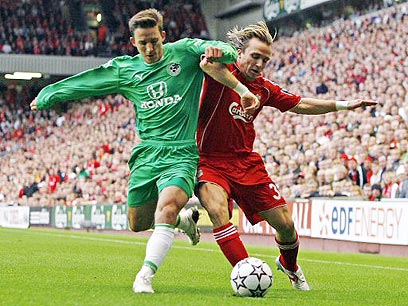 This Mondial was better than the last two of 2002 and 1998. There were more goals, and more exciting games. Still, some of the games were quite boring. With all my love for football, I fell asleep in some of them. If passionate fans are bored to sleep, how can we attract Americans to watch the game? Football needs the United States, and to gain its appreciation, the conservative body called FIFA needs to be inspired, and shake its norms and standards. The game needs imagination no less, arguably more, outside the pitch than on it.
Here is what I propose to make this game more exciting, kicking and shaking:
? There are far too many refereeing mistakes. The game needs more eyes on the ball, and on the players who sometimes settle differences with one another in ugly ways, without notice. Solution: Add one more referee on the pitch. Each of the two will be responsible for one half of the pitch. Each will do less running; they will be less tired, and you will add two pair eyes to cover the events on and off the pitch.
? Far too much time is wasted. Each team can have three substitutes. Each substitute requires stopping the game, and watching the players walk to the sideline. This is totally unnecessary. Solution: Like in hand-ball, introduce a “substitution gate” at one of the corners. The fifth referee will be responsible to call the player who is substituted to exit through the gate, and to introduce the substitute into the game. This way, the game need not stop. You keep the flow, and avoid wasting time.
? Allow one more substitute, if so desired, only for the goal-keeper. Sometimes there is a need to take the goal-keeper off the pitch. Because he has special skills that other players usually do not have, and his exit might have great impact on the game, it is unfair to see him like any other player. Goal-keepers constitute a category of their own.
? Sometimes teams waste time by passing the ball back, instead of forward. This is ugly. This is against the spirit of the game. Solution: Like in basketball, prohibit the passing of the ball beyond the central line after you entered the opponent’s half. Ball returned over the center line back to the goal-keeper or one of the defenders will automatically go to the opponent team. We should encourage positive, attacking game, not a negative one that retreats the motion.
? Games that end in a draw, in which one of the teams needs to be declared the winner to advance to the next stage will be extended by half hour, as is the case now, with one significant change: Each team will be required to take off the pitch two of its players. This will give more room to the remaining players, and work for teams with better stamina.
? All the above is minor compared with THE most significant proposal that, if accepted, will change the game forever, and for the better: Abolish the offside rule. When this rule was invented, teams were based on attack. The scores were high, and the inventor wished us to appreciate goals, not to take them for granted. The guy, apparently, was a masochist. Since his innovation, we all suffer, and many games end with agonizing scores: 0:0 or 1:0. Abolish the offside rule. Allow managers to plan their game. Counter attackers with personal defenders. Let skilled players show their magic one on one. Increase the score of the game. Replace masochism with joyful goals and high scores. Football scores need to be like in hand-ball. Take out, for good, the sting that has been destroying the game for decades.
I challenge FIFA to consider these suggestions and change the game. Make billions of people happy. Encourage the flow of American money into the game. Football has the potential to benefit investors more than basketball and baseball combined.
London Musical
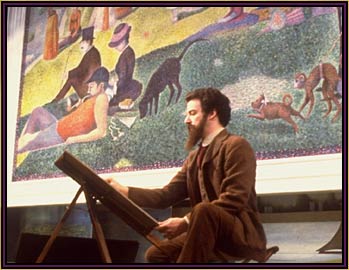 I recommend “Sunday in the Park with George”, a celebration of aesthetics, music and colours, a must for theater lovers and Stephen Sondheim followers. Inspired by the painting Sunday Afternoon on the Island of La Grande Jatte by Georges Seurat, “Sunday in the Park with George” focuses on the French pointillist painter himself, who believed that reality can always be improved upon in art. Through the act of painting, he washed away the petty disagreements of the characters in his landscape, creating a world of order, balance, and harmony. Locking himself in his solitary studio filled with paints and canvasses, Seurat devoted himself completely to his art, unable to commit to anything else, including his longtime mistress, Dot. I particularly enjoyed Jenna Russell as the suffering, meaningful 'Dot'. Sondheim's songs merge past and present into basic, heartfelt truths about life, creation, and emotion. This 1984 Pulitzer Prize-winning musical confirmed that Sondheim is one of the finest theater composers of this generation.
New Books
Ben-Shaul, Nitzan S. A. Violent World: TV news images of Middle Eastern terror and war, Critical media studies: Institutions, politics, and culture) Rowman &Littlefield. 0742537986. 9780742537989. R5896908 US. 2006.
Jon B. Gould, Speak No Evil: The Triumph of Hate Speech Regulation (Chicago: University of Chicago Press, 2005)
Peace, Salam, Shalom,
Rafi
My last communications are available on http://almagor.blogspot.comEarlier posts at my home page: http://hcc.haifa.ac.il/~rca/
Center for Democratic Studies http://cds.haifa.ac.il/
Those wishing to subscribe to this monthly Newsletter are welcome to contact Raphael Cohen-Almagor at ralmagor@soc.haifa.ac.il