Politicians who spend most of their time with fellow politicians neglect their constituencies and families. Politicians who spend most of their time with their lawyers neglect their people.
Raphael Cohen-Almagor
 This was a relative quiet month. But don’t be misled. It is not for the lack of trying on part of the Hamas and the Islamic Jihad. Instead, the quiet has been maintained thanks to the relentless efforts of Israel’s security forces. Rigorous IDF operations in the West Bank thwarted several attempts to launch terror attacks in Israel. Shin Bet chief Yuval Diskin told the cabinet an IDF operation in the Beit Ilma village near Nablus prevented a large suicide bombing set to be carried out in Tel Aviv during the holidays. However, he added that the Shin Bet was concerned about the fact that the explosive belt was passed through several checkpoints undetected.
According to Diskin, a significant drop has been registered in the number of rockets launched from Gaza, from 110 Qassams in August to 85 in September. The Shin Bet attributes the decrease to Hamas' decision not to fire rockets. On the other hand, the smuggling of weapons into Gaza has increased since Hamas rose to power, said Diskin, making Gaza "a barrel of explosives." (http://www.ynetnews.com/articles/0,7340,L-3457218,00.html).
Polls - Peace Index on the Annapolis conference - Mazuz Orders Police Probe of Prime Minister Olmert’s Home Purchase - You Too: Ami Ayalon? - Burma: Please Join Me in Signing the Petition - Lebanon - Ecology - Al Gore - Academic Boycott -
Academic Strike in Israel - American Presidential Elections and John Zogby -
Visit to the American Congress - Internet Fraud - British Chevening Scholarships 2008/2009 - European Journalism Fellowships - New Fashion - New Books - Thank You - Gem of the Month - Monthly Joke
Polls
 In the period of Rosh Hashana and Yom Kippur, the Israeli media customarily summarize the year and project what is likely to happen in the coming year. The Ynet poll of September 19, 2007 among the Jewish population in Israel revealed that 37% thought that Olmert should ask forgiveness from the people during his Yom Kippur prayers.
If elections were held now, Olmert's party "Kadima" would have been reduced to ten seats in the Knesset. Yisreal Beitenu of Avigdor Lieberman and the Sephardi-religious party Shas would also receive 10 seats. The Likud continues to lead the polls with a projection of 24 seats. Labour is second with 18 seats. Arkady Gaydamak's new party, "Social Justice", enjoys a good start of projected 8 seats in the Knesset.
After the 2006 war and the series of corruption and sex scandals that dominated last year's headlines, the public is fed up with politics. Many people just want to continue their lives. They are disillusioned and disappointed. The general feeling is that Olmert should have left office but manipulates the system to his own benefit. President Moshe Katzav faded away. Former Minister of Finance Hirschson fights to stay out of jail. The Police Commissioner Karadi was forced to step down. Minister of Defence Peretz was forced to leave office. Chief of Staff Halutz was forced to resign. And Olmert continues to sing: Everything is just all right, Marquise.
In 1996, Bibi Netanyahu's winning campaign slogan was "Peres Will Divide Jerusalem". Eleven years later, Deputy Prime Minister Ramon writes a paper detailing the plan to divide Jerusalem along the Clinton's lines: What is Jewish will remain Jewish; what is Palestinian will be transferred to Palestine. Yet little commotion takes place. How can this be explained?
The public hears peace plans all the time: The Arab Saudi plan; the Israeli plan; Abu Mazen plan; Condoleezza Rice plan. All result in nothing. The public receives them with disbelief. It is not that the Israeli public does not want peace. The majority does, and is willing to make significant sacrifices for peace. More than 60 percent are in favour of a two-state solution, giving up the major bulk of the West Bank. But the public thinks no plan is achievable as long as Hamas is in power. The public does not trust Abu Mazen's ability to deliver. The public thinks that Olmert announces such plans just to gain time. Only a small minority of the Israeli public trust Olmert's common sense and ability.
Thus, the Israeli right does not make a fuss. They think there is no need to stage large demonstrations because they would only help Olmert. They simply ignore him, as do most Israelis. They continue to live their lives, and wish Olmert to be the irrelevant to their daily conduct. Let him be prime minister and leave them alone. This attitude, however, is mistaken, because as prime minister he has vast ability to inflict further harm. The next mistake is just around the corner. We don't see it yet, but it might be imminent.
Some of you wrote to me saying that a major breakthrough in the peace process might change the entire picture. Olmert, then, may renew the people's trust in him, his popularity will be on the rise, and he will be able to carry out his peace plan. These people do not wish to see Netanyahu as prime minister.
I agree that one courageous step of a leader may turn history and bring significant changes. I agree that people can change their mind about leaders and grow to appreciate them. Sharon is a prime example. However, it is unlikely to see this happening now, not so much because Olmert is not really a leader; more so because Israel does not have a partner for peace. Hamas did not revoke its aim to destroy Israel and establish Palestine on Israel's ruins.
Peace Index on the Annapolis conference
 I was asked what is my opinion and expectations regarding the Annapolis conference. Well, it is very much like the Israeli public opinion, as reflected by the September Peace Index published by Eppie Yaar and Tamar Herman. The Jewish public does not trust its government. Throughout the political spectrum, an overwhelming majority thinks Ehud Olmert and his government are not strong enough to sign a peace agreement with the Palestinians in Israel’s name, assuming such an agreement would entail substantial concessions by Israel. About two-thirds—65%—of the Jewish public think that from Israel’s standpoint it is impossible to continue indefinitely in the present state of relations with the Palestinians (29.5% say it is possible to go on this way), and 62% think that among the issues on the government’s agenda, the Palestinian issue is the most urgent or moderately urgent (35% see it as moderately not urgent or not urgent at all). Interestingly, when Jewish Israelis are asked to assess the possibility of continuing the current situation from the Palestinian standpoint, the data are quite similar—62% say it is impossible from the Palestinian standpoint while 26% believe it is possible.
A majority does not expect the coming Annapolis conference to bring about a shift—only 39% of the entire Jewish public see a chance that in its framework the sides will be able to clarify the disagreements between them (57% see no such chance), and an identical rate believes the conference can increase the chances of reaching a permanent peace agreement (56% think it cannot). A segmentation of the responses to the question by Knesset voting reveals that the most optimistic—62.5%—are Meretz and Labor voters immediately followed by Kadima voters at 54%. Forty percent of Shas voters believe in the conference’s chances to bear fruit while only about one-third of voters for the rest of the parties are optimistic, and only about one-quarter of Likud voters, who are the most pessimistic about the conference, think it can contribute to achieving a peace agreement.
Mazuz Orders Police Probe of Prime Minister Olmert’s Home Purchase
 Attorney General Menachem Mazuz instructed police on September 24, 2007 to open a criminal investigation against Prime Minister Ehud Olmert over allegations that he benefited unduly from his purchase of a home on Jerusalem's Cremieux Street.
Olmert is suspected of having received an unreasonably low price on the house, allegedly as a result of his position in government.
Yuval Yoaz of Haaretz reported on the same day that the Prime Minister's Bureau issued a statement in response, saying: "We are certain and convinced that the Olmert family's purchase of the Cremieux Street home was clean and pure."
"We find the decision to continue the investigation unfortunate, because it is unnecessary," continued the statement.
"The purchase of the home, as was stated in the response given recently to the state comptroller, did not deviate from the market conditions and acceptable value estimates," said the statement. "The prime minister will fully cooperate with the investigation in order to bring it to an end as quickly as possible. We are certain that the investigation will clearly find that the purchase of the home was ethical and at a proper price."
Once the initial phase of the investigation is complete, the findings will be presented to the attorney general and the state prosecutor, who will decide whether to continue the probe. As is customary for investigations of senior officials, Olmert can only be questioned under caution with Mazuz’s prior consent.
Mazuz is known to be very careful with his decisions regarding senior public officials. He weighs them for long period of time and recommends such probe only when the evidence is clear and compelling. Shreds of doubt usually bring about positive outcome for the scrutinized public official.
Mazuz's decision was based on an investigation conducted by State Comptroller Micha Lindenstrauss, which found that that Olmert received a $480,000 discount on the home - $330,000 more than the standard discount for paying in cash, as the prime minister did.
"[The fact that] a major public figure, a government minister, receives such a large discount on the purchase of a home, requires a detailed explanation without delay, according to the norms of transparency, ethics, and proper administration," wrote attorney Rina Karmef from the State Comptroller's Office."Until the [prime minister] signed the contract, the full dismantlement and reconstruction of a structure was never done in Jerusalem, and only the decision on dismantling and reconstructing the structure allowed the Olmert family to receive the apartment in the agreed upon conditions," said the findings. "Advancing the granting of authorizations in a special and irregular manner to a public figure 'because he has rights in the city' is an improper act that harms the norms of proper administration."
The case is one of several involving suspicions against the prime minister, and was widely considered the weakest of the three affairs under study.
Another of the affairs involves suspicions that Olmert gave special consideration to a company represented by his friend and former law partner, Uri Messer, in grant allocations by the Industry, Trade, and Labor Ministry's Investment Center.
A third involves suspicions that he made political appointments at the Small Business Authority.
Both of these cases, which involve Olmert's term as Industry, Trade and Labor minister, began with an investigation and subsequent scathing report by State Comptroller Micha Lindenstrauss.
You Too – Ami Ayalon?
 On September 24, 2007, the Knesset approved the appointment of MK Ami Ayalon (Labour) to the position of minister without a portfolio. Ayalon will serve as a member of the Ministerial Committee on Security Issues, chairman of the Knesset State Control Committee and be responsible for implementing the recommendations of the state comptroller's report on the performance of the Home Front Command during the Second Lebanon War.
This is the same Ayalon who said after the Israel-Hezbollah War that Olmert should resign, that this government should not last for long, and that the idea of ministry without portfolio does a disservice to the public. And now for token power he grants his name to bolster Olmert’s shameful government. During the past years I spoke with a few people who served in the army under Ayalon. All of them commended him to be a fair and just person, “straight as a ruler”, someone who is unable to tell a lie or betray a promise. What happened to you, Ami Ayalon? What happened to the norms that brought you up the social and political echelons of Israel? Where is your dignity?
Politicians from both sides of the political spectrum criticized Ayalon for changing his stance towards Olmert's government, which he had previously vowed to work for its removal. "This is a discussion on a matter of principle which reflects on the image of our political system in the eyes of the disappointed public," Gideon Sa'ar (Likud) said. "The question is whether in our political system a promise is indeed a promise, or whether it can be broken without any explanation" (Haaretz, September 24, 2007).
Labour's MK Eitan Cabel whose resignation from his ministerial post four months ago following the partial publication of Lebanon war probe findings made the portfolio available for Ayalon rebuked his co-partisan, saying he thought it was "the wrong time fore Ayalon to join the government." "I hope that this government won't last," Cabel said. "At least we agree on one thing, and that is that Olmert must be replaced and that this government's tenure should be shortened."
What a disappointment, Ami Ayalon.
 On September 24, 2007, the Knesset approved the appointment of MK Ami Ayalon (Labour) to the position of minister without a portfolio. Ayalon will serve as a member of the Ministerial Committee on Security Issues, chairman of the Knesset State Control Committee and be responsible for implementing the recommendations of the state comptroller's report on the performance of the Home Front Command during the Second Lebanon War.
This is the same Ayalon who said after the Israel-Hezbollah War that Olmert should resign, that this government should not last for long, and that the idea of ministry without portfolio does a disservice to the public. And now for token power he grants his name to bolster Olmert’s shameful government. During the past years I spoke with a few people who served in the army under Ayalon. All of them commended him to be a fair and just person, “straight as a ruler”, someone who is unable to tell a lie or betray a promise. What happened to you, Ami Ayalon? What happened to the norms that brought you up the social and political echelons of Israel? Where is your dignity?
Politicians from both sides of the political spectrum criticized Ayalon for changing his stance towards Olmert's government, which he had previously vowed to work for its removal. "This is a discussion on a matter of principle which reflects on the image of our political system in the eyes of the disappointed public," Gideon Sa'ar (Likud) said. "The question is whether in our political system a promise is indeed a promise, or whether it can be broken without any explanation" (Haaretz, September 24, 2007).
Labour's MK Eitan Cabel whose resignation from his ministerial post four months ago following the partial publication of Lebanon war probe findings made the portfolio available for Ayalon rebuked his co-partisan, saying he thought it was "the wrong time fore Ayalon to join the government." "I hope that this government won't last," Cabel said. "At least we agree on one thing, and that is that Olmert must be replaced and that this government's tenure should be shortened."
What a disappointment, Ami Ayalon.
Burma - Please Join Me in Signing the Following Petition
Posted on September 30, 2007 -- Over the last few days, Burma's generals have unleashed terror on the peaceful monks and protesters – shooting and beating many to death, and taking others away to torture chambers where at this moment they must be enduring the unbearable.
 We can stop this horror. Burma's powerful sponsor China can halt the killing, if it believes that its international reputation and the 2008 Olympics in Beijing depend on it. To convince the Chinese government, Avaaz is launching a major global and Asian ad campaign on Tuesday that will deliver our message and the number of signers. Our petition has exploded to over 200,000 signers in just 72 hours, but we need 1 million voices to be the global roar that will get China's attention. If every one of us forwards this email to just 20 friends, we'll reach our target in the next 72 hours. Please sign the petition at the link below -if you haven't already- and forward this email to everyone you care about:
http://www.avaaz.org/en/stand_with_burma/q.php?cl=21173764The petition will also be delivered to the UN Secretary-General, and we will broadcast the news of our effort over radio to Burma's people, telling them not to lose hope, that the world is with them.
The Burmese people are showing incredible courage in the face of horror. The fate of many brave and good people is in our hands, we must help them – and we have hours, not days, to do it. Please sign the petition and forward this email to at least 20 friends right now.
Lebanon
 I have attended a talk of a minister in the Lebanese government, and received information from an official Israeli source about the events in Lebanon. There is a remarkable similarity between the portrayals of events in Lebanon since the ousting of Syria from Lebanon. In both interpretations of history, the Syrian government with the Hezbollah are the forces of evil that work against the best interests of the Lebanese people. Both described the struggle for the election of a new Lebanese president as a struggle for the sovereignty and independence of Lebanon. Both described the Israeli involvement as minimal, only in southern Lebanon, in order to safeguard the Israeli border but not to influence Lebanese politics. As a matter of fact, if I would provide you the transcript of both sources without revealing the names of authors; you might have hard time determining who the Israeli author is and who the Lebanese minister is.
Ecology
 I am told that in other parts of the US there are diesel pumps at gas stations, and recycle bins in homes. Maybe in my area these are non-existent out of respect for George W. Bush.
On September 24, eighty heads of state came to New York upon the request of U.N. Secretary General Ban Ki-moon to address climate and ecology. This was the largest gathering of world leaders to discuss the topic. George Bush W. was too busy to attend.
The same day, ABC reported the following: /www.abcnews.go.com/Technology/GlobalWarming/Story?id=3645961&page=3
"The consequences of global climate change are so pressing, it doesn't matter who was responsible for the past," Gov. Arnold Schwarzenegger told a packed General Assembly. "What matters is who is answerable for the future. And that means all of us," he added.
The Republican governor showcased California's recent efforts to go green as the "cutting edge" of how government can deal with climate change, highlighting the state's recent technological innovation and legislation to reduce carbon emissions.
Al Gore called for the world's top leaders to meet every three months -- starting in 2008 -- until they draft a plan that will reduce the emissions that cause global warming. Echoing such a call for action was French President Nicolas Sarkozy, who appealed to the major emitters to reduce their carbon dioxide emissions by at least half by 2050. German Chancellor Angela Merkel took a strong stance as well, suggesting that a global scheme to trade carbon, which puts a price on a nation's carbon dioxide emissions, will also be key in the fight against global warming.
U.S. Secretary of State Condoleezza Rice said that climate change is an "urgent" global challenge, and that the White House is willing to take a leadership role on the issue. Rice maintained the world's fight to cool the planet would have to come from a "technical revolution," such as the development of clean coal plants and biofuels.
The Bush administration has come under fire from critics who complain that the United States hasn't done enough to tackle climate change. The United States is second to China as the largest emitter of greenhouse gases in the world. Addressing the issue briefly in his State of the Union speech last January, Bush said that new technologies would help America fight global warming and reduce its dependence on oil.
Already, the United States has invested billions in development in new energy technology. But critics complain that the United States has failed to reduce the emissions responsible for the harmful greenhouse gases that scientists say warm the planet.
Bush, who does not favor emissions reductions, will be meeting with the leaders of 16 nations in Washington, D.C., Sept. 27 and 28 to discuss climate change.
The United Nations put the issue of climate change on the global political agenda nearly two decades ago with the creation of the Intergovernmental Panel on Climate Change.
Since then, 2,500 scientists from 130 nations at the IPCC have concluded with at least 90 percent certainty that mankind is to blame for most global warming in the last half century, up from a 66 percent certainty in 2001.
Rajendra Pachauri, chairman of the IPCC, warned world leaders at Monday's summit that millions of people are at risk of losing access to water as glaciers melt. Food scarcity will also become a major concern if crops that humans depend on are affected by climate change as well, he said.
The U.N. Secretary General, who called climate change a defining issue of this era, organized Monday's summit with hopes that it would galvanize world leaders to think about a plan of action to deal with global warming during December talks in Bali, he said. Nations will have to think of a new policy to replace the Kyoto Protocol, which expires in 2012.
Al Gore
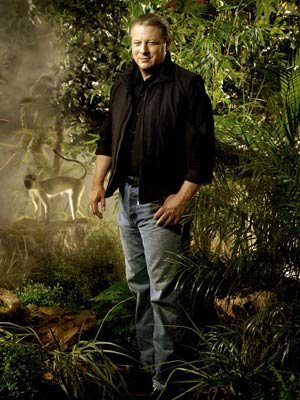 I was truly delighted to hear that former vice president Al Gore and a United Nations panel that monitors climate change were jointly awarded the Nobel Peace Prize for their most important work educating the world about global warming and pressing for political action to control it.
The Norwegian Nobel Committee characterized Gore as "the single individual who has done most" to convince world governments and leaders that climate change is real, is caused by human activity and poses a grave threat. Gore has focused on the issue through books, promotional events and his fascinating and thought-provoking documentary, "An Inconvenient Truth."
The science showcased by the panel and Gore's advocacy have helped to "build up and disseminate greater knowledge about man-made climate change, and to lay the foundations for the measures that are needed to counteract such change," the committee said.
"Whereas in the 1980s global warming seemed to be merely an interesting hypothesis, the 1990s produced clear scientific support."
In highlighting the IPCC's science and Gore's advocacy, peace prize committee chairman Ole Danbolt Mjoes said the hope was to use the power of the prestigious award to focus on an issue of planetary importance: "I want this prize to have everyone . . . every human being, asking what they should do," Mjoes said.
The panel said global warming "may induce large-scale migration and lead to greater competition for the Earth's resources. Such changes will place particularly heavy burdens on the world's most vulnerable countries. There may be increased danger of violent conflicts and wars, within and between states."
In a statement, Gore, 59, said he was honored to receive the prize. He said he would donate his half of the approximately $1.5 million award to the Alliance for Climate Protection, a nonprofit he chairs that works to educate the public about climate change and mobilize global support for action.
Gore joins a short list of other senior U.S. political figures to be honored with the peace prize, including former president Jimmy Carter in 2002; then-Secretary of State Henry Kissinger in 1973; secretary of state Cordell Hull in 1945; then-U.S. President and League of Nations founder Woodrow Wilson in 1919; and then-President Theodore Roosevelt in 1908.
Gore's signature climate-change effort was his 2006 film documentary, in which he narrated the effect of fossil fuel use on the planet. Once considered a fringe idea, the conclusion that human activity is damaging Earth's climate has become the underpinning for major governmental efforts around the world -- its premise now accepted even by former skeptics, including President Bush.
Jan Egeland, a former U.N. undersecretary for humanitarian affairs and now a peace mediator and director of the Norwegian Institute of International Affairs, said the world's initial "climate wars" were already being fought in parts of Africa where a lack of water has brought farmers, nomads and animal herders into conflict.
Joseph Zacune, a London-based spokesman for Friends of the Earth, said that by honoring both Gore and the somewhat obscure IPCC, the Nobel academy was recognizing both the public face of the movement to slow global warming and its behind-the-scenes actors. It was also, he said a vindication of the environmental movement's longtime efforts: "There can be no question of the urgency to stop climate change," the group Friends of the Earth said in a statement. "Now is the time for action."
Source: Howard Schneider and Debbi Wilgoren, “Gore, U.N. Body Win Nobel Peace Prize”, Washington Post (Friday October 12, 2007).
Bollinger’s Speech
 In 1997 I organized a conference on free speech and political extremism at the University of Haifa. One of the keynote speakers was Lee Bollinger, who wrote an important book, The Tolerant Society (Oxford: Clarendon Press, 1986). The products of the conference were later published under my editorship, Liberal Democracy and the Limits of Tolerance: Essays in Honor and Memory of Yitzhak Rabin (Ann Arbor: University of Michigan Press, 2000). 306 pp. ISBN 0-472-11016-0
Bollinger is an ardent advocate of free expression, in the tradition of American law professors who adhere to the First Amendment in almost all circumstances. Therefore, I was not surprised when he invited the Iranian president to speak at Columbia. Bollinger knew he would be subjected to fierce criticisms for issuing the invitation, and was prepared for it. In his speech he explained the rationale for inviting Mr. Ahmadinejad to his campus. He then went on to challenge the Iranian president on various issues, from human rights violation to Holocaust denial to his threats to destroy Israel to supporting terrorism and the Iranian nuclear program. A bold and courageous speech that expressed what many think and feel about the present regime in Iran.
The speech was published by the Columbia News and is available at
http://www.columbia.edu/cu/news/07/09/lcbopeningremarks.html
I have been teaching courses on free expression and political extremism for many years. The thought of inviting extremists like Baruch Marzel, Avigdor Esken and Itamar Ben-Gvir did cross my mind but, in the end, I decided against. I did not see how inviting any of them might advance the debate, further exchange of ideas, or "The Truth". The gap between the views is simply too wide and unbridgeable. They would not convince me that a good Arab is a dead Arab, and that the law is secondary to the Bible. I, in turn, would not be able to convince them that every person deserves concern and respect, notwithstanding his or her religion, nationality or ethnicity. All I would do is to provide them a platform to promote their vile ideas, possibly to influence young students, and I did not wish to confer on them any kind of legitimacy.
Lee Bollinger is in a different position. He himself said that he did not expect to influence President Ahmadinejad. I suspect the latter would not have convinced him of his so-called "Truth". His main considerations were PR for Columbia, to show that even the most abhorrent representative of today's politics is able to present his ideas in the free American academic setting. Did this act serve any benefits of free expression, i.e. advancement of autonomy, of truth, of exchange and debate, or of democracy? Did it serve Columbia’s best interests? Did it serve Ahmadinejad’s best interest? Did it serve the audience’s interest, beyond the interest of curiosity? I shall let you decide.
 In 1997 I organized a conference on free speech and political extremism at the University of Haifa. One of the keynote speakers was Lee Bollinger, who wrote an important book, The Tolerant Society (Oxford: Clarendon Press, 1986). The products of the conference were later published under my editorship, Liberal Democracy and the Limits of Tolerance: Essays in Honor and Memory of Yitzhak Rabin (Ann Arbor: University of Michigan Press, 2000). 306 pp. ISBN 0-472-11016-0
Bollinger is an ardent advocate of free expression, in the tradition of American law professors who adhere to the First Amendment in almost all circumstances. Therefore, I was not surprised when he invited the Iranian president to speak at Columbia. Bollinger knew he would be subjected to fierce criticisms for issuing the invitation, and was prepared for it. In his speech he explained the rationale for inviting Mr. Ahmadinejad to his campus. He then went on to challenge the Iranian president on various issues, from human rights violation to Holocaust denial to his threats to destroy Israel to supporting terrorism and the Iranian nuclear program. A bold and courageous speech that expressed what many think and feel about the present regime in Iran.
The speech was published by the Columbia News and is available at
http://www.columbia.edu/cu/news/07/09/lcbopeningremarks.html
I have been teaching courses on free expression and political extremism for many years. The thought of inviting extremists like Baruch Marzel, Avigdor Esken and Itamar Ben-Gvir did cross my mind but, in the end, I decided against. I did not see how inviting any of them might advance the debate, further exchange of ideas, or "The Truth". The gap between the views is simply too wide and unbridgeable. They would not convince me that a good Arab is a dead Arab, and that the law is secondary to the Bible. I, in turn, would not be able to convince them that every person deserves concern and respect, notwithstanding his or her religion, nationality or ethnicity. All I would do is to provide them a platform to promote their vile ideas, possibly to influence young students, and I did not wish to confer on them any kind of legitimacy.
Lee Bollinger is in a different position. He himself said that he did not expect to influence President Ahmadinejad. I suspect the latter would not have convinced him of his so-called "Truth". His main considerations were PR for Columbia, to show that even the most abhorrent representative of today's politics is able to present his ideas in the free American academic setting. Did this act serve any benefits of free expression, i.e. advancement of autonomy, of truth, of exchange and debate, or of democracy? Did it serve Columbia’s best interests? Did it serve Ahmadinejad’s best interest? Did it serve the audience’s interest, beyond the interest of curiosity? I shall let you decide.
Academic Boycott
 Or Is It?
On September 29, 2007 I received the following announcement from Engage (see http://www.engageonline.org.uk/blog/index.php): The campaign for an academic boycott of Israel has ended on September 28, 2007 in an absolute and final political, legal and moral defeat.
The University and College Union’s (UCU) own lawyers advised it that a policy to exclude academics who work in Israel from the global academic community – and to exclude nobody else on the planet - would have been a violation of equal opportunities legislation in Britain.
Given this legal advice, the leadership of the UCU had no choice but decisively to end the union’s flirtation with a boycott of Israeli academia. To persist in a ‘discussion’ of an illegal and discriminatory policy would have opened the union up to potentially fatal lawsuits on the grounds of unfair discrimination. Union members could have been held personally liable if they had ignored clear legal advice. The Opinion was given to UCU by a widely respected barrister.
UCU’s Strategy and Finance Committee voted unanimously today to end all consideration of the boycott proposal. The Opinion said:
"It would be beyond the Union's powers and unlawful for the Union, directly or indirectly to call for or to implement a boycott by the Union and its members of any kind of Israeli universities and other academic institutions; and that the use of Union funds directly or indirectly to further such a boycott would also be unlawful."
The Opinion also said:
"...to ensure that the Union acts lawfully meetings should not be used to ascertain the level of support for such a boycott."
It is scandalous that the proposal to exclude Israeli academics was seriously considered by political people and trade unionists. It was a proposal for direct unfair discrimination on the grounds of nationality and for a policy of indirect unfair discrimination against Jews. It was, in effect if not in intent, a racist proposal. Engage, the network which came together to oppose the boycott, the antiracist campaign against anti-Semitism, said, from the beginning, that it was a racist proposal.
Given the nature and the consequences of the history of exclusions and boycotts against Jews, particularly from universities, UCU members should have known better than to give a moment’s consideration to a proposal to exclude a significant proportion of the world’s Jewish scholars from the academic community in punishment for something which those Jewish scholars had not done.
Those who were for a boycott of Israel were not for boycotting the academics in all states which abused human rights. It was not a universal proposal for solidarity with all those who suffered from human rights abuses or from occupation. It was a proposal which singled out the academics of one state for unique punishment. It should have been obvious to decent people who wanted to help Palestine that a Jew-hunt was not just, would not be an effective remedy, and would surely license anti-Semitic ways of thinking. That this was not obvious should teach us all important lessons for the future.
This happy announcement appears to be premature.
Two weeks after the British Association of University Teachers announced that it was stopping its efforts to impose an academic boycott against Israel for legal reasons, the sponsors of the boycott announced that they were renewing their efforts to impose it.
The leaders of the campaign to boycott Israel met on October 14, 2007 in London at an event that drew some 150 people, mainly senior lecturers from universities across the UK. Among the speakers were also a number of Israelis, the likes of Dr. Oren Ben-Dor from Southampton University, Professor Ilan Pappe from Exeter University and Professor Haim Bereshit from the East London University.
The leader of the campaign, Sue Blackwell from Birmingham University, received loud applause when she announced that the third Intifada against Israel would be an academic Intifada that would involve an academic boycott. Blackwell rejected the legal opinion that was submitted to the AUT, which has a membership of 120,000. The legal opinion noted that an academic boycott of Israel was illegal in Britain.
Blackwell said: We weren’t shown the legal opinion and, in any event, it doesn’t include any restriction about talking about a boycott.
Therefore, we will talk about a boycott and we will invite a number of Palestinian academics for a round of appearances throughout Britain to explain their situation.
The sponsors of the boycott announced that they would fight the legal opinion and would seek to have it cancelled.
The campaign sponsors also decided to commission a report from Israel that would review what they referred to as the “apartheid policies” that are supposedly in place in academic institutions in Israel against Palestinian and Arab students.
If you wish to express your opinion, please feel free to write to Ms. Blackwell at
s.a.blackwell@bham.ac.uk. As a champion of free expression, I trust she would highly value your opinion.
Academic Strike in Israel
 On Sunday, October 21, 2007, the new academic year was scheduled to open in Israel. It did not. Representatives of the senior academic staff met on Saturday evening with the Education Minister Yuli Tamir and Finance Ministry representatives in last-moment efforts to prevent the strike but, as could be expected, the talks failed. They always fail. The Finance Ministry is willing to open its squeezed hand only after a prolonged strike. It is a familiar routine: discussions, failure, strike, compromise. Why this painful dance is needed, and why no lessons are learned from one year to another, maybe you know.
Hence, some 4,500 lecturers and academic staff will go ahead with the strike in an attempt to reach a new agreement with the Finance Ministry over their shrinking wages. The last agreement between the government and the teaching staff was signed in 2001 and since then, the professors claim their salaries have suffered significant erosion.
Salaries have eroded by 15% in the last six years in addition to the 5% supplement that public workers received as part of a Histadrut (labor federation) deal. The result is that many lecturers in Israel cannot support their families on their single salary and seek an additional job.
 On Sunday, October 21, 2007, the new academic year was scheduled to open in Israel. It did not. Representatives of the senior academic staff met on Saturday evening with the Education Minister Yuli Tamir and Finance Ministry representatives in last-moment efforts to prevent the strike but, as could be expected, the talks failed. They always fail. The Finance Ministry is willing to open its squeezed hand only after a prolonged strike. It is a familiar routine: discussions, failure, strike, compromise. Why this painful dance is needed, and why no lessons are learned from one year to another, maybe you know.
Hence, some 4,500 lecturers and academic staff will go ahead with the strike in an attempt to reach a new agreement with the Finance Ministry over their shrinking wages. The last agreement between the government and the teaching staff was signed in 2001 and since then, the professors claim their salaries have suffered significant erosion.
Salaries have eroded by 15% in the last six years in addition to the 5% supplement that public workers received as part of a Histadrut (labor federation) deal. The result is that many lecturers in Israel cannot support their families on their single salary and seek an additional job.
American Presidential Elections and John Zogby
 I recently attended a talk by John Zogby who argued that the key issues for the coming presidential elections are, in order of importance:
Iraq
Economy and health care
Immigration
Ecology
Terrorism.
Americans care most about these issues. Candidates who offer persuasive ideas on these issues increase their chances to win.
Zogby is an articulate speaker for Palestine, for Arab-Americans, and against Israel. He has no qualms using the platform granted to him as a pollster to speak convincingly, subjectively and with noticeable biases against the State of Israel.
 I recently attended a talk by John Zogby who argued that the key issues for the coming presidential elections are, in order of importance:
Iraq
Economy and health care
Immigration
Ecology
Terrorism.
Americans care most about these issues. Candidates who offer persuasive ideas on these issues increase their chances to win.
Zogby is an articulate speaker for Palestine, for Arab-Americans, and against Israel. He has no qualms using the platform granted to him as a pollster to speak convincingly, subjectively and with noticeable biases against the State of Israel.
Visit to the American Congress
 The Wilson Center had organized a visit to the House of Representatives. We went to hear the “One Minute” Session. The session was opened with a prayer, this time by a woman Chaplin. Then members of Congress and all who were attending vowed allegiance to the United States of America. All were seated and the House Speaker, who remained standing throughout the session, invited speakers to deliver their concise speeches, one minute each; a Democrat, then a Republican. They can speak about anything and everything. Indeed they did. One spoke of a war hero in his constituency who died recently. Another spoke about a senior citizen in her constituency who died in the age of 92, saluting all senior citizens of America. Yet another spoke about his wife, saluting all the wonderful spouses of America. Others spoke of pending bills, health issues, and the war in Iraq. All summarized the thoughts within a minute, and if not they were abruptly stopped by the stringent House Speaker. An interesting exercise of fast speech in the land of fast food, fast cars, fast sports, fast pace of life.
I thank Don Wolfensberger for this interesting experience.
 The Wilson Center had organized a visit to the House of Representatives. We went to hear the “One Minute” Session. The session was opened with a prayer, this time by a woman Chaplin. Then members of Congress and all who were attending vowed allegiance to the United States of America. All were seated and the House Speaker, who remained standing throughout the session, invited speakers to deliver their concise speeches, one minute each; a Democrat, then a Republican. They can speak about anything and everything. Indeed they did. One spoke of a war hero in his constituency who died recently. Another spoke about a senior citizen in her constituency who died in the age of 92, saluting all senior citizens of America. Yet another spoke about his wife, saluting all the wonderful spouses of America. Others spoke of pending bills, health issues, and the war in Iraq. All summarized the thoughts within a minute, and if not they were abruptly stopped by the stringent House Speaker. An interesting exercise of fast speech in the land of fast food, fast cars, fast sports, fast pace of life.
I thank Don Wolfensberger for this interesting experience.
Internet Fraud
 The United States is one of the most technologically advanced societies. This entails many disadvantages. The down side of it, however, is that there are many people who exploit the Internet in criminal ways.
For international phone calls I used a company that offers competitive calling card rates. It is called Mega Clean & Stable. Nice reassuring name. Their ad says it is completely clean and stable. Sure it is. Less than a month later, a hacker stole my pin and made calls to the Philippines and to other exotic countries on my expense. S/he was able to hide the number from which s/he initiated the calls, and the clean company used this as an excuse to wash their hands and say they are not responsible for any fraudulent activities that are made with the card.
 The United States is one of the most technologically advanced societies. This entails many disadvantages. The down side of it, however, is that there are many people who exploit the Internet in criminal ways.
For international phone calls I used a company that offers competitive calling card rates. It is called Mega Clean & Stable. Nice reassuring name. Their ad says it is completely clean and stable. Sure it is. Less than a month later, a hacker stole my pin and made calls to the Philippines and to other exotic countries on my expense. S/he was able to hide the number from which s/he initiated the calls, and the clean company used this as an excuse to wash their hands and say they are not responsible for any fraudulent activities that are made with the card.
British Chevening Scholarships 2008/2009


The British Council invites applications for the British Chevening Scholarship Scheme for postgraduate study or research for the academic year 2008/9. Funded by the Foreign and Commonwealth Office (FCO), Chevening enables promising young Israeli professionals to spend between three and twelve months in the UK. The application deadline is 18 December 2007.
Candidates interested in applying should refer to our website for application forms, guidelines and further information.
A number of jointly sponsored schemes are also available.
All fields of study are considered, but priority is given to subject areas related to politics and government, conflict prevention, regional and economic development, law and human rights, environment, media, business and economics, information technology and applied science.
The FCO is particularly interested in applicants who demonstrate leadership potential, strong motivation, good communication skills and an interest in contributing to Israeli society in addition to academic excellence
If you would like copies of our information sheet for distribution or to display on your notice boards, please contact us and we will be happy to send some to you.
Claire Levy,
Information & Scholarships Manager British Council Mobile: +972 (0)544 367 421, Fax: +972 (0)3 6113640, claire.levy@britishcouncil.org.il
Creating opportunity for people worldwide:
http://www.britishcouncil.org/israel-education-scholarships-chevening.htm
http://www.britishcouncil.org/israel-education-scholarships-chevening.htm
European Journalism Fellowships
I was asked to post the following and do this with pleasure.
 Please find a press release containing information on the "European Journalism Fellowships" and the application form. The European Journalism Fellowships at the Freie Universität Berlin are a program for mid-career journalists, designed to give participants the opportunity to take a two-semester leave from their professional positions and spend a sabbatical year in Berlin to work on a major research project. Journalists from all European countries and the United States are invited to apply for one of the fellowships.
The closing date for applications is January 31, 2008. Please note that the closing date for applications for the Superior Scholarship of the Abgeordnetenhaus of Berlin (Berlin State Parliament) Foundation (special requirements) is December 10, 2007.
We would be pleased if you could distribute the information to your members and interested journalists (e.g. by your online-newsletters) and/or post the information on your website, preferably with a link to our homepage (file:///C:/Documents%20and%20Settings/primary%20user/Local%20Settings/Temporary%20Internet%20Files/Content.IE5/M9MROZET/www.ejf.fu-berlin.de).
We would also like to ask you to forward this press release to the news agencies in your country if possible.
If you have further questions, please do not hesitate to contact us.
Europäische Journalisten-Fellowships Journalisten-Kolleg Freie Universität Berlin
Otto.von-Simson-Str. 3
D-14195 Berlin
Telephone: ++49 / (0)30 / 838 - 533 15
Telefax: ++49 / (0)30 / 838 - 533 05
Internet: http://www.ejf.fu-berlin.de/
E-mail: info@ejf.fu-berlin.de
Thank you very much!
Sincerely yours, Dagny Kleber
New Fashion
 Some young African-American show up in public wearing short-sleeve shirt, short pants with a belt tightened around their lower bottoms, and the underwear revealed to all. It looks like it sounds, only worse. The boxer underwear receives conspicuous attention in the preparation of exiting the house. Some just like the style of wearing and thus don't invest too much. Others make the most of it, and wear colourful boxers. Rainbow colours, stars, stripes, dots, squares, you name it. I understand this fashion started in the American jail system. There, I presume, it started for a reason.
I love the sun and dislike rain and snow. One good thing that will happen soon is the disappearance of this fashion from the streets. By next spring, hopefully a new fashion will emerge.
I was asked to post the following and do this with pleasure.
 Please find a press release containing information on the "European Journalism Fellowships" and the application form. The European Journalism Fellowships at the Freie Universität Berlin are a program for mid-career journalists, designed to give participants the opportunity to take a two-semester leave from their professional positions and spend a sabbatical year in Berlin to work on a major research project. Journalists from all European countries and the United States are invited to apply for one of the fellowships.
The closing date for applications is January 31, 2008. Please note that the closing date for applications for the Superior Scholarship of the Abgeordnetenhaus of Berlin (Berlin State Parliament) Foundation (special requirements) is December 10, 2007.
We would be pleased if you could distribute the information to your members and interested journalists (e.g. by your online-newsletters) and/or post the information on your website, preferably with a link to our homepage (file:///C:/Documents%20and%20Settings/primary%20user/Local%20Settings/Temporary%20Internet%20Files/Content.IE5/M9MROZET/www.ejf.fu-berlin.de).
We would also like to ask you to forward this press release to the news agencies in your country if possible.
If you have further questions, please do not hesitate to contact us.
Europäische Journalisten-Fellowships Journalisten-Kolleg Freie Universität Berlin
Otto.von-Simson-Str. 3
D-14195 Berlin
Telephone: ++49 / (0)30 / 838 - 533 15
Telefax: ++49 / (0)30 / 838 - 533 05
Internet: http://www.ejf.fu-berlin.de/
E-mail: info@ejf.fu-berlin.de
Thank you very much!
Sincerely yours, Dagny Kleber
New Fashion
 Some young African-American show up in public wearing short-sleeve shirt, short pants with a belt tightened around their lower bottoms, and the underwear revealed to all. It looks like it sounds, only worse. The boxer underwear receives conspicuous attention in the preparation of exiting the house. Some just like the style of wearing and thus don't invest too much. Others make the most of it, and wear colourful boxers. Rainbow colours, stars, stripes, dots, squares, you name it. I understand this fashion started in the American jail system. There, I presume, it started for a reason.
I love the sun and dislike rain and snow. One good thing that will happen soon is the disappearance of this fashion from the streets. By next spring, hopefully a new fashion will emerge.
New Books
Embracing Our Mortality: Hard Choices in an Age of Medical Miracles
Lawrence J. Schneiderman
Oxford University Press, ISBN13: 9780195339451ISBN10: 0195339452 hardback, 224 pages http://www.us.oup.com/us/catalog/general/subject/Medicine/PalliativeMedicine/?view=usa&ci=9780195339451
 While surveys shows that most of us would prefer to die at home, 80% of us will die in a health care facility, many hooked up to machines and faced with tough decisions. When you, a family member, or a friend are in this situation, what should you do next? In Embracing Our Mortality, Dr. Lawrence J. Schneiderman, a physician who is our leading expert on medical ethics at the end of life, urges all of us, including health care professionals caring for people at the end of life, to face these decisions with sensitivity and realism informed by both the latest medical evidence as well as the oldest humanistic visions. Dr. Schneiderman vividly demonstrates the wisdom of this approach by interweaving true stories of his patients, current empirical research on care at the end of life, displays of the power of empathy and imagination as embodied in the work of writers like Tolstoy and Chekov, and examples of how the distortion of medical research by media, and its misunderstanding even by health care professionals, cloud the ability to think, feel, and decide clearly about mortal concerns. He ends by addressing the question implicit in all of this which is how to achieve a just and universal health care.
Dr. Schneiderman proves a refreshingly honest, astringent, wry, and life-affirming guide to thinking about the choices that we or people we love will face when we die - not if, as the technological imperatives of modern medicine can suggest - and to making decisions at the end of life that respect all that has preceded it.
Power in World Politics
Edited by Felix Berenskoetter, University of London, UK and M.J. Williams, RUSI, UK
Edited by Felix Berenskoetter, University of London, UK and M.J. Williams, RUSI, UK
 Drawing from a variety of International Relations’ traditions and other fields and disciplines, this book contains some of the most cutting-edge and illuminating scholarship on power yet. It is no exaggeration to say, therefore, that after reading this book you will never think about power in simplistic and one-dimensional ways. Emanuel Adler, Andrea and Charles Bronfman Professor of Israeli Studies, University of Toronto, CanadaPower in World Politics substantially enhances and broadens our understanding of power by bringing together accomplished scholars from varied theoretical perspectives to explore the sources and forms of power in a changing world. Jack S. Levy, Board of Governor's Professor, Rutgers University, USAPower is one of the most important, but also most ambiguous, concepts in Political Science and, more specifically, International Relations; this fine collection of original essays by a mixture of senior figures in the field and members of the new generation of scholars may not eliminate these ambiguities altogether, but it does illuminate the concept more effectively than any other book published this century. A fine achievement. Chris Brown, Professor of International Relations, London School of Economics, UK
This book engages the view that students of International Relations need to break with the habit of defining power in terms of military capabilities of states.
Featuring contributions from both upcoming and distinguished scholars, including Steven Lukes, Joseph Nye, and Stefano Guzzini, it explores the nature and location of ‘power’ in international politics through a variety of conceptual lenses. With a particular focus on the phenomenon of ‘soft’ power and different types of actors in a globalizing world, fifteen chapters assess the meaning of ‘power’ from the perspectives of realism, constructivism, global governance, and development studies, presenting discussions ranging from conceptual to practical oriented analyses.
Power in World Politics attempts to broaden theoretical horizons to enrich our understanding of the distribution of power in world politics, thereby also contributing to the discovery and analysis of new political spaces. This is essential reading for all advanced students and scholars of international relations.
Contents:
1. Thinking about Power Felix Berenskoetter 2. The Concept of Power: A Constructivist Analysis Stefano Guzzini 3. Realist Conceptions of Power Brian C. Schmidt 4. Structural Realism and the Problem of Polarity and War Joseph M. Grieco 5. Power and the Battle for Hearts and Minds: On the Bluntness of Soft Power Steven Lukes 6. Why ‘Soft Power’ Isn’t So Soft: Representational Force and Attraction in World Politics Janice Bially Mattern 7. The Power of Persuasion Richard Ned Lebow 8. Contested Credibility: Symbolic Power in British Exchange Rate Politics Wolf Hassdorf 9. Notes on a Soft Power Research Agenda Joseph S. Nye, Jr. 10. Reflecting on ‘Normative Power Europe’ Thomas Diez and Ian Manners 11. Empowerment Among Nations: A Sociological Perspective Erik Ringmar 12. Levels, Spaces and Forms of Power: Analyzing Opportunities for Change John Gaventa 13. On the Transformational Potential of Global Civil Society Ronnie D. Lipschutz 14. Discourses of Power: Traversing the Realist-Postmodern Divide Jennifer Sterling-Folker and Rosemary E. Shinko 15. Theory Meets Practice: Facets of Power in the ‘War on Terror’ M.J. Williams
October 2007: 234x156: 352ppHb: 978-0-415-42113-3: £75.00 Pb: 978-0-415-42114-0: £21.99
Email politics@routledge.com to order a copy of the new Routledge Politics and International Relations catalogue.
Turkey: TERRORISM, CIVIL RIGHTS and THE EUROPEAN UNION
Edited by Yonah Alexander, Edgar H. Brenner and M. Serhat Tutuncuoglu
Edited by Yonah Alexander, Edgar H. Brenner and M. Serhat Tutuncuoglu
 How do democratic societies maintain the balance between civil rights and security while continuing the fight on global terrorism?
This work raises this issue and presents one country, Turkey, and its struggle to implement laws to combat terrorism and comply with the European Union’s civil rights standards.
A collection of materials that reflects the legal responses in combating terrorism
is an essential volume in any academic and professional collection as it provides
a case-specific reference point in the fields of EU politics, law, and international relations. Turkey: Terrorism, Civil Rights and the European Union contains translations, contextual notes, and explanations from the editors of over 112 Turkish and EU documents ranging from martial law, PKK terror, Turkey-EU relations, human rights, and Turkish reforms. This resource book enables the reader to gauge Turkey’s prospects for success in establishing an effective government that at the same time protects the rights of the individual.
The Editors:
Professor Yonah Alexander is Co-Director of the Inter-University Center for Legal Studies at the International Law Institute. He is also Director of the Inter-University Center for Terrorism Studies, and Senior Fellow at Potomac Institute and the George Washington University. He lectured on the legal aspects of terrorism throughout the world. Professor Alexander has published over ninety books in terrorism studies, including several books with Edgar H. Brenner: Legal Aspects of Terrorism in the United States, Terrorism and the Law, U.S. Federal Legal Responses to Terrorism, and The United Kingdom’s Legal Responses to Terrorism).
Professor Edgar H. Brenner is Co-Director of the Inter-University Center for Legal Studies at the International Law Institute, as well as Senior Advisor and Legal Counsel to the Inter-University Center for Terrorism Studies. He is a graduate of the Yale Law School and is a member of the District of Columbia Bar, and the Bar of the Supreme Court of the United States. He has lectured on legal responses to terrorism at such venues as The George Washington University, University of Bahceseshir Law School and Marmara University of Law School (Istanbul, Turkey), and the University of Michigan Law School.
Serhat Tutuncuoglu graduated from the Catholic University of America, Columbus School of Law in Washington, DC, where he was a Law Review Staff Member and a Teaching Assistant. He has a M.A. in Peace Studies from the University of Notre Dame and a M.A. level certificate in European Union Studies from Istanbul Bilgi University and Leiden University. During 2004-5, he served as Research Associate at the Inter-University Center for Legal Studies. He is an author of Turkey’s New Law on Association: Promising but not Tested, INT’L J. OF CIV. SOC’Y L., (January 2005) and is currently practicing law in New York City.
For more information or to place an order visit: www.routledge.com/politics
Thank You
I thank Tom Beauchamp for inviting me to introduce my book Euthanasia in the Netherlands: The Policy and Practice of Mercy Killing (Dordrecht: Springer-Kluwer, 2004), to his group of Post-Docs at Georgetown University. We had a lively exchange that I hope helped clarify why euthanasia should not be adopted as public policy.
I thank Tom Beauchamp for inviting me to introduce my book Euthanasia in the Netherlands: The Policy and Practice of Mercy Killing (Dordrecht: Springer-Kluwer, 2004), to his group of Post-Docs at Georgetown University. We had a lively exchange that I hope helped clarify why euthanasia should not be adopted as public policy.
Gem of the Month
 This is the Library of Congress, the largest and most comprehensive library in the world. I have yet to see a more beautiful building in Washington.
I asked the librarians whether they ever get used to working in such beauty. The Wilson Center organized for us meetings with the head librarians, each with his/her specialist. We are also allowed to borrow books from the Library of Congress. Every rule has exceptions.
Thomas Jefferson Building, Library of Congress, 10 First St. SE, Washington D.C. 20540
Monthly Joke
In a standard DC reception you will have a politician, a musician (or group of musicians), and a soldier who served in Iraq. Sometime there would be also a comedian or some Hollywood personality. DC loves the LA glitz. Here is a joke from an LA comedian whose name escapes me:
In a standard DC reception you will have a politician, a musician (or group of musicians), and a soldier who served in Iraq. Sometime there would be also a comedian or some Hollywood personality. DC loves the LA glitz. Here is a joke from an LA comedian whose name escapes me:
 Al Gore is at his home when the phone rings.
“Hello, may I speak with Mr. Al Gore?”
Gore: “This is he.”
“Oh hello. I am the Chairman of the Nobel Prize Committee in Stockholm. I am calling to tell you that the Committee has decided that you won the nomination for the Nobel Peace Prize for this year.”
Gore: “Who won?!?”
With my very best wishes,
Yours as ever,
Rafi
My last communications are available on http://almagor.blogspot.com/
Earlier posts at my home page: http://hcc.haifa.ac.il/~rca/ <http://hcc.haifa.ac.il/~rca/>
People wishing to subscribe to this Monthly Newsletter are welcome to e-mail me at rafi.almagor@wilsoncenter.org


