Politics – April 2022
First they came for Crimea, and I did not speak out—because I was not a Crimean.
Then they came for Ukraine, and I did not speak out— because I was not an Ukrainian.
Then they came for Georgia, and I did not speak out—because I was not a Georgian.
Then they came for Moldova, and I did not speak out—because I was not a Moldovian.
Then they came for me—and there was no one left to speak for me.
Inspired by Martin Niemöller
War is, often, the failure of reason. Stop the war in #Ukraine NOW!!

The free world made a mistake in 2014, when it allowed Russia to annex Crimea. Crimea was part of the Soviet Union until 1954. Then, the Soviets transferred control of the peninsula to Ukraine. Putin sees himself as the follower of Peter the Great, Tsar Alexander III and Stalin. Those three leaders expanded Russia and made it great. Putin wishes to return to the days of the Russian Empire, viewing himself as a leader of the same character and calibre.
When political and economic constraints are relatively low and the benefits resulting from aggression are high, leaders like Putin are more likely to choose violence. When the constraints are substantial, leaders like Putin would be more willing to turn to peaceful resolution.
Putin has no qualms to wage wars to achieve his objectives. But he, too, has constraints. He would not wish to risk his position in power.
War is a terrible thing. It should be ALWAYS the last resort, after exhausting ALL other alternatives, and it must be waged for JUST reasons via JUST means. Stop the war in #Ukraine NOW!!
I have been through four wars. Each left a deep scar on me. Leaders who wage wars need to think a thousand time whether they wish to inflict this horror on other people as well as on their own people. Stop the war in #Ukraine NOW!!
Watch Stand with Ukraine in the Fight against Evil | Garry Kasparov | TED, https://www.bing.com/videos/search?q=gary+kasparov+stand+with+ukraine+ted&docid=20766256616981&mid=03F3A46407C1DAE35B6903F3A46407C1DAE35B69&view=detail&FORM=VIRE
60 Minutes with President Zelenskyy
https://www.cbsnews.com/news/volodymyr-zelenskyy-full-ukrainian-60-minutes-interview-2022-04-10/
Reflections on my previous Blog
Terror
Noam Shalit
Dinner
Post-Dinner
Israelis take fewest sick days worldwide
The Assoc of Israel Studies (AIS) is hiring a social media manager!
MESC Books’ Celebration
New article: “Lessons from Peace Negotiations: Interview with Ehud Olmert”, Israel Affairs (published online 1 November 2021). https://doi.org/10.1080/13537121.2021.1993000
Short article: “Denying Education to Women: Ensuring the Freedom Balance in the Example of Israel”
Will Smith
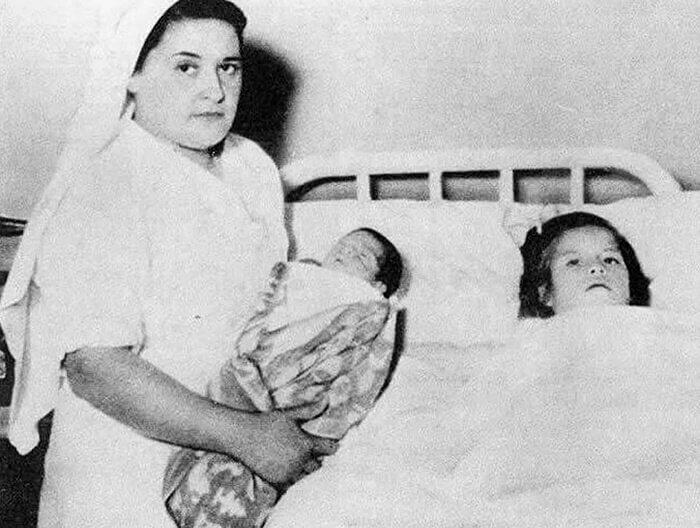
Do You Know Who Was the Youngest Mother to Give Birth?
Gem of the Month
Monthly Poem
Amazing Loren Allred
Light Side
Reflections on my previous Blog
Dr Alan Brener passed me the following that was published on the UCL Laws Faculty website:
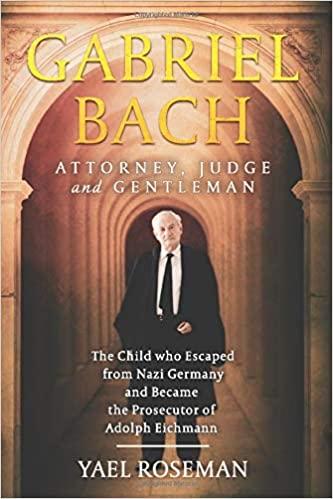
Tribute to Justice Gabriel Bach
7 March 2022
We are saddened to hear of the passing of Justice Gabriel Bach, alumnus (1950) and Honorary Fellow (1998) at UCL Laws.

Gabriel Bach, who served for 15 years as justice in the Israeli Supreme Court passed away on February 18, 2022. He was a proud UCL Laws alumnus and represented the university on the selection committee for the annual scholarship awarded by the Leonard Sainer Foundation.
Born in Germany in March 1927, Bach fled the country with his family in 1938, to Amsterdam and then to British Mandate for Palestine in 1940. He received a scholarship to study Law at UCL, completing his LLB, before returning to Israel for military service and subsequently a 46-year career in the public sector.
In 1953, Bach started working in the State Attorney’s Office and in 1961, was appointed Deputy Attorney General. While working in the State Attorney's Office, he handled two major cases associated with the Holocaust, including the case of Adolf Eichmann, which became one of the most iconic legal cases in Israeli jurisprudence. Eichmann, a senior official in the Nazi regime, was prosecuted and convicted in Israel for his actions during the Holocaust, and subsequently executed. During the trial, Bach allowed dozens of Holocaust survivors to tell the horrors they went through. Through this Bach raised awareness of the magnitude of the crimes committed during the war and started the process whereby survivors of the Holocaust gave public voice for the first time of their experiences. Thereafter Bach was appointed as the State Attorney and later a Supreme Court Justice.
Justice Bach was founding Chair of the UCL Israel Alumni Association. Over the past 22 years, he shared his valuable time to connect our university’s community in Israel, supporting activities such as the Chevening-UCL Israel Alumni-Chaim Herzog Award and other events that fostered connections between UCL graduates and their shared alma mater.
Professor Piet Eeckhout, Dean of UCL Laws, said:
‘We were deeply saddened to learn of the passing of Justice Gabriel Bach, but also grateful for the immense contribution he made to the pursuit of justice and the protection of human rights. UCL Laws is incredibly proud of his achievements. They show that justice is able to catch up with acts of genocide and crimes against humanity. His passing coincides with a war in Europe that again crosses the boundaries of justice and civilisation. We will all bear Justice Bach’s legacy in mind in the act of, again, restoring justice on our continent.’
Zvi Geffen and Jennifer Janes, who founded the UCL Israel Alumni Association, said:
‘Justice Bach was Chair of the Association for 22 years, from its establishment until last year, when he decided it was time to retire. During that period, we established the Chevening - UCL Israel Alumni - Chaim Herzog Award, which has so far enabled 16 Israeli graduates to obtain Master’s degrees at UCL. We were honoured to be led by him, and were inspired by his enthusiasm and energy. He will be greatly missed.’
Ashly Eckerling, Leonard Sainer Scholar and LLM student at the Hebrew University in Jerusalem, paid tribute to Gabriel:
‘Bach gave great weight to human rights and justice during his professional career, representing the highest standards for a judge and a jurist. As a judge, Bach was known for his liberal and humane approach. Bach praised the right of freedom of expression in his decision not to ban interviews with supporters of the Palestine Liberation Organization but recognised that restrictions on the right of expression may be required to prevent incitement to racism. May his memory be a blessing.’
UCL Laws would like to extend our condolences to Gabriel’s family, friends and colleagues at this difficult time.
Image: Justice Bach pictured at the end of 2021 with a print of the UCL Portico. The print was sent by UCL as a gift to express appreciation of his contribution as Chair of the Israel Alumni Association throughout the years, which Jennifer and Zvi presented him with. The original watercolour was painted by Mark Cleary, President of the UCL Friends and Alumni Association in the USA.
https://www.ucl.ac.uk/laws/news/2022/mar/tribute-justice-gabriel-bach
Terror
During the past few weeks, Israel has been challenged with a new wave of terror in Beer Sheva, Hadera, Bnei Brak and Tel Aviv. The terrorists were either Palestinians from the West Bank or Israeli-Arab/Palestinian Islamists who were equipped with guns, went to the streets and started shooting. In each incident, they murdered a few people before they were killed by Israelis who were on the scenes and reacted quickly to prevent further bloodshed.
The fact that Israeli-Arab/Palestinians were involved is a very worrying phenomenon for two reasons: the prevalence of weapons in Israeli society, and the fact that many perpetrators were Israeli civilians. Up until this wave of terror, Israeli-Arab/Palestinians were hardly involved in terrorist events. Their participation was a rarity. It seems, however, that jihadi Islam took hold among some circles of Israeli-Arab society. All the terrorists were young men who were radicalised by the messages of ISIS and like-minded jihadist organisations.
Israeli-Arab/Palestinians enjoy the rights and liberties of all Israelis. They enjoy free movement, know Israeli society well and it is not difficult for those who wish to have guns to get them.
Israel’s security organisations should closely monitor hubs that instigate violence both off and online. Gents on the ground and online should trace and isolate inciters. Luckily, in all incidents until now the terrorists were swiftly killed. But there might be the case that future perpetrators will have more time to kill before stopped.
The main thing that violence successfully does is breed more violence.
People resort to violence when they lose their patience. Often, however, violence proves to be an unsuccessful shortcut for reaching viable solutions.
Noam Shalit
Noam Shalit, father of Gilad, died recently. Noam was a role model. Role model for committed, unrelenting and passionate fatherhood. And role model for families that find themselves in similar horrific situations, when their loved ones are held hostage by bad people. Families should not and cannot expect that governments will operate for them. Governments are motivated by many considerations; some are aligned with the families’ interests; some are contradictory. Public pressure on governments to do whatever they can to bring the hostages home is certainly a factor. Governments need to be reminded of their commitment and obligations to their citizens.
Israel should do whatever it can to bring home Avraham Mengistu and Hisham al-Sayed as well as the remains of Hadar Golden and Shaul Aaron.
It is no less than state duty and, of course, the just and decent thing to do.
The British government recently brought home two of its citizens, Nazanin Zaghari-Ratcliffe and Anoosheh Ashoori, who were held captive in Iran. According to reports, the United Kingdom agreed to Britain settle a long-standing debt owed to Iran. Is it possible for Israel to pay with tangible assets to release its citizens?
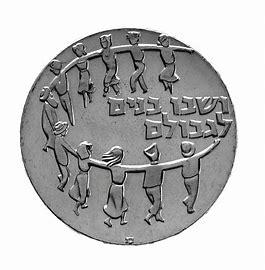
Dinner
On 5 March 2022, my wife and I were invited to dinner by a couple whom we have known for several years. The male host is a respected deacon at the Hull Minster and a magistrate at the local family court. Other guests were a Jewish couple from Hull. We had light dinner and then desert. Four pieces of cakes were served. The host explained that it was the Lent period. They do not eat sweets during Lent. I asked why. The host explained that late in his life, Jesus went to the desert to think and to contemplate for forty days. Jesus had little to eat. His followers recall this period.
I asked my host what happened after the forty days. My host explained that then Jesus returned to his village, was captured, stood trial and was crucified by the Jewish community. I voiced my objection, saying that I believe this assertion/belief is factually wrong. As far as I know, the Romans crucified Jesus. My host replied that the Romans did not particularly care about Jesus. It was the Jews who objected to him. They crucified Jesus.
The other Jewish man at the table, that perhaps was distracted initially, then jumped and said: No, this is not true. The Romans crucified Jesus.
Our host was surprised. Something that he believed all his life is now challenged by his two guests. I said that this issue is important, that I assume he knows Christian history far better than I do, that I also assume he conducted research about this important issue and, therefore, that I’d like to know his sources. Our host replied that he was not sure whether he is more knowledgeable than me on this, and that he will make inquiries.
Post-Dinner
The next day, our host wrote to me:
“Following on from last nights conversation regarding Lent and the Crucifixion.
I raised the question with a number of my colleagues at Church this morning.
What was so interesting that there was initial doubts!
On returning home I have put the question in to Google and so far within this text this presents an interesting suggestion.
Pilot was the Governor at the time and it suggests he had a significant role to play.
It also suggests he was indifferent to the calls from those attending Passover.
The conversation continues.”
I replied:
“I wish you success and good luck in the search for truth. I, for one, would not like to live in a lie. Thus, please keep me posted about the results of your research. I am curious to know the truth.
A word of caution: Please ensure you rely on reliable and credible sources, written by authoritative people”.
I decided to approach a Christian scholar whom I appreciate, Professor David Albert Jones. I told him about my encounter with the deacon and asked for his opinion and also for some statements of Christian sages who have related to the matter and explained this important historical episode.
David replied:
This is a deep question and touches on a troubling history.
Clearly crucifixion was a Roman punishment as opposed to e.g. being stoned to death (the Jewish punishment for blasphemy). In this sense, Jesus was crucified by the Romans not by his own people. However, there is a very strong theme running through all four gospels, which is that he was handed over to the Roman authorities by the leaders of the Jewish community (through actions ascribed variously to the chief priest and to the Sanhedrin but also to "scribes" and to "Pharisees") and that the local crowd in Jerusalem who at one time had welcomed Jesus as a saviour turned violently against him and supported his execution, and (most of) his own disciples also abandoned him.
Even from a skeptical historical perspective (the "search for the historical Jesus") the question might be asked how Jesus came to the attention of the Roman authorities and why they bothered to execute him. This is surely an example of the colonial power intervening in an intra-community dispute that was causing divisions (of a theological kind obscure to the Roman authorities). There are no accounts of Jesus specifically defying Roman rule (in contrast to the Jewish martyrs who defied had Antiochus Epiphanes during the Maccabean revolt). It was surely done to keep the peace among Jewish factions (one such being the followers of Jesus). The events of the "trial" by the Sanhedrin are disputed by historians but it cannot be doubted that Jesus attracted local opposition as well as followers and that it was because of this that he was executed.
Theologically speaking the rejection of Jesus even by his own people is important because it is the culmination of a rejection of God by humanity and the reconciliation of humanity despite this rejection. In this way Jesus is seen in continuity with Jeremiah and other prophets whose message was rejected by God's people. There is an important theological sense in which it can be said that though the Romans crucified Jesus (materially) it was his own people, the people of God, who handed him over and so they were responsible, and there is a deeper sense in which the Jewish people here represent the human race as loved by God and hence "we all" crucified Jesus.
The first disciples were Jews and the first Christian community was a mix of Jews and gentile converts. However, this was not a stable situation and the community was soon seen as a threat by orthodox Jews (I use this phrase generically rather than with a capital 'o') while at the same time gentile coverts to Christianity came to outnumber the original Jewish-Christian community. Christianity was regarded by the majority Jewish community as a Jewish heresy and the Jews who did not follow Jesus were regarded by Christians as obstinate. The first schism. Subsequently there has been a long history of antagonism and of Christian antisemitism (to varying degrees but rarely absent altogether). Within this dark history the theme of the gospels that Jesus's own people were in part responsible for his death (portrayed, for example in the shout from the crowd "his blood be upon us and upon our children" (Matthew 27.25)) rather than be seen as an expression of universal human guilt is attributed narrowly to the Jewish people and used as an excuse for persecution. This misuse of the idea that "the Jewish community crucified Jesus" is something to be rejected very strongly. However, if you read the gospels you will find, in all of them, the theme of rejection by the community including both the leaders of the community and people as a whole. This is because the Jews are (then, and still are) the people chosen by God, and so have a representative function for all humanity. This is my understanding of the gospels.
I hope this helps.
Kind regards
David
I then wrote to David and David answered (in brackets):
Dear David
So, according to you:
The Jewish community disliked Jesus and rejected him
[I would not quite put it like that. Not all the "Jewish community" and not all the time. Jesus was a Jew and a charismatic figure, healer and preacher who attracted both followers and opposition among his compatriots - as did other false messiahs, as indeed did John the Baptist]
The Romans crucified Jesus
[Clearly]
The Jewish community rejoiced watching this.
[There are two scenes in the gospels, one is the crowd in front of Pilate the other is the crowd watching the crucifixion. The historicity of this is disputed by historians. Pilate was by all accounts a weak and vacillating figure but capable to having people crucified. Watching public execution has been popular in every age and would likely draw a crowd]
Questions:
Why didn't the Jews kill Jesus? Jews had no qualms killing other people.
[According to the Gospels there were previous occasions where people tried to stone Jesus to death. Some other people died like that (as the proto-martyr Stephen) others were executed by the local Tetrarch (as with the beheading of John the Baptist) others were crucified by the Romans. Not all Jesus's enemies (who were diverse, the Pharisees, Herodians and Chief Priest representing different factions) would have wanted to kill him and not all would have wanted to kill him in the same way. Perhaps having the Romans kill him was politically convenient - this is how it is portrayed in the Gospels. According to the Gospels he was betrayed by one of his own (Judas) would had conspired with his enemies within the Jewish community but used the Romans to do the deed. Nothing in this story is beyond belief. Why do it this way? Why not? The opportunity arose. The Gospels have an agenda in telling this story but they are very close to the historical sources and the story of betrayal by a disciple seems well attested.]
Did the Jews specifically ask to kill Jesus (rather than, e.g., to exile him?)
[Again who are 'the Jews' here? I think few of Jesus’ enemies would have the power of exile [do you know of contemporary examples in the first century who were exiled? By whose authority?] The Gospel accounts differ in details but they imply a conspiracy involving some people to have Jesus executed. He was executed. This could surely not have been done within some witnesses coming forward claiming something about him. Why is this difficult to believe?]
Why did the Romans accept the Jewish plea to kill Jesus (if this was the plea)? They did not accept EVERY Jewish plea.
[Clearly the Romans did not do everything they were asked. So it was not because of 'plea' that the Romans executed Jesus but because of the specifics of the accusation. The claim is that he was executed as a pretender to the throne of Judea [as the 'King of the Jews' - a phrase repeated and allegedly written in Hebrew, Greek and Latin]. Such claims would certainly have been regarded as seditious by the Romans who would be concerned about rebellion - a constant threat. It was not a big deal for the Romans to crucify someone who was not a Roman citizen and was a potential threat. This happened every day.]
Then I asked:
Dear David
To clarify: Did Jesus have pretensions to be the 'King of the Jews' ? Did he have any other pretensions? Why some Jews wanted him killed?
Best wishes
Raphael
David replied:
Dear Raphael,
I believe that Jesus was the promised Messiah, the son of David who was to come. I also believe that Jesus saw himself as the Messiah and I think the available evidence points to him thinking of himself as this. He would not be unique in thinking this. I also think that, in his case, the Kingdom of God that he preached was not a political kingdom of the kind that should have concerned the Roman authorities but it was close enough to be used against him. I think some people would think that false messiahs were dangerous and possibly blasphemous and would want to have such a person stopped, if necessary by having him killed.
Kind regards
David
The respected deacon at the Hull Minster followed our discussion by sending me this link:
https://www.bibleodyssey.org/en/passages/related-articles/crucifixion-of-jesus-and-the-jews
It says: Whatever the historical circumstances might have been, early Christian tradition clearly and increasingly placed blame for the death of Jesus on the Jews, decreasing the Romans’ culpability.
I read the piece. It also established that the crucifixion was conducted by the Romans. Jews never crucified anybody. It does put the major responsibility on the Jews, which is curious. I welcome David’s thought. Here is his learned response:
Dear Raphael,
Jesus was a Jew and was killed by crucifixion which was a punishment of the Roman colonial authorities, not a spontaneous act of lynching by a mob or a Jewish punishment. This is doubted by no-one. What is at issue is the extent of the involvement of religious leaders and/or rival religious groups in delivering Jesus to the Roman authorities. The accounts in the four gospels vary in their details but all agree that Jesus had enemies of various sorts among his own people and that he was betrayed by one of his own (Judas Iscariot) and that he was betrayed to communal leaders who then had Jesus taken to the Roman authorities. The theme of Jesus being rejected by the people is not a minor one but recurs through the New Testament. It is taken as a fulfilment of the text in the psalms "The stone that the builders rejected has become the cornerstone." (Psalm 118.22). Essential to this narrative is that Jesus was rejected by his own people.
The gospels as we have them are not contemporaneous accounts. Jesus did not write a book. They are accounts by a later generation and probably reflect a process of oral retelling before they became written documents. Nevertheless, there is widespread agreement that they are all written within living memory and that they draw on multiple sources. Earlier than the gospel accounts are the letters, at least those where the authorship is not in doubt. Chief among these are the letters of Paul (formerly Saul of Tarsus) a Jewish convert to Christianity and well versed in contemporary Judaism but not a follower of Jesus during his lifetime. Saul had regarded Christianity as a Jewish heresy and Jesus as a false messiah and had worked actively to have Jewish Christians expelled from the synagogue (or condemned to death). He reacts to his own earlier views and actions and this colours his thoughts. Nevertheless, he is a good witness to what was believed by Christians only 20 years or so after the events of the crucifixion. Writing to Christians in Thessalonia he says:
"For you, brethren, became imitators of the churches of God in Christ Jesus which are in Judea; for you suffered the same things from your own countrymen as they did from the Jews, who killed both the Lord Jesus and the prophets, and drove us out, and displease God and oppose all men" (1 Thessalonians 2.14-15).
The word Jews here (Judaion) reflects the word Judea (Judaia) so we might translate it "as they did from the Judeans" but the key idea in this passage is that those who were responsible for the death of Jesus were his "own countrymen". This idea that the people themselves "killed the prophets" is a theme in Jewish literature (see for example Nehemiah 9.26) which Christian inherited but applied especially to Jesus.
There may be support from this theme from one near-contemporary Jewish source. The historian Josephus includes two references to Jesus in his works. Unfortunately, the first seems to have been corrupted by later Christian interpolations (including a reference to Jesus' resurrection) but many scholars think it includes an original authentic kernel. The historian and biblical scholar Geza Vermes, a Hungarian of Jewish decent who was raised Catholic but later renounced Christianity to embrace his Jewish identity (but not orthodox Jewish practice) proposes the following as his reconstruction of the original passage:
"Now there was about this time Jesus, a wise man. For he was a doer of startling deeds, a teacher of such men as receive the truth with pleasure. And he gained a following both among many Jews and many of Greek origin. He was called the Christ. And when Pilate, at the suggestion of the principal men amongst us, condemned him to the cross, those that loved him at the first did not forsake him. And the tribe of Christians, so named from him, are not extinct at this day." (G. Vermes Jesus in the Jewish World London: SCM Press 2010 referring to Flavius Josephus Antiquities 18.3)
The phrase I would draw to your attention is "at the suggestion of the principal men amongst us". Vermes regarded it as entirely plausible to attribute these words to Josephus. If authentic, they would be later than most if not all of the gospel accounts and much later than Paul's letters, but they would be an independent witness and the words of a first century Jewish historian familiar with the Roman world.
I think that the theme that the death of Jesus was the result of betrayal and that he was handed over to the Roman authorities by the religious leaders ("the principal men amongst us") and this was thus an instance of rejection by representatives of the people, is both a strong strand in the New Testament and is credible even by sceptical historical standards.
What is not credible, theologically, is to abuse this theme so as to attribute blame to the later Jewish community as some kind of inherited guilt for killing Christ (sometimes termed 'Deicide') as commonly done within the long and dark history of Christian anti-Semitism.
The article you cite is an example of a theologian seeking to redress this dark history by de-emphasising this theme and reminding people of Roman involvement. In this I commend him. However, when he says that the "early Christian tradition clearly and increasingly placed blame for the death of Jesus on the Jews, decreasing the Romans’ culpability" I respectfully disagree. In general, one should be wary of people saying something is "clearly" the case where the evidence is mixed. More particularly, I disagree that there is evidence that fellow-Jewish involvement in Jesus' arrest was "increasingly" emphasised and that acknowledgment of Roman involvement "decreased" during the first century. All the evidence we have points to his betrayal and rejection by his own people being prominent themes from the beginning.
I should state that I am not a Biblical scholar nor a historian. I am a theologian with some knowledge of the text and the history and the disputes among Biblical scholars. This is, nevertheless, my understanding of the evidence.
Greetings in this holiday season in a year when Jewish and Christian festivals coincide. I am very sorry for the resurgence of violence I see in the holy land and for those who have lost loved ones. I pray for peace among nations and among religions.
Kind regards
David
Israelis take fewest sick days worldwide
UK business information organization Small Business Prices found that in 2020, Israeli employees took an average of 3.9 sick days from work due to illness – the lowest of the 28 countries analyzed, suggesting a strong work ethic. The UK was 2nd (4.4 days) and Germany last (16.3 days).
https://en.globes.co.il/en/article-study-israelis-take-fewest-sick-days-worldwide-1001404065
The Assoc of Israel Studies (AIS) is hiring a social media manager!
The AIS is looking to hire a talented social media manager who will develop targeted content on social media platforms. The person will be in charge of building and managing the association’s social media profile and presence.
We are looking for a native English speaker who is up-to-date with the latest social media trends and has experience in creating content, managing posts, and responding to followers. The person will also be familiar with the academic world in general and with the field of Israel Studies in particular. We expect the position to be part-time.
Requirements:
- Proven work experience as a social media manager.
- Hands-on experience in online content management.
- Familiarity with the academic field of Israel Studies.
- Proficiency in both English and in Hebrew.
- Knowledge in small scale video editing.
- Ability to work independently and as part of a team.
Candidates should send the following: a cover letter, CV, and a letter describing their previous employment record to ais@aisisraelstudies.org
MESC Books’ Celebration
27 April 2022, 5:00-7:00pm
Link: https://attendee.gotowebinar.com/register/6165794445316367888
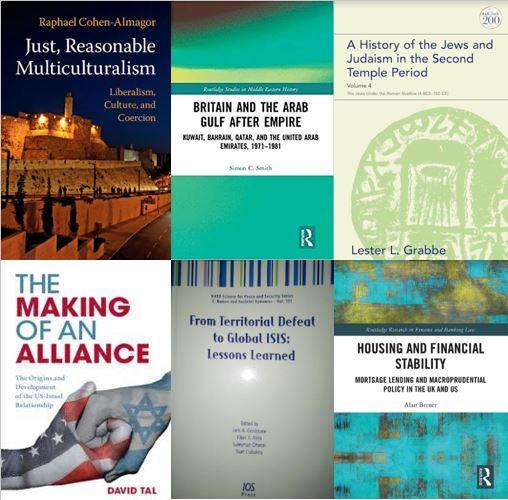
The books include the writings of:
Professor Lester Grabbe
Dr Alan Brener
Professor Jack Goldstone
Professor Simon C. Smith
Professor David Tal
Professor Alan Dowty
Professor Raphael Cohen-Almagor
Chair: Professor Stephen Hardy
Professor Lester Grabbe
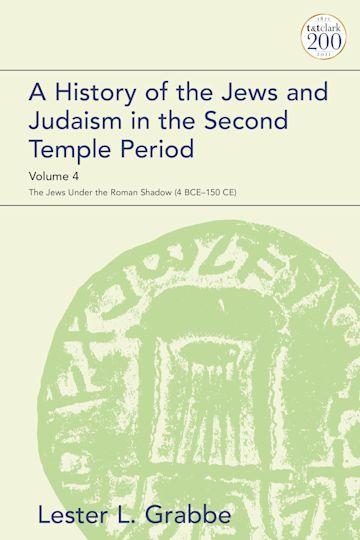
A History of the Jews and Judaism in the Second Temple Period 4: The Jews under the Roman Shadow (4 BCE–150 CE)
This is the fourth and final volume of my history of the Jews in the Second Temple period, i.e., the period beginning about 550 BC and covering the Jews under Persian, Greek, and Roman rule to about 150 of the Common Era. This volume gives the history from the death of King Herod the Great to the last Jewish revolt under Bar-Kokhva (about 132-35). It takes in the period of the Roman governors of Judaea including Pontius Pilate, the beginnings of Christianity, the conquest of Jerusalem and destruction of the Temple 66-70, and the foundations of Rabbinic Judaism. It collects all that is known about the Jews during the period in which they were ruled by the Roman Empire. Based directly on primary sources such as archaeology, inscriptions, Jewish literary sources and Greek, Roman and Christian sources, this study includes analysis of the Jewish diaspora, mystical and Gnosticism trends, and the developments in the Temple, the law, and contemporary attitudes towards Judaism. The volume concludes with a holistic perspective on the Jews and Judaism for the entire 700 years of the Second Temple Period.
place of publication: London
publisher: Bloomsbury T & T Clark
year: 2021
information: https://www.bloomsbury.com/uk/history-of-the-jews-and-judaism-in-the-second-temple-period-volume-4-9780567700711
Dr Alan Brener
Housing and Financial Stability: Mortgage Lending and Macroprudential Policy in the UK and US, (Routledge, 2020)

The book addresses the relationship between housing policy, credit and financial instability in the light of the recent global financial crisis, and proposes both short and long-term solutions. Although it is not known where the next crisis will come from, history suggests that it will have credit and property at its source. This book is focused on the UK and US but it also considers a number of other countries including Israel.
It is important that the UK and other countries look more broadly at what should be done in terms of policies, institutions and tools to make the housing market and mortgage lenders more resilient against a future crisis. This book sets out a number of workable proposals. Central to this work are questions relating to the quantitative macroprudential measures, such as loan-to-value and debt-to-income restrictions. In particular, the book questions the political legitimacy of their use and the potential consequences for the institutions, such as central banks, promulgating such policies. Preserving financial stability in very uncertain market conditions is of key importance to central bankers and other regulators, and macroprudential policy is a rapidly growing subject for both legal and economics study.
place of publication: London
publisher: Routledge
year: 2020
Professor Jack Goldstone
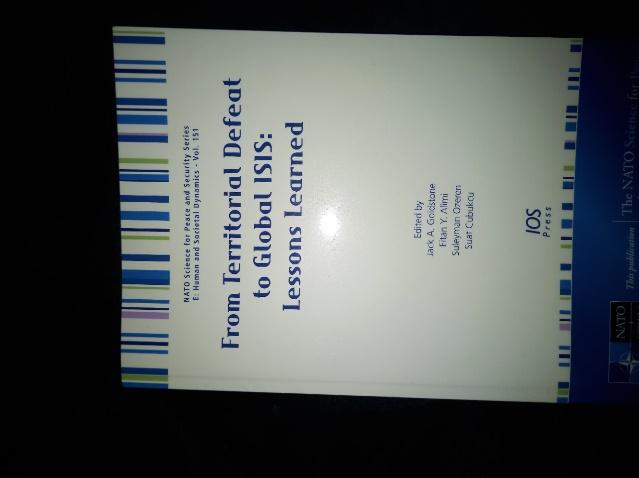
The Post ISIS-era: Regional and Global Implications
This edited volume is the result of a NATO workshop that was held in Washington DC in September 2019. It discusses the future of ISIS, maintaining security and stability, ISIS recruitment, propaganda and activities, plight of refugees, radicalization, and public fear of terrorism.
The Netherlands
IOS Press
2021
Professor Simon C. Smith

Britain and the Arab Gulf after Empire, 1971-1981: Kuwait Bahrain, Qatar and the United Arab Emirates.
Although Britain’s formal imperial role in the smaller, oil-rich Sheikhdoms of the Arab Gulf – Kuwait, Bahrain, Qatar, and the United Arab Emirates – ended in 1971, Britain continued to have a strong interest and continuing presence in the region. This book explores the nature of Britain’s role after the formal end of empire. It traces the historical events of the post-imperial years, including the 1973 oil shock, the fall of the Shah in Iran, and the beginnings of the Iran–Iraq War; considers the changing positions towards the region of other major world powers, including the United States; and engages with debates on the nature of empire and the end of empire. The book is a sequel to the author’s highly acclaimed previous books Britain’s Revival and Fall in the Gulf: Kuwait, Bahrain, Qatar, and the Trucial States, 1950–71 (Routledge 2004) and Ending Empire in the Middle East: Britain, the United States and Post-war Decolonization, 1945–1973 (Routledge 2012).
Routledge
2020
Professor David Tal
The Making of an Alliance: the Origins and Development of the US-Israel Relationship
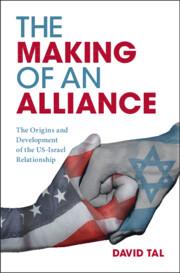
Laying the foundation for an understanding of US-Israeli relations, this lively and accessible book provides critical background on the origins and development of the 'special' relations between Israel and the United States. Questioning the usual neo-realist approach to understanding this relationship, David Tal instead suggests that the relations between the two nations were constructed on idealism, political culture, and strategic ties. Based on a diverse range of primary sources collected in archives in both Israel and the United States, The Making of an Alliance discusses the development of relations built through constant contact between people and ideas, showing how presidents and Prime Ministers, state officials, and ordinary people from both countries, impacted one another. It was this constancy of religion, values, and history, serving the bedrock of the relations between the two countries and peoples, over which the ephemeral was negotiated.
Place of publication: Cambridge
Publisher: Cambridge UP
Year: 2021
https://www.cambridge.org/core/books/making-of-an-alliance/ABA7C129D04B14BCED4B09EBEE70489C
Professor Alan Dowty

Israel
How did a community of a few thousand Jewish refugees become, in little over a century, a modern nation-state and homeland of half the world's Jews? Alan Dowty distils over half a century of study as an inside/outside analyst of Israel in tracing this remarkable story.
Cambridge
Polity
2021
https://politybooks.com/bookdetail/?isbn=9781509536894
Professor Raphael Cohen-Almagor
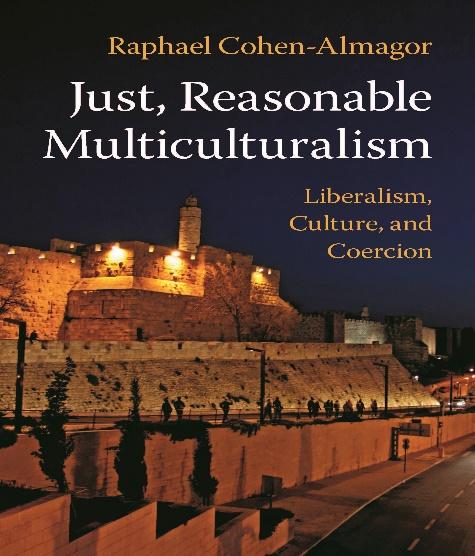
Just, Reasonable Multiculturalism: Liberalism, Culture and Coercion
The book explores the main challenges against multiculturalism. Its primary objectives are twofold: to examine whether liberalism and multiculturalism are reconcilable, and what are the limits of liberal democratic interventions in illiberal affairs of minority cultures within democracy when minorities engage in practices that inflict physical harm on group members (e.g. Female Genital Mutilation) or non-physical harm (e.g. denying members property or education). In the process, the book addresses three questions: whether multiculturalism is bad for democracy; whether multiculturalism is bad for women, and whether multiculturalism contributes to terrorism.
The main thesis is that liberalism and multiculturalism are reconcilable provided that a fair balance is struck between individual rights and group rights. It is argued that reasonable multiculturalism can be achieved via mechanisms of deliberate democracy, compromise and, when necessary, coercion. Placing necessary checks on groups that discriminate against vulnerable third parties, commonly women and children, the approach insists on the protection of basic human rights as well as on exit rights for individuals if and when they wish to leave their cultural groups.
place of publication: Cambridge
Publisher: Cambridge University Press
Year: 2021
Information: https://www.cambridge.org/core/books/just-reasonable-multiculturalism/5EB0648682BB3A81E392DC2E374A5A09#fndtn-information
Link to register:
https://attendee.gotowebinar.com/register/6165794445316367888
All welcome
New article: “Lessons from Peace Negotiations: Interview with Ehud Olmert”, Israel Affairs (published online 1 November 2021). https://doi.org/10.1080/13537121.2021.1993000
Israeli PM Ehud Olmert (2006–9) offered the Palestinians the most comprehensive peace deal they had ever received. Palestinian Authority President Mahmoud Abbas said he would reply ‘soon’ and never did. This interview records Olmert’s thoughts on the Israeli-Palestinian peace process and his own attempts to end the bitter conflict.
Available on https://hull.academia.edu/RaphaelCohenalmagor/Papers
SSRN Author Page: https://papers.ssrn.com/sol3/cf_dev/AbsByAuth.cfm?per_id=293806
Short article: “Denying Education to Women: Ensuring the Freedom Balance in the Example of Israel”, Turkish Policy, March 2, 2022.
What degree of freedom should be allowed to communities in deciding their educational matters? What is the duty of the state to ensure that citizens receive acceptable standard of education?
Will Smith
Some people confuse between their cinematic persona and their real-life persona and continue their behaviour on the silver screen in their real life. This is extremely dangerous, especially when those actors are role models. The main thing that violence successfully does is breed more violence.
People resort to violence when they lose their patience. Often, however, violence proves to be an unsuccessful shortcut for reaching viable solutions.
Do You Know?
What is the longest word in the English language with one vowel?
(Answer below)
Gem of the Month
My son Roei and I travelled to Manchester to watch a football match at Old Trafford: Manchester United v Tottenham Hotspur. Roei is a fan of Man U. I support Spurs. For both of us, this was the first time we went to Old Trafford to watch a game. Some years ago, we had a tour of the stadium but did not see a game.

The atmosphere was thrilling. Ronaldo scored first. Kane responded. Ronaldo scored again. Spurs equalized and then, in the 82 minute or so, Ronaldo scored for the third time. Spurs did not have time to respond.
It was an exciting game. Time passed quickly than ever. Roei and I had a wonderful time. I was happy to see his joy. It was nice of Ronaldo to perform to brilliantly in front of our eyes. Frankly, I would prefer if he were to perform a little less brilliantly…
Monthly Poem
Spring, the Sweet Spring
Spring, the sweet spring, is the year's pleasant king,
Then blooms each thing, then maids dance in a ring,
Cold doth not sting, the pretty birds do sing:
Cuckoo, jug-jug, pu-we, to-witta-woo!
The palm and may make country houses gay,
Lambs frisk and play, the shepherds pipe all day,
And we hear aye birds tune this merry lay:
Cuckoo, jug-jug, pu-we, to-witta-woo!
The fields breathe sweet, the daisies kiss our feet,
Young lovers meet, old wives a-sunning sit,
In every street these tunes our ears do greet:
Cuckoo, jug-jug, pu-we, to witta-woo!
Thomas Nashe
Amazing Loren Allred
Loren Allred is simply magical in BGT. Enjoy!!
https://www.itv.com/britainsgottalent/articles/golden-buzzer-loren-allred-shines-bright-with-never-enough

Light Side:
A woman in Moscow buys a newspaper, glances at the front page and throws the paper away.
She does the same thing each and every day.
Eventually, the seller asks her: “Why do you do that each day?”
“I am just checking for obituary”, the woman replied.
“But obituaries are not published on the front page”, said the seller.
“The one I’m looking for will be”.
With my very best wishes for a very festive season, Happy Easter, Happy Passover, Ramadan Kareem
Rafi
My last communications with all the photos and illustrations are available on Israel: Democracy, Human Rights, Politics and Society, http://almagor.blogspot.com
People wishing to subscribe to this Monthly Newsletter are welcome to e-mail me at r.cohen-almagor@hull.ac.uk
Twitter at @almagor35
Strengths