Monday, February 04, 2013

Politics – January 2013

Support is sought to facilitate the work of the Middle East Study Group. Information at http://www2.hull.ac.uk/fass/mestudygroup/informationfordonors.aspx

I also welcome promoting the two-state solution. See http://www.hull.ac.uk/rca/campaigns.html


We, the people, still believe that enduring security and lasting peace do not require perpetual war.
~ President Obama Inaugural Speech (January 21, 2013)


One scratch on the wall is just a scratch. Many thousands of scratches, however, may change the shape of the wall.

~Raphael Cohen-Almagor


Please feel free to circulate.
                                         

Israeli Elections
Comments on Petition for Two-state Solution
Views of the Israeli Public on Israeli Security
Syria
Jordan
Documentary – The Gatekeepers
My New Article - “Two-State Solution – The Way Forward”
Book Review – Israel’s Palestinians
New Books
Gem of the Month – One Man, Two Guvnors
Monthly Poems
Light Side


Israeli Elections

On January 22, 2013 (my wedding anniversary), elections were held for the 19th Knesset. 32 political lists competed for seats. With the proviso that not all votes were counted until the time of writing, 12 of them entered the Knesset. The clear winner was PM Netanyahu, whose party Likud Beitenu, received 31 seats.

Second came Yesh Atid (There Is Future), the wild card of the elections with 19 seats. Yesh Atid is headed by Yair Lapid, a journalist and television personality, who followed the footsteps of his father Tomy Lapid who had a similar career: journalist, then TV personality, then politician. Lapid brings a refreshing face, youth appealing to youth and to women, flexible agenda, zero experience in politics, eighteen new faces to the Knesset, and a social agenda that relates to education and state/religion issues. Lapid said before the elections that he was quite willing to sit in Netanyahu’s government.


Yair Lapid


Yesh Atid was victorious in several cities in Israel. Lapid should invest in opening branches in those cities and compete in coming local elections. His list includes two local leaders.

Third came the disappointed Labour, with 15 seats. Shelli Yehimovich hoped for at least 20 mandates. Apparently 5 of them went to Lapid and Livni (below).

Jewish Home, the hard-line, nationalistic and religious party, headed by another new (and quite scary) face and very old, chauvinistic agenda -- Naftali Bennett, came a joint fourth with 11 seats. I think many of the former moderate and sensible leaders of the Mafdal would turn in their graves hearing Mr Bennett. The only moderate thing in Mr Bennett is his haircut. Wise he is not.

Shas, the Sephardi ultra religious party, also received 11 seats.

Ultra religious Yahaduth Hatorah received 7 seats.

Hatnuah, Tzipi Livni’s party, and my party, Meretz-the Civil Rights Party, received 6 seats each.

Three Palestinian parties – Raam, Hadash and Balad received 5, 4 and 3 seats. There combined power is 12.

Lastly, Kadima, headed by Shaul Mofaz, barely made it with 2 seats (the entrance threshold is 2% of the vote). Ariel Sharon’s Forward (Kadima in Hebrew) certainly went backwards. A question for Mofaz: What is better: to be a leader of a 2-seat party, or to be second in a 9-seat party?

First observations:

Netanyahu will most probably be the next prime minister.

I find it hard to believe that he won’t continue his very successful partnership with Shas and Yahaduth Hatorah. The three parties together give him 49 seats. He needs at least 61 seats, but will aim for a large coalition. History showed that narrow coalitions of 61-65 seats tend to be unstable and open to blackmail as the opposition attempts to lure some of the shaky members to change allegiance.

Netanyahu will probably aim to bring Yesh Atid into the coalition. I think he will be successful. He will then have 68 seats in the Knesset, a stable coalition. Yesh Atid has plenty of energy and ideas but zero political experience. With all due respect, Lapid has a lot to learn from Netanyahu.

Thus, I expect that for the right rewards, Lapid and the religious parties will be able to overcome their obvious differences. When there is will there is a way. This, of course, is bad news for Israel as it means deadlock. Problematic issues relating to women status in society, private and personal matters in the most intimate matters of marriage, divorce, conversion and death will remain in the hands of the few. Exemption from army service to Yeshiva buchers will remain intact. No separation between State and religion.

Coalition partnership with other parties is a bonus.

There are some good news for the Israel center-left. It seems that the Israeli society returned to have equilibrium between the two blocs. The combined power of Yesh Atid, Labour, Livni, Meretz, Kadima and the Palestinian parties is 60 seats, exactly half of the Knesset, to match the 60 seats of the right – Likud Beitenu, Jewish Home, Shas and Yahaduth Hatorah.

Theoretically, if Lapid, Labour and Livni were to run together, they would have come victorious, and President Peres would have called upon them to comprise the coalition. This should be a lesson for future elections, and the challenge for the next leader of the Israeli center-left.

These are great news because it shows that there are enough sane voices in Israeli society who see beyond sheer force, the building of settlements, and Am Levadad Yishkon (meaning in Hebrew, and please excuse the language, Fuck the Goyim; we will do what we want and we don’t care what the world is saying). This should be a clear enough message for Netanyahu.

A leader, any elected leader, represents the entire society, not only those who elected him. The challenge for any leader, and the recipe for a continued leadership, is to achieve unity. Let me quote President Obama:

You and I, as citizens, have the power to set this country's course. You and I, as citizens, have the obligation to shape the debates of our time -- not only with the votes we cast, but with the voices we lift in defense of our most ancient values and enduring ideals.
Let us, each of us, now embrace with solemn duty and awesome joy what is our lasting birthright. With common effort and common purpose, with passion and dedication, let us answer the call of history and carry into an uncertain future that precious light of freedom.

In his inspiring Inaugural Speech made a day prior the Israeli elections (January 21, 2013), President Obama also said the following words that ring true to many liberal Israelis, who share the same values of the great Judeo-Christian tradition:


For our journey is not complete until our wives, our mothers and daughters can earn a living equal to their efforts. Our journey is not complete until our gay brothers and sisters are treated like anyone else under the law -- for if we are truly created equal, then surely the love we commit to one another must be equal as well... Our journey is not complete until we find a better way to welcome the striving, hopeful immigrants… until bright young students and engineers are enlisted in our workforce rather than expelled from our country. Our journey is not complete until all our children… know that they are cared for and cherished and always safe from harm.
And lastly, it is worth reiterating:

We, the people, still believe that enduring security and lasting peace do not require perpetual war.

Amen.


Comments on Petition for Two-state Solution

Professor Naomi Chazan wrote from Jerusalem that I should change the phrase “Palestinian Authority” to Palestine.

I did.


I was asked:

A 2-state-solution could, theoretically, entail a Palestinian state in, say, Jericho, and an Israeli state that encompasses all the rest, correct? Or is the ambiguity part of the plan?


To which I answered:

Petitions are concise. It is about promoting an idea. I agree with you that the devil is in the details, but this will come later. It is not that I am ignoring details. I am not. Just one step at the time. At the moment we are far away from any reconciliation.

The question is simple: Do you foresee any other solution but a two-state solution?

If you think another solution is preferable (one state; three states; continued occupation; transfer; Palestine in Jordan; the Iranian option or any other option), do not sign. If you think that the most viable option is a two-state solution, please consider signing.


Michal Anosh wrote:
Shalom Rafi, I think the situation in the ME is too unstable at this time to push for such a statement. I personally believe that many Palestinians would prefer to get on with their lives and would appreciate the more stable and accountable form of democratic government within Israel, but this is not the reality in either the West Bank or Gaza. My own recommendation would be a 3 state solution - wherein Gaza becomes its own entity and could make a great economic development of its own serving tourists and greenhouse garden products for Europe. Meanwhile the West Bank and Israel could be the financial and economic development platform for the rest of the moribund economies of the ME where an estimated 80 million unemployed Arabs will come of age by 2020 in a context where there is no possibility of entrepreneurship to create jobs of them. We just need to get rid of Hamas and Fatah...or maybe the people will be able to do that as the economic situations get more dire and Arab states renege on funding. So...here's how crazy I am...comments welcome. M

Nehemia Stern suggested:
We could wait for the Hashemite Kingdom of Jordan to collapse. Then you will have a de-facto Palestinian State on the east Bank of the Jordan River
When the Hashemite Kingdom of Jordan collapses (and it's inevitable) there will be a de-Facto Palestinian State on the east bank of the Jordan River. The question is, what obligations will they have towards their brethren on the West Bank of the Jordan River. Hopefully they can be persuaded to offer them citizenship in the new Palestinian State of Jordan. Then Palestinians of the West Bank (if they don't opt to move) can simply be permanent residents of Israel, and citizens of Jordan. What Israel ought to be doing is creating structures and institutions on the ground that can facilitate this eventuality.

As my mom once told me when, as a 6 year old I asked for sprinkles AND whipped cream on my Ice Cream, "Nehemia, you can't always get what you want".


Exchange with Lindsay Talmud

Dear Raphael,

I don't know if you remember me. We met at a conference in Turkey a few
years ago. I have been reading your regular e-letters with interest since
then.

I want to express my view with regard to your current campaign to obtain
signatures in order to petition the "Governments of Israel and the
Palestinian Authority: Sign a peace treaty on the basis of two-state
solution."

While I wholeheartedly agree with your sentiment that "enough blood has been
shed," I believe there are problems with your approach at two levels.

First, the idea of a "solution" is misconceived. The resolution of the
Palestine/Israel conflict needs to be process-oriented and not
solution-oriented. All sort of solutions, plans and road maps have been
proposed in the past and they have not worked. The alternative is the South
African and the Irish conflict resolution model: once both parties to the
conflict, the Palestinians and the Israelis, reach the point where they are
determined to resolve the conflict between them, they will enter a process
of negotiations where issues will be resolved. And all preconceptions about
the outcome will only stymie the process.

Second, the division of the land between the Mediterranean Sea and the
Jordan River into two viable, sovereign states is no longer possible. It
might have been possible once; it no longer is. We have missed that train. I
will not elaborate. I'll refer you instead to writings, etc. of Eyal
Weizman, Meron Benvenisti, Rashid Khalidi, Sari Nusseibeh, Omar Barghouti,
Ruby Rivlin and Moshe Ahrens.

We all recognize that this is an intractable conflict. However, it can be
resolved, but only when the two parties finally decide to do so. Until then
nothing will stop the bloodshed.

Regards,

Lindsay Talmud


Dear Lindsay,

I agree that the conflict can be resolved only when the two parties finally decide to do so. I think this petition is a step in the right direction, leading to the parties agreeing to do so. We should not be passive. I believe that one scratch on the wall is only a scratch. Many thousands of scratches, however, may change the shape of the wall.

Best wishes
Rafi


Dear Raphael,
As much as I respect your sense that "We should not be passive," I cannot sign your petition and that is why I wrote to you.
I do not want to support petitions or perpetuate attitudes that entrench what I see as a misguided mind-set and that stand in the way of potential change. I believe that continued talk of the chimerical "two-state solution" serves essentially as an escape from current reality for some people and a reinforcement of the status quo for others. From my perspective it's counter-productive, not a scratch on the wall.  
To my mind the unacceptable status quo will remain unchanged unless there is a fundamental paradigm shift within the ruling elites in Israel/Palestine. Accepting that the "two-state solution" is no longer possible is a necessary step in the direction of that shift.
Regards,
Lindsay

Dear Lindsay
I am campaigning for a two-state solution precisely because I wish to change the status quo, certainly not to enforce it. The status quo disserves both Israeli and Palestinian interests. While Abu Mazen tries to change it in a way that would lead to the creation of a Palestinian state, my government is bolstering settlements.
The Israeli government thinks that somehow Israel could continue the occupation forever; that the Palestinians will have some sort of sovereignty in the Ramallah area, and that parts of the West Bank will eventually be annexed to Israel with as few Palestinians as possible. This is a recipe for an endless cycle of violence.
I do not think the Israeli government is determined to resolve the conflict. This is even truer for Hamas. I am not sure about Abu Mazen. Should we just wait for the Israeli and Hamas leaders to wake up? Passivity is not my nature. I believe in action, in doing. We must contribute our share and act upon our beliefs.
It is unclear to me what solution you have in mind. I suspect it is a one-state solution. As a Zionist who cares deeply for the continued existence of one Jewish state in the world, I prefer two-state solution.
Best wishes
Rafi

Views of the Israeli Public on Israeli Security and Resolution of the Arab-Israeli Conflict

Poll conducted in December 2012 by the Jerusalem Center for Public Affairs / Dahaf Institute Survey shows:


76% of Israelis (83% of Jews) believe that a withdrawal to the 1967 lines and a division of Jerusalem would not bring about an end of the conflict.


61% of the Jewish population believes that defensible borders are more important than peace for assuring Israel’s security (up from 49% in 2005).


78% of Jews indicated they would change their vote if the party they intended to support indicated that it was prepared to relinquish sovereignty in east Jerusalem. 59% of Jews said the same about the Jordan Valley.


Syria

I have been calling for international involvement in Syria for more than a year now. President Obama seems to fail to understand that things do not remain in vacuum and that it is better for western influence to fill the void than al Qaeda.


Jordan

The Hashemite Kingdom is shaky. Watch for developments. They may happen any day now.

Documentary – The Gatekeepers

Dror Moreh’s film, which won the U.S. National Society of Film Critics' award for best documentary, extracts frank admissions and fascinating analysis from the former Shin Bet chiefs.


Moreh interviews them on delicate issues: fighting terrorism; suicide bombing; targeted assassinations; the Jewish Underground; Bus 300 Affair; the Palestinian Intifada; Yitzhak Rabin’s assassination.

The six people who were interviewed for "The Gatekeepers" (about 12 hours interview each; the film is 90 minutes long) dispatched people at risk to their own lives into enemy territory. The six approved brutal interrogations of security detainees. They convinced people to betray their own homelands and ordered a number of assassinations. In the film, they speak openly about the implications of the occupation on Israeli society; the penetration of violent norms into Israeli life. One of them compared the IDF to the German army in occupied Europe. They speak of the need to speak to our enemies and resolve the conflict before it reaches a point of no return, when it would be too late. This, they acknowledge, requires boldness and resolute decision-making process, willingness to hold the bull by the horns and pay the price. Does Israel have the required leadership to do this? Is peace more than wishful thinking? Are Israeli and Palestinian children doom to suffer for the rest of their lives?


My New Article

“Two-State Solution – The Way Forward”, Annual Review of Law and Ethics, Vol. 20 (2012), pp. 381-395.


Abstract

In November 2011, I launched my fourth campaign which is arguably the most difficult of all but like the former three is much needed. This campaign calls for a two state solution. I believe this is the only true option for both Israel and Palestine. I believe it is a just and necessary solution.
Only a fair solution for both sides will be successful. A partial solution, or a solution that favours one side over another would leave the other side frustrated and angry. It won’t work.

The article is available at http://www.hull.ac.uk/rca/articles.html

I am indebted to my good friend, Professor Jan Joerden, for facilitating this publication.

Part of this article was already republished: Regional Study RS86B: A two state solution: an Israeli view with Palestinian perspectives. “Beyond the Taba Promise”, The UK Defence Forum (2013), http://www.ukdf.org.uk/assets/downloads/Atwostatesolution-anIsraeliviewwithPalestinianperspectives.pdf

Book Review – Israel’s Palestinians

Ilan Peleg and Dov Waxman, Israel's Palestinians (NY: Cambridge University Press, 2011), 272 pages. $28.00. ISBN: 978-0521157025.
Israel Affairs (January 2013),


This is to date the most comprehensive and important discussion on the Palestinian position in Israeli society. It explains the reasons for their discrimination by the establishment since the founding of the state in 1948 until today, the magnitude of the discrimination, and its consequences. The authors propose practical reforms to better the condition of the Palestinians in Israeli society, to decrease and eliminate discrimination, and consequently to mitigate the tension between the Jewish majority and the Palestinian minority. The proposals are well reasoned and constructive. Their importance cannot be underestimated. I share with the authors the sense of moral urgency. Discriminating some twenty percent of society on a systematic basis due to national-religious reasons is both immoral and destructive. Such discrimination undermines the democratic foundations of Israel of which its leaders are so proud. Israel should strive to see that all its citizens, without exception, feel at home in their country and that they share enough to sustain a common creed that is believed to be valuable and worthwhile. Necessary accommodations are in need to make Israel a vital democracy in the international community of nations. These accommodations will be instrumental also in resolving the wider Israeli Palestinian conflict concerning the Palestinian brethren in the West Bank and the Gaza Strip.

Chapter 1 analyses the Palestinian internal composition, its collective identity and socio-economic status. Around 50 percent of the Arab population lives in poverty. The authors note that the poverty rate among Arab families has significantly increased since the 1990s, rising from 35 percent in 1990 to 45 percent in 2002 (p. 35). Arabs have generally held the low-wage jobs in Israeli economy. On average, Arab men earn 60 percent of the national average wage, while Arab women earn 70 percent of the average wage (pp. 36-37). Arab citizens are discriminated in having access to land, in land planning, in rural and urban development, and in housing provisions. Arabs own only 3.5 percent of Israel’s lands (pp. 40-41). Arab municipalities are not allocated comparable funding granted to Jewish municipalities (p. 43).

Chapter 2 discusses the changes in the Palestinian political behaviour over time -- from passivity to activity. Chapter 3 argues that the Palestinians became more militant in their political conduct in recent years. Chapter 4 shows that Jewish-Palestinian relations have deteriorated in recent years, putting the Jewish majority and the Palestinian minority on a collision course. Once the nature and magnitude of the conflict within Israel is clarified, Peleg and Waxman turn to discuss how to manage the conflict. While the discussion is interesting and important as the authors make valuable suggestions, its organisation can be improved. Suddenly in chapter 5, Peleg and Waxman reflect on Israel's formative years to show how the state became a Jewish republic. I think this discussion should have opened the book. Then, in chapter 6, multicultural theories are discussed. Why then? Why not earlier? What is the point in reflecting on them? The theories are mentioned but not employed to analyse the case study at hand.

Chapter 7 is the most interesting and important part of the book, offering practical ways to improve the status, rights and conditions of the Israeli-Palestinians. Inter alia, the authors propose to establish a Palestinian functional autonomy; appointing Palestinians to significant power positions; abolish the systematic discrimination against Palestinians; amend the Israeli anthem so that the Palestinian citizens could identify with it; resolving the problems of land and housing that create constant friction between Palestinians and Israeli authorities; introducing Basic Law: Equal Citizenship, and strengthening the status of Arabic in the nation. Finally, in chapter 8, Peleg and Waxman map Israeli society and the Jewish population’s willingness to accept their constructive proposals, implicitly acknowledging that their views represent minority view of about 7 to 8 percent of the Jewish-Israeli population. They warn that unless dramatic action is taken to remedy the present illiberal situation, the Jewish majority and the Palestinian minority are on a confrontation course.

At the end of the book the reader finds updated bibliography and useful index.[1]

This book is a valuable resource to scholars, students, and policy makers who wish to understand the Jewish-Palestinian rift in Israel and who seek ways to resolve it. 


New Books

Linda T. Darling, A History of Social Justice and Political Power in the Middle East (London and New York: Routledge, 2013).
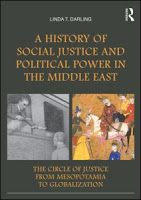


From ancient Mesopotamia into the 20th century, "the Circle of Justice" as a concept has pervaded Middle Eastern political thought and underpinned the exercise of power in the Middle East. The Circle of Justice depicts graphically how a government’s justice toward the population generates political power, military strength, prosperity, and good administration.
This book traces this set of relationships from its earliest appearance in the political writings of the Sumerians through four millennia of Middle Eastern culture. It explores how people conceptualized and acted upon this powerful insight, how they portrayed it in symbol, painting, and story, and how they transmitted it from one regime to the next. Moving towards the modern day, the author shows how, although the Circle of Justice was largely dropped from political discourse, it did not disappear from people’s political culture and expectations of government. The book demonstrates the Circle’s relevance to the Iranian Revolution and the rise of Islamist movements all over the Middle East, and suggests how the concept remains relevant in an age of capitalism.

Contents include: Mesopotamia: "That the Strong Might Not Oppress the Weak";
Persia: "The Deeds God Likes Best are Righteousness and Justice";
The Islamic Empire: "No Prosperity without Justice and Good Administration";
The Turks and Islamic Civilization: "The Most Penetrating of Arrows is the Prayer of the Oppressed";
Mongols and Turks: "Fierce toward Offenders, and in Judgements Just";
The Middle East in the Twentieth Century: "A Regime Can Endure with Impiety but not with Injustice".


I thank Routledge for a copy of this book.


Peri Roberts and Peter Sutch, An Introduction to Political Thought (Edinburgh: Edinburgh University Press, 2012).


This book tries in 340 pages to introduce to interested people a wide range of philosophies, from Plato and Aristotle to contemporary thinkers: Walzer, Kymlicka and Parekh. I let you decide whether the authors were successful in achieving their aim of providing a succinct analysis of the complicated philosophies.

I thank EUP for a copy of this book.


Monthly Poems


Our Life and Four Seasons

Birth years and spring days
how it all begins to liven up
we see the light of day
and spring begins to lighten our days

Summer days and younger years
days are longer and we are stronger
summer blooms with the warmth of the sun
we bloom with knowledge and love

The fall and mid age
Fall arrives and tries to hold on to the warmth
of the summer
we try to hold on, to our youth and knowledge
fall felt the heat of summer
and then starts to feel, the cold freeze of winter
Mid life seen the joy of youth and hopes
to see the old age of wisdom

Old age and winter
our steps are shorter
and so are the days
winter will end and so will we
to a new beginning and in time
Or
to the holy land
forever and ever amen

Vasco M. Resendes

Instants

If I could live again my life,
In the next - I'll try,
- to make more mistakes,
I won't try to be so perfect,
I'll be more relaxed,
I'll be more full - than I am now,
In fact, I'll take fewer things seriously,
I'll be less hygenic,
I'll take more risks,
I'll take more trips,
I'll watch more sunsets,
I'll climb more mountains,
I'll swim more rivers,
I'll go to more places - I've never been,
I'll eat more ice creams and less (lime) beans,
I'll have more real problems - and less imaginary
ones,
I was one of those people who live
prudent and prolific lives -
each minute of his life,
Of course that I had moments of joy - but,
if I could go back I'll try to have only good moments,

If you don't know - thats what life is made of,
Don't lose the now!

I was one of those who never goes anywhere
without a thermometer,
without a hot-water bottle,
and without an umbrella and without a parachute,

If I could live again - I will travel light,
If I could live again - I'll try to work bare feet
at the beginning of spring till
the end of autumn,
I'll ride more carts,
I'll watch more sunrises and play with more children,
If I have the life to live - but now I am 85,
- and I know that I am dying ...

Jorge Luis Borges

Gem of the Month – One Man, Two Guvnors

I LOVE theatre. Theatre is my greatest passion. And of all genres I prefer comedy. The problem, however, that good comedies are in short supply. There are many productions that present themselves as “comedies” but most of them are funny like a graveyard. I rather watch grass grow.

Thus, when there are rumours about comedies, I check them very carefully before I decide to take my chances.  One Man, Two Guvnors is a joy to watch. It is not particularly witty or refined, with the famous, dry, cynical British humour. If you insist on that, don’t bother. But if you are less picky and able to relish down-to-earth fun, this one is for you. One Man, Two Guvnors is very entertaining, with many scenes and lines in-your-face, so to speak. Not very elegant or sophisticated, but very effective.


Richard Bean, the playwright, was born in East Hull (one of the best known parts of the city, for the wrong reasons) in 1956. Bean took Carlo Goldoni’s The Servant of Two Masters (1746) and adopted it, with wild interpretation, to Brighton 1963. Bean’ s strength is in the portrayal of characters, and in setting the scenes. The characters are not deep or sophisticated. They are simple, black-and-white, easy to follow and understand. The blond is dumb. The lawyer wants money. The gangster relishes violence. The old waiter is old. The aspiring actor is aspiring. The confused servant is very confused. Everyone wants love and to be loved. Everything is melodramatic, stretched to absurdity, and old-fashioned fun.

I loved Nicholas Hytner’s impeccable production, the joy of the actors, their free spirited laugh, the unabashed slapstick, and the splendid 1960s music from “The Craze”. The band came onstage even before the show, in appropriate clothing, and continued to perform throughout.

I liked the way that the actors involved the audience, or were said to involve the audience. The confusion continues off-stage as well...

But above all, I truly and whole-heartedly enjoyed Owain Arthur’s performance as the lovable buffoon Francis Henshall, the confused servant who cannot decide whether he likes better: eating or making love, who finds himself for the first time in his life employed by two people who he thinks, quite wrongly, must be kept apart at all costs.

I warmly recommend. Two entertaining hours.

You can see some scenes, from another production, at
http://www.youtube.com/watch?v=0F_faR2yCeU


Light Side

I often feel guilty


Sheri, a pretty nurse took her troubles to a resident psychiatrist in the hospital where she worked. "Doctor, you must help me," she pleaded. "It's gotten so that every time I date one of the young doctors here, I end up sleeping with him. And then afterward, I feel guilty and depressed for a week."

"I see," nodded the psychiatrist. "And you, no doubt, want me to strengthen your will power and resolve in this matter."

"NO!!!" exclaimed the nurse. "I want you to fix it so I won't feel guilty and depressed afterward!"


Peace and love.

Yours as ever,

Rafi

My last communications are available on http://almagor.blogspot.com/
Earlier posts at my home page:
http://hcc.haifa.ac.il/~rca/

People wishing to subscribe to this Monthly Newsletter are welcome to e-mail me at r.cohen-almagor@hull.ac.uk
Follow me on Twitter at @almagor35


[1] For further discussion, see R. Cohen-Almagor (ed.), Israeli Democracy at the Crossroads (London: Routledge, 2005); Israeli Institutions at the Crossroads (London: Routledge, 2005), and “Israel and International Human Rights”, Encyclopedia of Human Rights, ed. Frederick P. Forsythe (New York: Oxford University Press, 2009), Vol. 3, pp. 247-257.

Monday, December 24, 2012

Politics – December 2012

Support is sought to facilitate the work of the Middle East Study Group. Information at http://www2.hull.ac.uk/fass/mestudygroup/informationfordonors.aspx

I also welcome promoting the two-state solution. See http://www.hull.ac.uk/rca/campaigns.html


If you support two-state solution, then you should support UN recognition in Palestine.

Words are far more effective than guns.

Wars should not replace words. They are the last resort after the failure of words.


~Raphael Cohen-Almagor


I continue my campaign for a two-state solution. I am getting invitations to travel to different parts of the world to speak before audiences, or to speak to people. That’s all very nice but without funding this is simply impossible. Peace, like any other precious commodity, requires investment and resources. If you are able to provide assistance, big or little, please contact me. My gratitude and appreciation are granted.

My most recent meetings were with NGOs in London, several members of the House of Lords, members of the Board of Deputies and the Jewish community in Britain, and senior diplomats at the Israeli Embassy in London.

My statement that the decision to accept the ceasefire was significantly influenced by the Likud primaries, set for November 25, 2012, received quite a lot of attention. To recall, at the start of the negotiations Israel demanded a lull for a period of more than 15 years; an immediate cessation of arms smuggling and the transfer of weapons to Gaza; cessation of rocket fire on the part of all armed Palestinian factions; and an end to attacks on soldiers near the Gaza border. The signed ceasefire agreement was a far cry from these demands.

The Likud primaries were held on time. It was riddled with controversies: the computer system malfunctioned; voters complained of deficiencies; one candidate spilled the beans by informing the press that people offered him their services for bringing votes; there were “elimination lists” and “recommended lists”; labour unions mobilized their workers to vote for their union’s candidate. Primaries yield populism. Populism yields corruption. Democratization, Likud style.

So populism pays. Extremism also pays. The more extreme you are, the better are your chances to get elected. Minister of Education, Gideon Saar, received more votes than any other candidate. I know him since his days as a clerk in the office of Legal Advisor to the Government and followed his impressive career ever since. Over the years, his views have become more and more extreme. It pays him well. Candidates who continue to espouse middle-of-the-road views (sort of) are not popular. The Likud Dream Team makes Avigdor Lieberman look pareve. What a Nightmare!

On November 27, 2012, Tzipi Livni announced her comeback to the political arena, establishing a new party called Ha'tnuah (The Movement). I wrote before that the wise decision for the Centre-Left camp, in order to pose a challenge for the Netanyahu-Lieberman camp, is for Livni to merge with Labour. What Livni-Yechimovitz did not learn Netanyahu has already forgotten. This is the difference between political professionals who understand what is required to win, and amateurs who do not deserve to win.
According to a poll conducted immediately after the Hamas-Israel War, or Operation Pillar of Defence (on November 23, 2012), MP Netanyahu more or less retains his position. Barak’s Atzmaut was just passing the threshold barrier and might have 4 seats in the Knesset. Barak was perceived as the “responsible voice” in the trio Netanyahu-Lieberman-Barak. Many voters wished to see him continuing his service in the security seat.

According to this poll and others conducted since then, the Likud-right bloc will have enough mandates to form a coalition. On November 23, 2012, 67 of the 120 Knesset seats (Likud-Beitenu 37, Jewish Home 9, Shas 14, Am Shalem of Haim Amsalem 3, and Atzmaut 4). According to last week’s poll, the right-orthodox bloc holds a lead of roughly 10 seats over the center-left, including Likud-Beitenu 39, Jewish Home 10, Shas 11, and United Torah Judaism 6.
The center-left parties are not gaining momentum. When combined, Kadima, Yair Lapid’s new party Yesh Atid, and Tzipi Livni’s Hatnuah do not reach the number of seats Kadima held in the previous elections (28). Taken together, the center, left and Arab parties have fewer seats (52 in our poll average) than in the current Knesset (55). The right continues to be on the rise both inside the right wing parties that become more and more extreme and an overall force in politics. A new party, Otzmah Le’Israel (Power to Israel), based on the ideology and activists of the racist banned party Kach, may enter the Knesset as well.
These are bad news for the peace camp. Indeed, these are bad news for Israel.

Reflections on November Newsletter
United Nations General Assembly Voted to Grant Palestine Non-member State Status
Palestinian Public Opinion Poll
Labour Primaries
Settlements
MP Diana Johnson
Newspaper Article on MP Netanyahu
Ehud Barak
2013 VICTOR J. GOLDBERG IIE PRIZE FOR PEACE IN THE MIDDLE EAST
My New Article
New Books
Gem of the Month
Movie of the Month
Monthly Poem
Light Side


Reflections on November Newsletter

I received some comments on the Mill article. I have been thinking about this issue -- individualism v. paternalism in Mill's theory -- for many years. The common interpretation of Mill as a liberal philosopher who accentuated autonomy and individualism always seemed far too simplistic as it does not reconcile with his elitism. Mill genuinely thought he knew better than most people what was good for them. His paternalism was striking considering that at the same time he was a modern liberal. At the end of the day, the distinction between "self" and "other" regarding conduct hardly holds water.

I was asked to explain Ehud Barak’s retirement from politics. Barak had three options. His first option was to run on the Likud list. It seems he was hoping that PM Netanyahu would secure him a place as a show of gratitude for his loyal service. PM Netanyahu had internal difficulties and after the merger with Israel Beitenu, this option became impossible. Lieberman likes Barak to the same extent, or less, than Barak appreciates him. Lieberman apparently made it clear that Barak is out.

Second option was to run together with Labour and/or Livni. Dov Weisglass, PM Sharon’s close advisor, tried to test the waters for Barak. The answer was an unequivocal NO. Barak has this unfortunate tendency to look at people from the height of his stature. For him, all others are midgets who should cherish the ground on which he walks. Those “midgets”, when Barak finally required their help, were reluctant to provide it. The “genius”, after all, can take care of himself. And he will.

The third option, and the least preferred, was to run alone with his tiny party “Atzmaut” and risk failing to pass the threshold line. Barak decided to relieve himself of the possible disgrace. He went home. More on Barak infra.


Professor Art Hobson wrote from Fayetteville:

Rafi - Thanks for your views about the latest violence.  I agree with you that Israel had to respond to the Hamas rocket attacks.  Such Hamas attacks must stop.  And I agree that Israel must look at the long term picture and find a solution that works for all sides, including the two Palestinian factions (West Bank and Gaza) and all of Israel (not just Bibi's conservatives).  Given Israel's current government, the only way I can see this happening is for President Obama to lean on Bibi to stop new settlement activity and work seriously toward a two-state solution.   Cheers - Art

Art Hobson, Emeritus Professor of Physics, U Arkansas, Fayetteville.  
See my liberal-arts physics textbook and other stuff at http://physics.uark.edu/hobson/.  


On 11/28/12, A., a UK journalist, wrote:

Dear Raphael,
We've never met so I'm not sure I'm qualified to advise. I have worked as a reporter for The Jerusalem Post, at a very tense time. With respect, and for what it's worth, I strongly advise against pushing the 2 state solution. Even now, Hamas is rearming. The Post has covered this, as have others. Iran is behind this, backed by Egypt, the Sudan, Hizb'Allah and others. If you create a Palestinian State on Israel's doorstep, it is political suicide. And not only political, but literal. The PLO Charter has never been revoked and calls for the destruction of Israel. How can you have such a state side by side with a tiny, vulnerable, peace-loving democracy? I KNOW that Israelis want and need peace. I UNDERSTAND that many feel this is the only solution. But it can't be. When the recent bombing happened on the bus in Tel Aviv, CITIZENS of Gaza were shouting 'Go back to Germany'. Can we please wake up to the spirit behind this thing? It is a Nazi spirit. You can't negotiate with that, unless you want to do what Chamberlain did. I DO feel for the Palestinian population, especially the children. I know what they are being taught and how they are being indoctrinated (see Palestinian Media Watch). But their perceived redemption cannot come at the expense of the Jewish State.
Yours very sincerely,
Amanda

On 11/29/12 I responded:
Dear A.

Thank you for writing. You air justified concerns. Israel needs to isolate Hamas, bypass Hamas, or engage with Hamas. Two-state solution is not perfect. But if you think it undermines Israel's best interests, you need to offer a better alternative. What is this alternative?

Best wishes

Raphael
On 12/1/12 Amanda wrote:
Dear Raphael,
I appreciate your knowledge and research. It is a really good point about the nature of Hamas as a partner, judging by the zero involvement of Fatah. It is interesting that the PA leadership also seemed completely powerless, necessitating Egypt's mediation. If Palestinian society is so fragmented, how is Israel to negotiate. Who, exactly, is the partner? If you compare with the challenges to the US and UK, namely al-Qaida, how much negotiation have we done? Between our SAS and the Mossad, I think your term 'isolation' is the most relevant. It isn't fair to expect more of Israel than any other Western democracy. It isn't fair to make her the scapegoat.
As for an alternative solution, I don't really know. All I know is that, historically, the Jewish homeland was already carved up, 77% I think being sacrificed to create Jordan. So for the second time, you are considering further division of the land. I know it is already divided. But I don't think Israel should become any smaller than it is already. The coastal plain now is only 7 or 8 miles wide. In addition, some of Judaism's holiest sites are in the West Bank. If over a million Arabs can be assimilated into Israel and be given citizenship, I don't see why others have to have their own state. I think the Palestinians should be given a choice: Accept Israel and become Israeli, or choose a Muslim state to identify with. There are enough of them! There has never been a Palestine historically; it was simply a name used by the Romans. Before '48 you had, of course, Palestinian Jews! I think negotiators like Tony Blair should understand the history, prior to 1917, including Balfour, the sacrifices already made and the wars won fair and square. Israel took the West Bank from Jordan in '67 legally. Palestinian claims on the land are false. I think it is extremely dangerous, however well meaning, to push the two-state solution. You may be interested in a documentary entitled 'The Forsaken Promise', covering the whole period of the British Mandate. I would be happy to order a copy for you, if you would like.
Good Shabas,
A
On 12/3/12 I replied:
Dear A
Egypt has been playing an instrumental role for many years. Its role is beneficial to Palestine, AND to Israel. Both sides need Egyptian involvement.

Israel should and must negotiate with the Palestinians, with any moderate element. Israel should either isolate Hamas, or strive to negotiate with Hamas, at first via mediators like Egypt, and then face to face. If you don’t talk to your enemies, you end up fighting with them. I prefer talking.

The struggle is so bitter because it concerns such a small piece of land. This piece of land thus becomes very important to both sides. Both want it. Both have justified claims over it. Both won’t give up without a fight. So are we doomed to fight forever?

I cannot settle for such a bleak future. The Israeli and Palestinian children deserve better.

You think the Palestinians should be given a choice: Accept Israel and become Israeli, or choose a Muslim state to identify with. Let’s explore the second option first. A recent Palestinian poll enquired how many Palestinians seek emigration. 16% “certainly seek to emigrate”; 18% “seek emigration”; 37% “do not seek emigration” and 29% “certainly do not seek emigration”. Suppose for a moment that 34% will emigrate. What about the rest?

Now we come to your first option: offer them to become Israeli. This is very generous of you. I should say that BOTH Palestinian and Israeli societies do not seek or wish this option. The Palestinians do not wish to become Israeli, as they have their own national aspirations, and do not identify with their enemy to such an extent as to wish to become one of them. This, I presume you agree, is certainly understandable. The Israelis, by erecting the Fence, declared a divorce. They do not wish to have many contacts with the Palestinians, wishing that they remain on the other side of the Fence. Moreover, Israelis realize that if you offer them the latter, it is only a matter of time for the Palestinians to become a majority. This will be the end of Israel as a Jewish state. While a minority of Israelis see no problem in that, the majority (including myself) wish to retain the Jewish character of the State. There is only one Jewish state in the world. It should remain.

So then we come to the third option, which you did not mention: the continuation of the occupation. Would you be willing to live under occupation? Is it a pleasing option for you and your children, and your children’s children? Why should the Palestinians concede to such an attractive proposition? They won’t.

In the Six Day War, Israel took advantage of its remarkable first strike and occupied Arab lands. There were no pre-war plans to take those lands, meaning no much thought was invested regarding the aftermath of that decision. No careful consideration was paid to the fact that the land did not come empty and desolated. These people deserve the same rights and liberties that you have, that I have, that we all wish to have. Any solution you wish to propose should take this into account. It cannot focus only on the best interests of the Israelis. A one-sided solution is not a solution. It is a recipe for continued violent confrontation.

I should also say that the occupation has negative effects on Israeli society. Soldiers who are in charge of the occupation cannot be occupiers “Dr Jekyll” and then in Israel “nice Mr Hyde”. It does not work this way. Human beings are not built this way. The occupation undermines Israeli democracy.

Yes, I’d be happy to receive a copy of 'The Forsaken Promise'. Thank you.

Best wishes
Rafi


United Nations General Assembly Voted to Grant Palestine Non-member State Status


On November 29, 2012, the United Nations General Assembly voted 138-9 to grant Palestine non-member state status. 41 members abstained.
“We are here for a final serious attempt to achieve peace,” Palestinian President Mahmoud Abbas told delegates before the vote. “Not to end the negotiation process ... rather to breathe new life into the negotiation process.” Abbas maintained: “I did not come here to de-legitimize a state established years ago, that is Israel. Rather we are here to affirm a state that must achieve its independence, and that is Palestine.”
Vuk Jeremic, president of the General Assembly, acknowledged the historical nature of the vote and called on Israeli and Palestinian leaders “to work for peace, negotiate in good faith and succeed.”
The Israeli government objected, saying that peace is only achieved through negotiations, and not by unilateral declarations that do not take into consideration Israel’s security needs.
The Israeli government is right, of course. Peace is indeed achieved through negotiations. Unilateral steps are not well received by the other party. Israeli pulled out from Gaza unilaterally. Abbas did not like it, for good reasons. See what the results were.
At the same time, if you wish to have negotiations, you must establish trust between the two sides and come to the table in good faith. Both trust and good faith won’t be achieved as long as Israel establishes new settlements, bolsters existing settlements, and taking away land from the Palestinians, shrinking its prospective boundaries.
Israel does not like the Hamas strategy – terror and violence. It does not like the Fatah’s strategy as well. Between terrorism and diplomatic efforts I support the latter wholeheartedly. This is exactly what people in the democratic world should do when they have a justified national aspiration. Israel should engage with Fatah in good faith and show expressed understanding that compromises must be made, that price for peace must be paid. The currency is clear: A viable Palestine in secure borders. Security is a mutual interest, to be established via collaboration and shared effort.

Palestinian Public Opinion Poll

The Palestinian Center for Policy and Survey Research (PSR) in the West Bank and the Gaza Strip conducted a public on a variety of subjects between 13-15 September 2012. I wish to share with you some interesting findings.

Self-perception
·         44% describe themselves as “Religious”;
·         50% “somewhat religious”;
·         5% not religious.
Peace
·         56% support the peace process;
·         25% oppose the peace process.
Findings show strong opposition (about 70%) to return to negotiations with Israel before it freezes settlement construction and accepts the 1967 lines with swap as a base for negotiations.
  • 52% support and 46% oppose the two-state solution;
  • 57% believe such a solution is no longer practical due to continued settlement expansion;
  • 71% believe that that the chances for establishing a Palestinian state alongside Israel in the next five years are slim to non-existent.
  • 69% oppose a one-state solution and only 30% support it.

Violent Struggle
59% oppose a return to an armed intifada; 39% support armed struggle.
32% support and 12% certainly support (combined 44%) armed attacks against Israeli civilians inside Israel (i.e., not in the West Bank and the Gaza Strip); 53% oppose such attacks (7% certainly oppose, and 46% oppose).

Leaders
President Abbas
46% are satisfied with the performance of Abbas. This approval rate is not bad compared to leaders in other parts of the world, including yours, my dear readers.
Satisfaction with Abbas increases in the West Bank (50%) compared to the Gaza Strip (40%).

Prime Minister Haniyeh
Positive evaluation of the performance of the Haniyeh government stands at 35%.

Prime Minister Fayyad
Positive evaluation of the performance of the Fayyad government stands at 22%. Fayyad is not a popular figure.

Popularity
The poll provided two scenarios for presidential elections:
  • Two candidates, Abbas and Haniyeh: In presidential elections between Abbas and Haniyeh, the former receives 51% of the vote and the latter 40%.
  • Three candidates, Abbas, Haniyeh and the former head of the Tanzim Marwan Barghouti, presently serving time in Israeli prison for his involvement in many terrorist attacks during the second wave of Palestinian terrorism (known as the second “Intifada”): Barghouti 45%; Haniyeh 29%, and Abbas 20%.
In other words, the majority of Fateh supporters prefer to see Barghouti as the leader of the Palestinian people. Some Hamas supporters agree.
Support for Fateh in the Gaza Strip stands in this poll at 40% and in the West Bank at 35%. Fateh is more popular than Hamas in Gaza.
Support for Hamas in the Gaza Strip stands in this poll at 31% and in the West Bank at 25%.
Interestingly, overall support for Fateh is 28%, and for Hamas is 16%. That means that the majority of the people, 56%, do not support either of these two parties. 39% do not support any party, while the remaining 17% smaller parties.

Democracy
Asked whether people in the West Bank can criticize the PA without fear, 42% answered in the affirmative; 54% in the negative, and 4% did not answer.
Compare these figures to Gaza: Asked whether people in the Gaza Strip can criticize Hamas without fear, 26% answered in the affirmative; 61% in the negative, and 13% did not answer.

Hamas-Fateh relationship
In light of the stalemate in the Fateh-Hamas reconciliation efforts, the largest percentage (42%) believes that unity will never be restored and that two separate entities will be established in the West Bank and the Gaza Strip; 14% believe that unity will be restored soon, and 40% believe unity will be restored but only after a long time.
This is quite a somber view. However, a year and a half ago, in March 2011, only 21% said unity will not be restored and two separate entities will be established.

Living conditions
Positive evaluation of conditions in the West Bank drops significantly from 30% last June to 19% in this poll. 60% say conditions in the West Bank are bad or very bad. 
Positive evaluation of conditions in the Gaza Strip rises from 22% to 25% while 52% say conditions are bad or very bad. Interestingly, more Palestinians evaluate conditions in the Gaza Strip as better than conditions in the West Bank.

Corruption
Perception of corruption in PA institutions in the West Bank reaches 79%. Interestingly, Gaza is not immune to corruption as well. Hamas’ “clean image” is defective, with 63% saying that the public institutions in the Gaza Strip are also corrupt.

Short-term goals
44% believe that the first most vital Palestinian goal should be to end Israeli occupation in the areas occupied in 1967 and build a Palestinian state in the West Bank and the Gaza Strip with East Jerusalem as its capital.
30% believe the first most vital goal should be to obtain the right of return of refugees to their 1948 towns and villages.
15% believe that it should be to build a pious or moral individual and a religious society, one that applies all Islamic teachings. Thus it seems that liberty and sovereignty are more important than religion.
11% believe that the first and most vital goal should be to establish a democratic political system that respects freedoms and rights of Palestinians.

Long-term goals
Asked whether the Palestinian long term goal is to recover the lands occupied in 1967 or alternatively to recover the land of 1948 and destroy the state of Israel, two thirds (66%) said that the long term goal is to recover all or parts of the 1967 territories; less than one quarter (24%) indicated that the goal is to defeat Israel and recover the 1948 land.
When asked about Israel's long term goal, more than 80% said it was to annex all lands occupied in 1967 and expel its population or deny them their political rights.

Syria
  • 79% support Syrian demonstrators against the regime;
  • 13% stand with the regime and Assad.

TV
·         The most popular TV station is Al Jazeera (39%);
·         Second popular is Palestine TV (18%);
·         Third popular is Al Arabia (14%).


Internet

·         45% have no email and do not visit social sites;
·         20% use the Internet on daily basis.

For further details, contact PSR director, Dr. Khalil Shikaki, or Walid Ladadweh at tel 02-296 4933 or email pcpsr@pcpsr.org.

Settlements

A day after the UN decision, the Israeli government authorized the building of  3,000 new housing units in the West Bank, outside the Green Line.
The Obama administration swiftly condemned the move as unhelpful. Senior officials expressed frustration that it came after Israeli officials had played down the importance of the Palestinian bid and suggested that they would only employ harsh retaliatory measures if the Palestinians used their new status to go after Israel in the International Criminal Court.
“We reiterate our longstanding opposition to settlements and East Jerusalem construction and announcements,” a spokesman for the National Security Council, Tommy Vietor, said. “We believe these actions are counterproductive and make it harder to resume direct negotiations or achieve a two-state solution.”
Secretary of State Hillary Rodham Clinton, in a Saban Forum speech on Friday night at a Washington hotel, criticized Israel’s decision to proceed with plans for construction without referring to any settlements directly by name. “These activities set back the cause of a negotiated peace,” Mrs. Clinton said.
Source: JODI RUDOREN and MARK LANDLER, “Housing Move in Israel Seen as Setback for a Two-State Plan”, NY Times (November 30, 2012), http://www.nytimes.com/2012/12/01/world/middleeast/israel-moves-to-expand-settlements-in-east-jerusalem.html?pagewanted=1&nl=todaysheadlines&emc=edit_th_20121201&adxnnlx=1354359932-9bqhigV6FDH0X8aZE3xSuA


Labour Primaries


The Israeli Labour Party held its primaries, electing fine people to its Knesset list. Hope they enjoy enough appeal to attract voters.

The List has a good mix of experienced parliamentarians and new faces, some of them quite young, leaders of the social justice movement. This is a list of peace-yearning people, able and intelligent.

Among the new faces are media personalities Merav Michaeli (ranked 5) and Miki Rosenthal (13); Stav Shafir of the social justice movement (9); military personality Omer Bar-Lev, son of former Chief of Staff Haim Bar-Lev (8); former chairperson of the Israeli Student Union Itzik Shmulli (12); former MK Kadima member Nachman Shai (15, congrats Nachman); police personality Moshe Mizrachi, renowned for his fight against corruption (16); and Professor Yossi Yona (21, congrats Yossi. Hope you will make it!).

Since the primaries, no. 3 Amir Peretz left Labour and joined Livni.

MP Diana Johnson

The Hull Middle East Study Group hosted MP Diana Johnson. MP Johnson reflected, in the main, on her summer journey to Jordan as part of a delegation of British parliamentarians who arrived at Amman upon the Court’s invitation. Jordan struggles with water and energy. Its economy is not technologically developed. Corruption is a problem.

MP Johnson was impressed with the King, and felt that he was well liked by his people. There is a wide support for the King, she exclaimed. At the same time, people wish to have reform and change while retaining the Kingdom.

MP Johnson was not impressed with the local parliamentarians she met. She described them as middle class, old men intent on smoking, who are not ideologically motivated and have very vague ideas on democracy. They, for instance, did not understand the need for objective information in order to shape and decide on policies. Her impression was that those parliamentarians  were quite content with their comfortable lives and did not wish to introduce any changes, changes that are, in her opinion, much needed.

Political parties cannot operate on university campuses. The MP delegation discussed with the King the need for grassroots political activity to involve the wider population in political processes. MP Johnson believes this is the key for democratization. She emphasized the need for a civil society, an open debate, capacity building, grassroots work for the development of democracy. She thinks that many ties need to be bolstered between parliament and society. As a Labour MP, she was surprised that no labour unionists were present in their meetings.

King Abdullah II bin Al-Hussein was concerned about the Moslem Brotherhood. He wishes to ascertain that the Islamic Action Front, Jordan's main Islamist political party, founded in 1992 as the political arm of the Jordanian Muslim Brotherhood, will not receive more than a certain quota of the vote. As in Israel, Jordanian elections are scheduled for January 2013 (in Israel on 22; in Jordan 23) and King Abdullah wishes to exert his power to ensure that the Islamic Action Front will not get too strong.

The Hashemite Kingdom relies on the tribal vote. While the tribes support the King, the Palestinians support reform and Moslem parties.

Jordan is a beautiful country. Tourism is developed and more can be done to develop tourism further.

MP Johnson reflected also on Syria, saying that there is a genuine agreement in parliament not to have another Iraq. There is a shared reluctance to get involved in another country’s affairs. While William Hague resents Russia and China for their stand on Syria, there is  not much that Britain is intent on doing to help the rebels in Syria. At the same time, MP Johnson noted that Britain is one of the major donors to the humanitarian help in Syria.

As for the Israel-Palestinian conflict, MP Johnson believes that two-state is the preferred solution. She hopes President Obama will involve his administration more in seeking that solution and establishing peace between the two rivals.


Newspaper Article on MP Netanyahu

I was contacted by a reporter of Life Week. This is the most widely circulated news magazine located in Beijing, China. The magazine’s circulation is about 250,000 per week. The reporter published an article on Prime Minister Benjamin Netanyahu and I was asked to comment on a few questions:

11 月25 日,这所位于加沙的由联合国开办的学校在以色列空袭中遭到巨大损坏。图为空袭结束后,巴勒斯坦人开始清扫学校

1.            In 1996, Netanyahu beat Peres, the prestigious Prime Minister in the election by a narrow margin. It surprised many people. Why could he win at that time?
Shimon Peres lost the elections more than Netanyahu won them. Peres lost the 1996 elections because he remained aloof from reality. He spoke of three glorious years; of the New Middle East; of “victims of peace” – a new and frivolous Orwellian oxymoron. I tried to alert Peres but his busy schedule did not allow time for a meeting. I then published an article in Yedioth Ahronoth, arguing that terror is terror is terror.[1] Peres’ bid for the prime minister’s office was further hampered by the bombing of the Lebanese village of Kfar Qana that resulted in dozens of innocent casualties,[2] and the failed TV debate with Benjamin Netanyahu. The electorate decided to bring change. First and foremost, they wanted security and thought that Peres and his illusions of peace were misguided. Netanyahu hit hard on the security issue and became prime minister.

2.       What is your comment on Netanyahu’s first term from 1996 to 1999? What were his biggest mistakes?

Netanyahu Government (1996-1999)
When Netanyahu came to power, deadlock was inevitable. Both Arafat and Netanyahu wanted similar things for their nations: the greatest possible territory at the expense of the other. Both leaders believed that the other side understood only force and neither leader trusted the other, for good reasons.

Netanyahu tried to halt everything. In the following three years in office almost nothing was agreed upon. The negotiations for the final status settlements that were scheduled to take place according to the Oslo Accords did not even start. Steadfastly opposed to peace, Netanyahu perceived the PLO as a terrorist organization, resisted Palestinian and American pressures, and made it clear that his priority was to achieve security, not peace. The promised second and third phases of withdrawal and redeployment were long overdue and the settlements, in turn, continued to expand. On January 15, 1997, however, Netanyahu succumbed to pressure when he signed the Hebron Agreement regarding the evacuation of Hebron.[3] This was too little. Palestinian frustration and mutual suspicion grew bitterly and Israeli standing in the international community eroded.
Netanyhau’s government did not complete its term in office. The Wye Agreement opposed by some elements in his coalition and the prime minister’s personal behavior became an issue. His lack of judgment, poor handling of internal schisms, wrong choices of people, poor management, scandals, all brought Netanyahu’s government to an end in less than three years. He had to pay the price of his failures and Ehud Barak came to power in May 1999.


3. Netanyahu got into a corruption scandal in 1999. He said he thought he was finished in 1999. But he came back to power again. He is poised to become the longest-serving Israeli Prime Minister since David Ben-Gurion, the founding father of Israel. Why could he come back to center of the political scene? What are his most important political advantages?

Netanyahu is a seasoned politician. After his disastrous term in government, he moved aside because he had no other option. His popularity was so low. But he is a person who craves power. He loves it. So he moved aside when Sharon became the uncontested leader, and rebuilt his position within the party system, meeting people, organizing, creating deals, establishing commitments.  Netanyahu is very charismatic and charming. He has a leader’s qualities, he is clever (but not wise), has political zeal and immense ambition.

4.       Netanyahu is always a hawk. In your analysis, what are the differences of his performance in his second term as PM from his first term from 1996 to 1999? If he does have changes, what make he change, the domestic politics, the foreign relationship or himself?

Netanyahu learned a few lessons. He is far more careful now than he was younger. He knows he is very ambitious, and now he learned to restrain himself. I think this is the first difference that you see between the two terms in office. How does this translate practically? He does not let his hedonistic inclinations to take over. There are no corruption rumours lurking above his head. He learned to distance himself from the media when it comes to personal life. His wife is not in the limelight. His children are older and ceased to be the “pride and joy” of the family.  Netanyahu retains his qualities as an astute politician, very involved in party affairs, guarding his back. He moved more to the right of spectrum, bolstering loyalties with the ultra-orthodox, with Shas, with the settlers who are for him true pioneers. And he used powerful, rich friends to buy the Israeli media and move public opinion to his side.

5.       It seems it is always not easy for U.S. to keep relations with Netanyahu. In your opinion, how does Netanyahu think about the U.S.? And what is his strategy to deal with the U.S.?

Netanyahu lived in the US for many years. He knows the country and its culture very well. His English is as good as his Hebrew. I would say that he is more articulate in English than in Hebrew. He is a wonderful orator, very charismatic and very successful in delivering a message. He connects with his audience well. Netanyahu knows that the US is Israel’s greatest ally. He wishes Israel to remain a very close ally of the Americans.

At the same time, there are fundamental differences between his worldview and Obama’s. While Netanyahu wishes to secure the largest possible Israel at the expense of the Palestinian aspirations, Obama believes that the only way to the security of the region is compromise, two-state solution. Netanyahu is not willing to pay the price for peace. He is committed to peace only verbally, not practically. Only a few weeks ago, two more settlements were established in the West Bank. I will write about this soon on my blog, http://almagor.blogspot.co.uk/

6.       How did Israeli public and society change from his first term to his second term?

The Israeli public now is more hawkish, to the right of the spectrum. During the 1990s, the difference between right-wing coalition and left-wing coalition was 2-4 mandates (Knesset seats). Now the difference is 6-8 mandates. The entire political map moved to the right. The prime reasons are that in violent times, political agenda is often dictated by extremists. Violence feeds violence. You will find many Israelis who sincerely believe that “Arabs understand only the language of force and violence”. Years of terrorism and wars (2006, 2008-2009, 2012) pushed people to the right. Second, the Russian immigration to Israel, which is wonderful, productive and positive in many respects, is also patriotic, nationalistic, with strong emphasis on land (Russia is the largest country in the world. Land is of great importance). Third, Netanyahu controls large sectors of the media. His media promotes nationalism, the idea of Greater Israel, security concerns. Security precedes peace aspirations by far.

7.       Netanyahu is a tough guy, but his career is full of strategic retreats: He said he wouldn't sign an agreement with Arafat, but he did. He said wouldn't give back West Bank land, but he did. He said wouldn't agree to the concept of a Palestinian state even on paper, but he has. What are the decisive factors for him to compromise?

Netanyahu is a very opinionated leader, with strong and defined views. The world is crystal clear to him, and he never rushes to admit mistakes. At the same time, his prime motivation is to retain power. Thus, the very few compromises that he made vis-a-vis the Palestinians were only when he had, in his calculations, no other option. He made a very few and very small compromises.

8.       In your opinion, is he an ideology motivated politician or a pragmatic one?

To depict Netanyahu as a pragmatist is a joke.
Netanyahu is not a pragmatist like Menachem Begin who withdrew from Sinai or like Ariel Sharon who withdrew from Gaza; he is not driven by a sense of history, as Begin was, and his realpolitik is based on different principles than Sharon’s. Netanyahu’s philosophy is based on the following components:
• Israel should take care of itself. No other country will go out of its way for Israel. The world is busy. Countries have other priorities. We are the only people who understand our needs, appreciate our difficulties, and will be there for us in time of trouble.
• Therefore, Israel needs to be strong. Very strong. Our enemies will restrain themselves in the face of a strong Israel.
• Strength is manifested also by a strong economy which is founded on capitalist interests, bringing wealth to the nation, and retaining it. This means keeping the economic elite happy, and bringing in external investments. 
• Israel is a very small country, surrounded by hostile neighbours. It should not be smaller than it already is. Therefore, we should retain our territory, build in it, settle it, and we need to help those pioneers, those wonderful people who are willing to conquer new lands, and establish facts in the land. These people truly care for Israel and its destiny.
• The Palestinians have severe problems. They should strive to solve them, possibly with the help of the Arab world, but not at the expense of Israel.
• Some of their problems are the result of Israel’s presence in the occupied territories. This is granted. But these problems are the result of their terrorist behavior. They should first prove to us that they had deserted terror. Once they do, Israel will be happy to relax the pressure. We don’t enjoy pressuring the Palestinians. We do it out of necessity to retain our strength and secure our people.
• The UN is not to be trusted. It is biased toward the Muslim and Arab world, with dozens of representatives in the UN, against one tiny Israel.
• The European Union is biased. It is driven by economic interests, by its own concerns vis-a-vis the growing Muslim presence in the continent, by geopolitical interests in which Israel features as a problem. Some argue that Europe is anti-Semitic. Europe should prove otherwise.
• Israel should retain its special relationship with the USA. We should be attentive to any American administration’s demands, with reason, communication, and mutual understanding of their respective needs.

This set of principles allows very little scope for concessions and for pragmatism. The Palestinians will not be satisfied with what is offered. At best, the region is at a standstill as far as peace is concerned. At worse, things will escalate into yet another bloody confrontation. Iran, with its offshoots (Hezbollah in Lebanon, Hamas in Gaza and the West Bank), will make things messier and volatile.


9.       Will he win the coming election? It seems he has a great chance and there is no one strong enough to beat him. Why?

I explained above why the left-peace camp is weak. In addition, the peace camp lacks a charismatic leader who could challenge Netanyahu. According to a poll conducted immediately after the Hamas-Israel War, or Operation Pillar of Defence (on November 23, 2012), MP Netanyahu more or less retains his position. Barak’s Atzmaut is now passing the threshold barrier and may have 4 seats in the Knesset. Barak is perceived as the “responsible voice” in the trio Netanyahu-Lieberman-Barak. Many voters wish to see him continuing his service in the security seat.

According to this poll, the Likud-right bloc will have enough mandates to consolidate a coalition. On November 23, 67 of the 120 Knesset seats (Likud-Beitenu 37, Jewish Home 9, Shas 14, Am Shalem of Haim Amsalem 3, and Atzmaut 4). This is bad news for the peace camp.

I added that I wish China will see to itself to get involved in the Israeli-Palestinian conflict. We need more players on the scene, in addition to the US. But China needs to have the will to do this, as a super-power intent to shape world peace and security, and it needs to posit itself as an unbiased mediator, credible power that enjoys trust of both sides. China’s present position on Iran and Syria is very problematic.

I’d be happy to send the original newspaper article, in fluent Chinese, to interested parties.


Ehud Barak
On November 26, 2012, Israeli Defense Minister Ehud Barak announced that he was leaving politics and would not run in the January 2013 parliamentary elections.
The surprise announcement snuffed out speculation that Barak might unite with other centrist candidates to challenge PM Netanyahu in the election.
A former prime minister and army chief of staff, Barak said he felt that he had “exhausted my involvement in politics” and wanted to devote more time to his family and “allow others to assume senior positions in Israel.”
“I will end my term as defense minister with the formation of the next government in about three months,” he said.
Barak was noncommittal when asked whether he would be willing to serve as defense minister as an outside appointee to the cabinet in the next government, widely expected to be led by Netanyahu.
Barak said that the issue had not been discussed, and that he would respond to that question after the elections.
If I were to believe him, I would have posted a farewell photo (-:. However, we have been in this movie before. Barak had already retired from politics once. It seems he is following the model of Israel’s first prime minister, David Ben-Gurion, who retired from politics a few times, always happy to return when others called upon him while emphasising how indispensable he was for the country. As you may know, Barak appreciated Ben Gurion to a great extent. Thus, I would not put too much confidence in this second retirement. I would be very surprised if Barak were to disappear into oblivion.

2013 VICTOR J. GOLDBERG IIE PRIZE FOR PEACE IN THE MIDDLE EAST

We would greatly appreciate your assistance in publicizing this Prize to anyone you know who may be eligible, or who may be interested in nominating others. Please send any questions or comments to goldbergprize@iie.org.

The Institute of International Education (IIE) awards the Victor J. Goldberg IIE Prize for Peace in the Middle East annually to recognize outstanding work being conducted by two individuals, one Arab and one Israeli, working together to advance the cause of peace in the Middle East. The two individuals whose work is judged to be the most successful in bringing people together and breaking down the barriers of hatred toward "the other" share a $10,000 prize. The winners are selected by a prestigious international selection committee.

“While there is no magic solution, one positive force may be to encourage people to live and work
together at the grass roots, learning to trust and depend on one another for their common good.”
— Vic Goldberg, IIE Trustee

Eligibility
To be eligible for the Prize, at least one of the nominated individuals must be an alumna/us of any program administered by IIE, or any exchange program funded by IIE's sponsors and administered by another organization.

Alumni of the following IIE‐administered programs, among others, are encouraged to apply: Fulbright Programs, Hubert H. Humphrey Fellowships, International Visitor Leadership Program (formerly International Visitor Program, or IVP), State Department Middle East Partnership Initiative, Scholar Rescue Fund (SRF), Ford Foundation International Fellowship Program, Ford Foundation Global Travel and Learning Fund, and training programs funded by the U.S. Agency for International Development.

Fulbright alumni and alumni of the Israel Arab Scholarship Program whose grants were administered by AMIDEAST are also eligible. Similarly, individuals who came to the United States under funding from the Ford Foundation or as part of the International Visitor Leadership Program are eligible even if they were participating in a program coordinated by another organization.

About the Institute of International Education
The Institute of International Education is a world leader in the international exchange of people and ideas. An independent, nonprofit organization founded in 1919, IIE has a network of 17 offices worldwide and over 1,000 member institutions. IIE designs and implements programs of study and training for students, educators, young professionals and trainees from all sectors with funding from government agencies, foundations, and corporations. IIE also conducts policy research and program evaluations, and provides advising and counseling on international education and opportunities
abroad.


My New Article


“Is Law Appropriate to Regulate Hateful and Racist Speech: The Israeli Experience”, The Israel Studies Review, Vol. 27, Issue 2 (Winter 2012), pp. 41–64.

This article examines the tension between liberalism and Orthodoxy in Israel as it relates to censorship. The first section aims to explain Israel’s vulnerability as a multicultural democracy in a hostile region, with significant schisms that divide the nation. The next section presents the dilemma: should Israel employ legal mechanisms to counter hate speech and racism? The third section details the legal framework, while the fourth reviews recent cases in which political radicals were pros­ecuted for incitement to racism. The final section discusses cases in which football supporters were charged with incitement after chanting “Death to Arabs” during matches. I argue that the state should consider the costs and risks of allowing hate speech and balance these against the costs and risks to democracy and free speech that are associated with censorship.

KEYWORDS: Arabs, bigotry, education, football, freedom of expression, hate, incitement, Israel, laws, racism, tolerance


The article is available on my website, http://www.hull.ac.uk/rca/articles.html


New Books


Michael Cox and Doug Stokes, US Foreign Policy (Oxford: Oxford University Press, 2012).


This highly informative text book is divided into five sections: historical perspective; institutions and processes; the USA and the world; key issues, and the future of US foreign policy. Each of the 23 chapters is written clearly by a different scholar. The book is up-to-date and relevant, very accessible to students and others who are interested in US foreign policy.

Chapter 12 concerns US foreign policy in the Middle East. Four pages are dedicated to Israel. US-Israel relationships are explained as the result of historical, ideological and political considerations: (1) empathy to the Jewish people following the Holocaust; empathy to the young country situated in a hostile region that wishes its destruction.
(2) perceived similarities: both USA and Israel are immigrant countries, the pioneering spirit, democratic values. Various forms of Christianity support Israel for religious reasons.
(3) Israel has been a staunch ally of the US. During the Cold War, while the Arab states allied themselves with the Soviet Union, Israel and the USA had tightened their relationships. There is mutual trust.
(4) Domestic-electoral calculations. Israel has a very well organized lobby in the Capitol. As a group, Jews have one of the highest voter turnouts, with 89% living in electorally key states.

I thank OUP for a copy of this book.


Russ Shafer-Landau (ed.), Ethical Theory: An Anthology (West Sussex: Wiley-Blackwell, 2013).


This is a very good collection of essays presenting different approaches in ethical theory. It provides a window to the big names in ethics, and to contemporary scholars. The anthology is divided to the following parts:


Pt. 1. The status of morality
pt. 2. Moral knowledge
pt. 3. Why be moral? –- includes writings by Plato, Feinberg, Rachels and Wolf
pt. 4. Ethics and religion -- includes writings by Plato, Kant and Adams
pt. 5. Value -- includes writings by Mill, Nozick and Parfit
pt. 6. Moral responsibility -- includes writings by Taylor, Ayer, Nagel and Strawson
pt. 7. Moral standing -- includes writings by Kant, Feinberg and Tooley
pt. 8. Consequentialism -- includes writings by Mill, Smart, Hare and Harris
pt. 9. Deontology -- includes writings by Kant, O’Neill, Nozick, Foot and Thomspn
pt. 10. Contractarianism -- includes writings by Hobbes, Rawls and Scanlon
pt. 11. Virtue ethics -- includes writings by Aristotle, Nussbaum and Annas
pt. 12. Feminist ethics -- includes writings by Gilligan, Baier and Walker
pt. 13. Prima facie duties and particularism.


This is an extensive volume, with 82 chapters and 800 pages. It may serve all those who study and teach ethics.


I thank Wiley for a copy of this book.


Gem of the Month

Leda, By Leonardo

Ten Drawings by Leonardo da Vinci
From the Royal Collection
A Diamond Jubilee Celebration
10 November 2012 – 20 January 2013.

Leonardo is one of the greatest people in human history. Thus I was excited to hear that some of his art has come my way. The Ferens Art Gallery is the only Yorkshire venue to host this exciting exhibition, which includes some of Leonardo da Vinci’s drawings. The ten drawings reflect the artist's use of different media and his extraordinary range of interests from painting and sculpture to engineering, botany, mapmaking, hydraulics, and anatomy. The exhibition includes designs for chariots fitted with flailing clubs, a study of the head of Leda, a drawing of oak leaves, a double-sided sheet of anatomical sketches, a design for a scheme to drain marshland, a view of a river from a window, a costume study of a man on horseback, apocalyptic scenes, and a rough study of an old man in profile, which is one of the last drawings made by the artist.

The Royal Collection, one of the world's greatest art collections, is held in trust by The Queen for her successors and the nation. For more information visit www.royalcollection.org.uk
Ferens also holds an exhibition of Andy Warhol's stitched photographs, if you are into pop culture. Three rooms are filled with some of Warhol’s well-known documents of American society plus a documentary film with foggy photography and terrible sound, not sure whether this was intentional or just crappy work... See http://www.digyorkshire.com/%28S%28m1gbqo553dwrwj2kh5qbkkjk%29A%28ZbOE6ljtzQEkAAAAMGM2OTgzOGItNzZmYy00NTMxLTkzNTktMzcyZTc0MzE4OTBmHBsmv5mxd3ObIVCa5Mnd9z6wBlc1%29%29/EventListing.aspx?event=68651&pdate=28/11/2012&name=Andy+Warhol+%281928+-+1987%29+ARTIST+ROOMS+at+Ferens+Art+Gallery++in+Hull&AspxAutoDetectCookieSupport=1#.UMSoZHe0N50

Movie of the Month

Terry Pratchett: Choosing to Die
This is a TV documentary on the right to die with dignity. Sir Terry Pratchett is a well-known UK novelist who suffers from Alzheimer's and explores alternatives at the end of life.
The program captured the assisted death of Peter Smedley, 71, who suffered from motor neuron disease, at Swiss suicide clinic Dignitas. Pratchett flew to the clinic to see the assisted suicide methods first-hand. Pratchett has publicly voiced his support for legalising assisted suicide as he was diagnosed with early-onset Alzheimer's disease in late 2007.
The film has been awarded an International Emmy.

I was impressed by two remarkable and noble individuals who are the heart and soul of this film: Terry Pratchett and Peter Smedley. I was very touched by Mr Smedley, a courageous, fine individual; strong-minded, autonomous, considerate, self-assured, articulate, polite until the very last moment. Mr Smedley typifies the perfect gentleman. May his soul rest in love and peace.
You can watch this moving film in full on YouTube: http://www.youtube.com/watch?v=slZnfC-V1SY


Monthly Poem


Song Of The New Year

I heard the bells at midnight
Ring in the dawning year;
And above the clanging chorus
Of the song, I seemed to hear
A choir of mystic voices
Flinging echoes, ringing clear,
From a band of angels winging
Through the haunted atmosphere:
'Ring out the shame and sorrow,
And the misery and sin,
That the dawning of the morrow
May in peace be ushered in.'

And I thought of all the trials
The departed years had cost,
And the blooming hopes and pleasures
That are withered now and lost;
And with joy I drank the music
Stealing o'er the feeling there
As the spirit song came pealing
On the silence everywhere:
'Ring out the shame and sorrow,
And the misery and sin,
That the dawning of the morrow
May in peace be ushered in.'

And I listened as a lover
To an utterance that flows
In syllables like dewdrops
From the red lips of a rose,
Till the anthem, fainter growing,
Climbing higher, chiming on
Up the rounds of happy rhyming,
Slowly vanished in the dawn:
'Ring out the shame and sorrow,
And the misery and sin,
That the dawning of the morrow
May in peace be ushered in.'

Then I raised my eyes to Heaven,
And with trembling lips I pled
For a blessing for the living
And a pardon for the dead;
And like a ghost of music
Slowly whispered--lowly sung--
Came the echo pure and holy
In the happy angel tongue:
'Ring out the shame and sorrow,
And the misery and sin,
And the dawn of every morrow
Will in peace be ushered in.'

James Whitcomb Riley

Light Side

Trouble sleeping

The woman seated herself in the psychiatrist office. "What seems to be the problem?" the doctor asked.

"Well, I, uh," she stammered. "I think I, uh, might be a nymphomaniac."

"I see," he said. "I can help you, but I must advise you that my fee is $80 an hour."

"That's not bad," she replied. "How much for all night?"


With my best wishes for a very Happy New Year to you and your loved ones, a year of good health, of small magical moments, of new hopes and accomplishments, filled with sweet surprises, Love, Joy and Happiness.
Merry Christmas, Peace and Tranquility with your loved ones,


Yours as ever,

Rafi

My last communications are available on http://almagor.blogspot.com/
Earlier posts at my home page:
http://hcc.haifa.ac.il/~rca/

People wishing to subscribe to this Monthly Newsletter are welcome to e-mail me at r.cohen-almagor@hull.ac.uk
Follow me on Twitter at @almagor35

---
[1]               Raphael Cohen-Almagor, "Call terror by its name”, Yedioth Ahronoth (March 5, 1996) (Hebrew).
[2]               Operation Grapes of Wrath was launched on April 11, 1996, aimed to destroy the Hezbollah positions in South Lebanon which were used to launch rockets on Israel. On April 18, Israeli shell-fire fell on a UN base in Kfar Qana, where many Lebanese refugees took refuge. 102 people, including many women and children, were killed. See YNET (January 8, 2006), http://www.ynetnews.com/articles/0,7340,L-3284744,00.html
[3]              See Kirsten E. Schulze, “The Hebron agreement”, Mediterranean Politics, Vol. 2, Issue 1 (Summer 1997): 201–205. See also Sara Roy, “Why Peace Failed: An Oslo Autopsy”, Current History, Vol. 101, Nr. 651 (2002): 8-16.