Thursday, November 28, 2013

Politics-November 2013

Support is sought to facilitate the work of the Middle East Study Group. Information at http://www2.hull.ac.uk/fass/mestudygroup/informationfordonors.aspx

I also welcome promoting the two-state solution. See http://www.hull.ac.uk/rca/campaigns.html


French President François Hollande in the Israeli Knesset: Peace will be your greatest victory.


John Kerry: "Some NSA spying went too far".
I wonder what "too far" means...
Apparently short-distance-spying is kosher...


Good News for MESG
MA scholarships in the School of Politics, Philosophy & International Studies
Peace Negotiations
Settlements, More Settlements
Anti-Semitism in the US
French Court Orders Ban on Anti-Semitic Books

Insulin Warnings
Israeli Scientific Innovations
Visitors to the University of Hull
My New Article
Book Review - Yigal Kipnis
New Books
Monthly Poem
Light Side
Monthly Movie – Captain Philips ****1/2 


Good News for MESG

The Hull Middle East Study Group has received further support of £20,000 to promote Middle East studies in the University.

We are now trying to raise £15,000 for the organization of an international peace conference with leading decision-makers in May 2015. All help is much appreciated.


MA scholarships in the School of Politics, Philosophy & International Studies

To celebrate the University's research successes, the University of Hull is offering 3 MA scholarships of £10,000 each in the School of Politics, Philosophy & International Studies.


The scholarships are for students applying for an MA in International Politics, with an emphasis on Middle Eastern Studies.

Closing date for applications: 11 January 2014. Interviews will be held in February 2014. Successful applicants will be informed of the award by 29th March 2013. Scholarships will start in September 2014.

For inquiries contact: Professor Raphael Cohen-Almagor
Chair in Politics
School of Politics, Philosophy and International Studies 
The University of Hull           
Cottingham Road
Hull, HU6 7RX
United Kingdom       
T: +0044 (0)1482 465024
F: +0044 (0)1482 466208


Peace Negotiations

Up until now, representatives of Israel and the Palestinian Authority (PA) have met fifteen times. Upon Israel’s request, most of the meetings revolved around security issues. There were also some discussions on borders and water.

According to Israeli media, Israel’s starting point on borders is that the future Palestinian state will be within the Separating Barrier (known also as The Fence, or The Wall) and that there will be Israeli presence in the Jordan Valley. This is less than what Israel has offered to the Palestinians since Oslo, September 2013. No one has any illusions that this would lead to peace.

The Palestinians remain party to the negotiations due to American requests. Martin Indyk, an experience peace negotiator, fully realizes that this is a non-starter. The writing on the wall is very clear.


Settlements, More Settlements

Peace is a precious commodity. It demands sacrifices. The peace process has continuously failed because Arafat turned a blind eye on terrorism, because Hamas believes in terror as a way to resolve the conflict, and because Israel is determined not to pay the price for peace and continues the settlement building unabated.
On October 30, 2013 Israel announced plans to build hundreds of new settlement homes on land that the Palestinians want for a future state, hours after it released a group of Palestinian prisoners from its jails.
Israel's Interior Ministry said 1,500 housing units will be built in Ramat Shlomo, a settlement for mainly Ultra-Orthodox Jews established in East Jerusalem in 1995.
In a bid to appease right-wing coalition members angered by the amnesty for 26 Palestinian inmates, government officials had said that housing projects would be part of settlements that Israel plans to keep in any peace deal.
Israel counts Ramat Shlomo as part of its Jerusalem municipality and says the city will remain its eternal, indivisible capital.
The Palestinian Authority announced that it was “seriously studying” filing immediate complaints against Israel with international courts and forums in a bid to halt construction in West Bank settlements and east Jerusalem neighborhoods.


Anti-Semitism in the US

The Anti-Defamation League published a survey on indicating that 12% of Americans hold deeply anti-Semitic opinions.

A significant percentage, 26%, held the age-old attitude that Jews are responsible for the killing of Jesus Christ.


French Court Orders Ban on Anti-Semitic Books

A court near Paris has ordered the withdrawal from distribution of five books for anti-Semitic content.

“The Anthology of Quotes against Jews, Judaism and Zionism” by Paul-Eric Blanrue was ordered to be withdrawn from sale within a month by the court.

Other books banned for distribution include historic anti-Semitic texts such as “La France Juive” by Edouard Drumont and “The International Jew” by Henry Ford.

The book’s publishing house and well-known far-Rightist Alain Soral were ordered to pay a fine of 8,000 Euros to the International League Against Racism and Anti-Semitism (LICRA) who brought the case to the court.

Read the full article at Le Point: http://www.lepoint.fr/livres/des-ouvrages-antisemites-interdits-13-11-2013-1756703_37.php


Insulin Warnings

I am getting consistent warnings about the use of insulin, with increasing evidence that it results in internal bleeding. I wish to raise caution about the use of this medication.

Always inquire about its potential side-effects and the availability of alternative medication. Sometimes insulin is unavoidable for specific conditions. Then make sure that the prescription of insulin does not contradict other medications you take, and that it is indeed the most suitable medication for your condition.


Israeli Scientific Innovations

You can watch some of the recent Israeli exciting health innovations on


Visitors to the University of Hull


MESG - 'The Peace Process -- where to?'

The Middle East Study Group (MESG) will host His Excellency Ambassador Professor Manuel Hassassian, Palestinian Authority Ambassador to the UK, who will speak on "The Peace Process -- where to?".


Born in Jerusalem, Ambassador Hassassian pursued his higher education in the USA, lectured at Bethlehem University and became the University Executive Vice President. He also served as the President of the Rectors' Conference of the Palestinian Ministry of Higher Education, and President of the Palestinian-European-American Cooperation in Education (PEACE) program.

Wednesday 20 November, 16:00
Wilberforce LT12

RSVP: Marianne Lewsley-Stier, m.lewsleystier@hull.ac.uk


Is it legitimate to ban hate speech?

Professor Eric Barendt


The legitimacy of hate speech bans is one of the hardest questions for liberal democracies to resolve. Can extreme hate speech be restricted without interfering with free political discourse?

Eric Barendt, Emeritus Professor of Law, UCL, is an internationally renowned expert on media law. He was Goodman Professor of Media Law at UCL from 1990 until 2010. Before coming to UCL, he lectured law at St. Catherine’s College, Oxford. Professor Barendt is the author of many important books and articles on media law, the laws of libel and privacy, and freedom of expression, most notably Freedom of Speech (2nd edition: Oxford University Press, 2005). His most recent book is Academic Freedom and the Law (Hart, 2010). Professor Barendt is also the editor of the Journal of Media Law.

Thursday 21 November, 16:00-18:00
Wilberforce LT12

RSVP: Marianne Lewsley-Stier, m.lewsleystier@hull.ac.uk


MESG - “The Arab Spring and Its Impact on the Middle East and World Order”

The Middle East Study Group (MESG) will host former Israeli Deputy Prime Minister, Mr Dan Meridor, who will speak on “The Arab Spring and Its Impact on the Middle East and World Order”.


Born in Jerusalem, Mr Meridor has had a distinguished career in Israeli politics. Among his many duties he was Minister of Finance, Minister of Justice, Minister of Intelligence, Minister in charge of strategic affairs, Chairman of the Foreign Affairs and Defense Committee of the Knesset, and Secretary of the Cabinet.

Wednesday 18 December, 16:00
Wilberforce LT 29

RSVP: Marianne Lewsley-Stier, m.lewsleystier@hull.ac.uk


My New Article

"In Internet's Way: Radical, Terrorist Islamists on the Free Highway", International Journal of Cyber Warfare and Terrorism, Vol. 2(3) (2012), pp. 39-58. The article was published in September 2013.


Abstract
The article is opened with definitions of terms utilized throughout the article. Terrorism is defined as the threat or employment of violence against noncombatant targets for political, religious, or ideological purposes by sub-national groups and/or clandestine individuals who are willing to justify all means to achieve their goals. Terrorist conduct is designed to attract attention to the terrorist’s cause and to spread fear and anxiety among wide circles of the targeted population. Subsequently I analyse how terrorists use the Internet, and what can be done to counter their activities. The Internet is used to disseminate information, for propaganda, indoctrination, networking, psychological warfare, socialization, motivation, fund raising, spreading tactics, recruitment, planning activities and coordination. As the Internet became a major arena for modern terrorists, we need to devise appropriate methods to forestall their activities and establish security.

Keywords: al-Qaeda, terror, jihad, e-jihad, encryption, counter-terrorism

The article is available on my personal website,  http://www.hull.ac.uk/rca/articles.html

Part of this article was published on The Jerusalem Post


Book Review - Yigal Kipnis

Yigal Kipnis, 1973, The Way to War (Or Yehuda: Dvir, 2012, Hebrew), 365 pp. 94 NIS. DANACODE 1-0006719.

Israel Affairs, Vol. 19, No. 3 (2013), pp. 580-582.


Previous research on the Yom Kippur War tended to emphasise the wrong intelligence concept that mislead the decision-makers in Israel and had blinded their eyes. This fascinating new book reiterates this conclusion but adds another factor that for Kipnis is no less important: diplomatic misconception.
The book is based on archival research in Israel and the United States. It provides ample evidence that the war drums were loud and clear, yet a day before the outbreak of the war, on 5 October 1973, the Israeli decision-makers thought that the likelihood for war was low (pp. 216-229). They all ignored the clear signs:
·         The Egyptian army was in a battle positions; artillery and tanks were mobilized to the Suez Canal; anti-aircraft weaponry was intensified; equipment to pass the Canal was brought forward;
·         The Syrian army was in a battle positions; artillery and tanks were mobilized.
·         Families of the Soviet “advisors” left Egypt.
·         Ashraf Marwan, Israel’s moll inside President Sadat’s chamber, met with the Head of Mossad Zvi Zamir on 5 October 1973, and warned that war was likely to start the day after.
·         King Hussein flew to Tel Aviv twice during the months leading to war and warned Israel that Syria and Egypt were coordinating a massive attack on Israel.
Why, then, Israel ignored those clear signs? Why its leaders misread the picture and thought there was low likelihood for war?
Kipnis poses this question and attempts in this book to provide answers. His thesis is that Israel relied heavily on Ashraf Marwan to warn them in time, and on US Secretary of State Henry Kissinger to use his leverage and engage with the Egyptians in order to find a political solution. This over-reliance on Marwan and Kissinger had failed Israel. When push came to shove, both failed to deliver.

Why did Israel rely so heavily on Marwan?
Marwan married Gamal Abdel Nasser’s daughter, Mona. He was well connected to the Egyptian elite and was made Chief of Staff to Anwar Sadat. Marwan was the one who contacted the Mossad in 1969, not vice versa, a fact that should evoke suspicion. Indeed, it did (p. 256), but Marwan delivered high quality documents that had shed important light on Egypt’s decision-making processes -- military and political -- that he was able to convince even the most suspicious people in Israel of his credibility.
In April 1973, Marwan warned the Mossad that Egypt and Syria would launch a surprise attack against Israel on 15 May; it proved a false warning, and Israel lost $35 million while under the subsequent heightened state of alert. Marwan again met with Zamir on the eve of the Yom Kippur War, warning that Egypt and Syria were once again preparing to attack at sunset (p. 266). This warning was somewhat correct: The Egyptians actually attacked around 2:00 p.m., giving them four "head start" hours.

Why did Israel rely so heavily on Kissinger?
Kissinger maintained close contacts with Prime Minster Meir. He served Israeli interests by engaging with Egypt and delaying political processes, as Meir asked. Kissinger is quoted saying that due to him the political processes were frozen for twenty months (p. 112).
Kissinger had troubled relations with Secretary of State Rogers. They did not see eye to eye. In the battle between the two, Kissinger gained the upper hand. Rogers left the State Department in September 1973 and Kissinger replaced him as he wanted. According to Kipnis, Kissinger asked Meir for assistance in receiving the Congress approval for his nomination. Meir was happy to comply (p. 130). After the nomination, Kissinger surprised Simha Dinitz, Israel’s ambassador to Washington, by asking who Israel preferred to be nominated as his assistant for Middle East affairs (p. 145). The relationships between Kissinger and Israel were that close.
Thus, the Israeli leaders believed they had a loyal and powerful friend in the White House, someone who would rush to help in case of need. However, they failed to realize that powerful as Kissinger was, he was not the sole actor; there were other objective factors that Israel had to take into consideration.
In June 1973, President Sadat realized that the diplomatic arena was just a facade, that Israel was not interested to engage in genuine peace negotiations, and that Kissinger did not play with honest, impartial cards (p. 135). Then he had set his lot on violence.
The Israeli trio, known as “Golda’s Kitchenette”, which consisted of Prime Minister Golda Meir, Defence Minister Moshe Dayan, and Meir’s close advisor Yisrael Galilee, did not wish to engage in peace talks because they did not wish to pay the price. They did not want to return Sinai to the Egyptians. Their tactics was to delay, buy time, and create facts on the ground. In September 1973, the Israeli government approved the decision to build the town of Yamit in north Sinai. Thus, they heard and understood Sadat’s clear signs to engage in peace talks but were not interested (p. 199).
As both Marwan and Kissinger were positioned in strategic points of influence and delivered so skilfully, the trio thought that in crisis time Marwan will provide an adequate warning, and Kissinger will swiftly intervene to avert danger (p. 169). The trio relied on the IDF to win the war if required. They were self-assured, complacent and cocky. The air battle of 13 September 1973 between the Israeli and the Syrian air-forces that ended with 13 MiGs on the ground against one Israeli Mirage down only increased Israel’s self-confidence (p. 173). Israel thought that Syria would never attack alone, and that Sadat would exhaust the diplomatic avenue before going to war. But whereas Sadat reached the conclusion that that avenue was exhausted without achievements, somehow PM Meir and Defence Minister Dayan believed that there was still room for diplomatic maneavours (pp. 180, 198, 224). In other words, Israel failed to read the map, failed to understand Sadat, failed to see that he grasped Israel’s delaying tactics and decided to put Israel to the test.

Kipnis highlights the objective factors that influenced the Israeli decision-making process:
a)     There were only three major decision-makers in Israel (p. 161). Prime Minister Meir trusted Dayan on military issues. Galilee had more experience and insights into military affairs then Meir but he allowed Dayan to have the last word. As all humans are prone to err, it is unwise to place such responsibility on one human being, even on a great military personality of the stature of Moshe Dayan. Dayan, like many leaders, had great confidence in himself, and little confidence or appreciation of others. He liked to talk and to decide far more than he liked to listen and to act in concert with others (pp. 197-198, 208, 222). Meir’s little kitchenette of three people suited him just well. He was quite happy to take upon himself many responsibilities, but he did not take into account the possibility of making a mistake. He, with many others, learned the hard way. Israel lost some 2,650 soldiers.
b)      Kissinger was appointed Secretary of State on 21 September 1973. During the crucial days before the outbreak of the war, he was preoccupied with initial preparations for his big role. After all, he was US Secretary of State, not Israel’s.
c)      Elections were due in Israel on 30 October 1973. All Israeli politicians entered a pre-election phase, fighting for their political careers (p. 157). They were preoccupied with internal affairs and war did not suit their plans. Thus, they conveniently assumed that Sadat will wait until a new government would assume office in Jerusalem. They were sure that Sadat won’t open war prior the elections and wait to see whether there would be personal changes in the Israeli government which might make exploring the diplomatic option viable. Sadat, however, did not wish to wait. He understood that Israeli leaders were preoccupied with elections and made the most of their predicament.
d)      And there was the dubious role of Marwan. He warned Israel a few times before that war was imminent (p. 259). When you cry Wolf several times with no wolf, your credibility is eroding. The Crying Wolf tactics worked wonderfully for the Egyptians. Marwan, in every warning, added the proviso that Sadat might rethink and cancel everything. He said the same thing also on 5 October (p. 260). The decision-makers did not wish to call the reserves yet again, separating thousands of men from their families and their work places, just to realize it was, yet again, a false alarm. They were convinced that in any event the IDF had the ability to destroy the Egyptian and Syrian armies swiftly as it did in 1967.

Kipnis’ meticulous analysis provides fascinating insights and valuable information on the Israeli decision-making process leading to the 1973 War, on the relationships between some of the key leaders, and on the relationships between Israel and the United States. This book is rich with data, important and engaging. It is a must read for scholars, students, and policy makers who wish to understand the pitfalls leading to 6 October 1973, when 500 Israeli soldiers had to face 80,000 Egyptian soldiers.


I thank Yigal Kipnis for a copy of his book.

The book was recently (2013) published also in English.


New Books

Dona J. Stewart (ed.), The Middle East Today: Political, Geographical and Cultural Perspectives (London: Routledge, 2013), 2 ed.
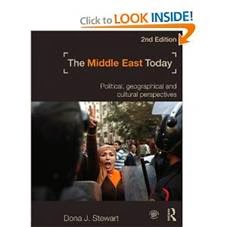
 The new edition of The Middle East Today provides an accessible and comprehensive introductory textbook for undergraduate students of Middle East Studies, Middle East politics and geography. This updated and revised edition features a host of pedagogical features to assist students with their learning, including; detailed maps and images, case studies on key issues, boxed sections and suggestions for further reading.

The book highlights the current issues facing the Middle East, linking them to the rich political, geographical and cultural history of the region. The author examines the crises and conflicts, both current and potential, likely to dominate the region in coming years.

The second edition has been fully updated and revised to include discussion of such recent events as:
·         the effects of the Arab Spring
·         Turkey’s growing influence in the region
·         the dramatic increase in Iran’s nuclear capabilities
·         Usama bin Laden’s death and declining support for violent extremist movements in the Middle East.
The book has concise article on diverse topics. It can provide background information for undergraduate students. If you are looking for in-depth analysis, look elsewhere.

I thank Routledge for a copy of this book.


Steven Foster, Political Communication (Edinburgh: Edinburgh University Press, 2010).

This is a succinct, very useful book for teaching undergraduate media studies. Although it is mainly concerned with the British media, some parts of it are relevant also to other media.


The book opens with a detailed analysis of political communication today and its impact on parties, pressure groups, and government. It then places media politics within a constitutional context, addressing open government and freedom of expression, freedom of information, privacy, human rights, and the manipulation of the media by government. There are useful chapters on political advertising, spin doctors, media effects and elections, media ownership and media freedom. The book is written in a clear and concise language, clarifies basic terms and key issues and for each and every chapter suggests themes for discussion.

I thank EUP for a copy of this book.


Monthly Poems

Few singers in the world have the powerful voice of Céline Dion. I am a fan of singers with great voices and listening to Dion singing Ne Me Quitte Pas is, quite surprisingly, even more touching and emotional than the original Jacques Brel’s performance.

Dion refused to sing this song for many years as she found it too heavy to bear.

and
and


Ne Me Quitte Pas


Ne me quitte pas.
Il faut oublier.
Tout peut s'oublier
Qui s'enfuit deja.
Oublier le temps
Des malentendus
Et le temps perdu
A savoir comment
Oublier ces heures
Qui tuaient parfois
A coups de pourquoi
Le coeur du bonheur.
Ne me quitte pas.
Moi je t'offrirai
Des perles de pluie
Venues de pays
Ou il ne pleut pas.
Je creuserai la terre
Jusqu'apres ma mort
Pour couvrir ton corps
D'or et de lumiere.
Je ferai un domaine
Où l'amour sera roi,
Où l'amour sera loi,
Où tu seras reine.
Ne me quitte pas.
Ne me quitte pas.
Je t'inventerai
Des mots insensés
Que tu comprendras.
Je te parlerai
De ces amants-là
Qui ont vu deux fois
Leurs coeurs s'embraser.
Je te raconterai
L'histoire de ce roi
Mort de n'avoir pas
Pu te rencontrer.
Ne me quitte pas.
On a vu souvent
Rejaillir le feu
De l'ancien volcan
Qu'on croyait trop vieux.
Il est paraît-il
Des terres brûlées
Donnant plus de blé
Qu'un meilleur avril.
Et quand vient le soir,
Pour qu'un ciel flamboie
Le rouge et le noir
Ne s'épousent-ils pas ?
Ne me quitte pas.
Ne me quitte pas.
Je ne veux plus pleurer,
Je ne veux plus parler.
Je me cacherai là
A te regarder
Danser et sourire
Et à t'écouter
Chanter et puis rire.
Laisse-moi devenir
L'ombre de ton ombre,
L'ombre de ta main,
L'ombre de ton chien.
Ne me quitte pas.


Don't leave me
We must forget
All can be forgotten
Which is already fleeing away
To forget the times
Of misunderstanding
And the lost times
To know how
To forget those hours
Which sometimes killed
With blows of "Why?"
The heart of happiness
Don't leave me (4x)
I will offer you
Pearls of rain
Come from lands
Where it doesn't rain
I will dig the earth
Until after my death
To cover your body
With gold and light
I will make a realm
Where Love will be law
Where Love will be king
And you will be queen
Don't leave me (4x)
Don't leave me
I will invent for you
Senseless words
Which you will understand
I will speak to you
Of those lovers
Who have twice seen
Their hearts ignite
I will tell you
The story of that king
Dead of not having
Been able to meet you
Don't leave me (4x)
It has often been seen
For fire to erupt again
From the extinct volcano
That was thought too old
There are, it seems,
Scorched lands
Yielding more wheat
Than the best April
And when the evening comes
For the sky to blaze
Do the red and the black
Not marry?
Don't leave me (4x)
Don't leave me
I will weep no more
I will speak no more
I will hide myself there
To watch you
Dance and smile
And listen to you
Sing and then laugh
Let me become
The shadow of your shadow
The shadow of your hand
The shadow of your dog
Don't leave me
Don't leave me
Don't leave me
Don't leave me


A Calendar of Sonnets: November


This is the treacherous month when autumn days
With summer's voice come bearing summer's gifts.
Beguiled, the pale down-trodden aster lifts
Her head and blooms again. The soft, warm haze
Makes moist once more the sere and dusty ways,
And, creeping through where dead leaves lie in drifts,
The violet returns. Snow noiseless sifts
Ere night, an icy shroud, which morning's rays
Willidly shine upon and slowly melt,
Too late to bid the violet live again.
The treachery, at last, too late, is plain;
Bare are the places where the sweet flowers dwelt.
What joy sufficient hath November felt?
What profit from the violet's day of pain?

Helen Hunt Jackson


Light Side

James changed his job and was required to relocate to another city. As a good Englishman, first thing once he was settled was to visit the local pub. While drinking his favourite beer, he saw a gentleman climbing on one of the tables, beer in his hand, cheerful smile on his face. That man said: 56, and all the pub crowd burst in laughter. Once they relaxed a bit, the gentleman uttered: 87, to which the crowd rolled on the floor with laughter.

James looked around with puzzlement, then asked one of the cheerful guys what’s on earth is going on. The man explained: We, the locals, numbered all the jokes, and we know them by heart. So the guy on the table does not need to repeat the jokes. He simply says the numbers, and we know which joke he has in mind.

James was impressed. It took him over a year to memorize all the local jokes and then, one evening, he climbed on the table, beer in his hand, cheerful smile on his face, and uttered: 45. The crowd was dead silent. James tried again: 66. Nothing. James: 103. Silence.

Baffled, James sat down. After collecting himself he asked one of his mates: What’s happened? Why didn’t you laugh?
To which the mate answered: Some people know to tell jokes; some don’t. You don’t.


Monthly Movie – Captain Philips ****1/2 

Captain Philips is Fantastic. In 2009, U.S. container ship Maersk Alabama was hijacked by a crew of Somali pirates. The movie tells the story, focusing on the ship captain’s ordeal in the hands of his desperate captives who are depicted as having two options in life: to fish or to become criminal. Tom Hanks is one of the greatest ever, a classic actor. He reminds me of Gregory Peck, Cary Grant and Henry Fonda. Hanks has been my favourite actor for the three decades.


The last part of the movie in the life boat is griping, taking you by the balls; you will have difficulty blinking, and breathing. Hanks is in one word, superb. Yet another Oscar performance.

Kudos to the Director Paul Greengrass for his wonderful work. He made the ordeal a vivid experience and gave Hanks one of the best roles of his acting career.

Kudos for the production team (Michael De Luca Productions, Scott Rudin Productions, Translux and Trigger Street Productions) for making this cinematic experience. Not many production companies in the world are able to execute such an expensive and thoughtful production. Attention to detail was meticulous. Hollywood at its best.

If you like dramatic, tense films, based on true stories, and you love cinema, this one for you.


Captain Philips returned to sea a year later.

****/0.5 on Rafi's scale. Rush.


Wishing you the very best for this festive season of warmth, light, friendship and togetherness.

Peace and love.

Yours as ever,

Rafi


My last communications are available on http://almagor.blogspot.com/
Earlier posts at my home page:
http://hcc.haifa.ac.il/~rca/

People wishing to subscribe to this Monthly Newsletter are welcome to e-mail me at r.cohen-almagor@hull.ac.uk

Follow me on Twitter at @almagor35

Sunday, November 03, 2013

Politics – October 2013

Support is sought to facilitate the work of the Middle East Study Group. Information at http://www2.hull.ac.uk/fass/mestudygroup/informationfordonors.aspx

I also welcome promoting the two-state solution. See http://www.hull.ac.uk/rca/campaigns.html


Academic institutions are established to transmit and enrich our knowledge and our understanding of phenomena. To do this they must distinguish between valid ideas and illogical, nonsensical, baseless ideas and bad ideas (such as racism). Thus, universities cannot protect a broad, abstract concept of marketplace of ideas.

~Raphael Cohen-Almagor


Two State Solution
Reflections on the September 2013 Newsletter
Iran
Question: Iran’s Obsession with the Holocaust
Amos Oz Won the Franz Kafka Prize for 2013
Nazi War Criminal Erich Priebke died in Italy aged 100
My Republished Article
Euthanasia in the Belgium
Book Review - Ilan Peleg and Dov Waxman
New Books
Monthly Poems
Light Side


Two State Solution

I have sent Abe Silverman two of my articles on two-state solution whose principles are:

Palestinian sovereignty – will be declared and respected.

Mutual recognition – Israel shall recognize the State of Palestine. Palestine shall recognize the State of Israel.

Mutual diplomatic relations – Israel and Palestine shall immediately establish full diplomatic relationships with each other, installing ambassadors in the capital of the respective partner.

Capital – each state is free to choose its own capital.

Borders – These should be reasonable and logical for both sides. Former military intelligence chief Amos Yadlin explained: “Having a border is the best security arrangement.”[1]  Settling the conflict would give Israel greater international legitimacy to fight terrorism and enable it to deal with the more serious emerging threat from Iran.
Israel will withdraw to the Green Line, evacuating settlements and resettling the settlers in other parts of the country. The major settlement blocs -- Ma’ale Adumim, Givat Ze’ev, Gush Etzion, Modi’in Illit and Ariel –- which account for approximately 70% of the Jewish population in the West Bank and for less than 2% of its size, may be annexed to Israel upon reaching an agreement with the PA of territorial exchange that will be equal in size.[2] Border adjustment must be kept to the necessary minimum and must be reciprocal. At the Taba talks, the Palestinians presented a map in which Israel would annex 3.1 percent of the West Bank and transfer to the PA other territory of the same size.[3] Beilin said that they were willing to concede Israeli annexation of three settlement blocs of at least 4 percent of the West Bank.[4] Prime Minister Olmert offered Palestinian President Abbas a similar or even slightly better deal but Abbas did not reply positively.

Territorial contiguity – a corridor would connect the West Bank and the Gaza Strip to allow safe and free passage. The road will be permanently open and solely Palestinian. No Israeli checkpoints will be there. Palestinians will not be able to enter Israel from this corridor, nor shall Israelis enter Palestine from the corridor. 

The Security Barrier creates a political reality. It should run roughly along the 1967 mutually agreed borders.

SecurityPalestine and Israel shall base their security relations on cooperation, mutual trust, good neighborly relations, and the protection of their joint interests.[5] Palestinian sovereignty should be respected as much as possible. Checkpoints will be dismantled. Only the most necessary control and early-warning posts will remain, subject to review and necessity agreed upon by both sides. The Palestinian state will be non-militarized. This issue was agreed upon in 1995. Also agreed upon were joint Israeli-Palestinian patrols along the Jordan River, the installation of early warning posts, and the establishment of a permanent international observer force to ensure the implementation of the agreed security arrangements.[6] The early warning posts will be periodically visited by Israeli security officers but they won’t be permanently present on Palestinian soil. If there is a need for a permanent presence, this would be trusted to an agreed-upon third party.

Safe passage – There will be a safe passage between the West Bank and Gaza, with no Israeli presence or checkpoints. The safe passage will be under Palestinian sovereignty and control. Palestine will ensure that this safe passage won’t be abused for violent purposes. Such abuse would undermine peace and trust between the two parties.

Jerusalem – What is Palestinian will come under the territory of the new capital Al Kuds. Al Kuds would include East Jerusalem [what about the massive Jewish neighborhoods in East Jerusalem? Ramot, Pisgat Zeev, French Hiill etc??] and the adjacent Palestinian land and villages. Abu Dis, Al-Izarieh and Al-Sawahreh will be included in the Palestinian capital. The Israeli capital would include West Jerusalem and the adjacent Israeli settlements. To maintain Palestinian contiguity, Israel may be required to give up some of the settlements around Arab Jerusalem. The Old City will be granted a special status. Special arrangements and recognition will be made to honour the importance of the Western Wall and the Jewish Quarter for Jews, and similarly special arrangements and recognition will be made to honour the importance of the Islamic and Christian holy places. The Old City will be opened to all faiths under international custodianship. There will be Israeli-Palestinian cooperation in providing municipality services to both populations.

Haram al-Sharif – On March 31, 2013, a Jordan-Palestinian agreement was signed between the PA and Jordan, entrusting King Abdullah II with the defense of Muslim and Christian holy sites in Jerusalem.[7] While Jordan may be a party to any agreement concerning the site, a broader arrangement is welcomed. As agreed by Abbas and Olmert, it will be under the control of a five-nation consortium: Palestine, Israel, Jordan, Saudi Arabia and the United States. The Waqf will continue its administration. Jews will enjoy right of access. Excavation for antiquities may be undertaken only with the full agreement of both sides. Similarly, alterations to the historical structures and foundations can be made only upon the consent of both sides.

Water – The UN secretary-general has said that Palestinians “have virtually no control” over the water resources in the West Bank, with 86 percent of the Jordan Valley and the Dead Sea under the de facto jurisdiction of the settlement regional councils.[8] Israel and Palestine should seek a fair solution that would not infringe the rights of any of the sides and will assure that the Palestinian people will have the required water supply for sustenance and growth.[9]

Fishing – Israel and Palestine will enjoy fishing rights in their respective territorial waters.

Terrorism and violence – Israel should remain steadfast on its demand of the Palestinians to fight terrorism. Zero tolerance in this sphere. Both sides will work together to curb violence. Both sides will see to it that their citizens on both sides of the border reside in peace and tranquility. Zealots and terrorists, Palestinian and Jews, will receive grave penalties for any violation of peace and tranquility. The Palestinians, apparently, fail to understand the gravity of terrorism and are willing to accept it as part of life. Nabil Shaath said: “The option is not either armed struggle or negotiations. We can fight and negotiate at the same time, just as the Algerians and the Vietnamese had done”.[10] Democracies, however, see things differently. On this issue there should be no compromise.

Incitement – Both sides need to clean up the atmosphere, fight bigotry, racism, incitement and hate on both sides of the fence/wall. This includes a close study of the education curricula in both the PA and Israel. Both sides need to overhaul their school books, excluding incitement, racism, bigotry and hate against one another.[11] The curricula should reflect a language of peace, tolerance and liberty. Both sides should utilize the media to promote peaceful messages of reconciliation and mutual recognition.

Education – Israel and Palestine will institute a shared curriculum on good neighborhood, understanding cultures and religions, respect for others and not harming others. This education program will commence at the kindergarten and continue at primary and high schools. In every age group vital concepts for understanding the other will be studied. This program is critical for establishing peaceful relationships and trust between the two parties.

Language – Starting in primary schools, Arabic will be a mandatory language for pupils to study in Jewish schools. Similarly, Hebrew will be a mandatory language for pupils to study in Palestinian schools. Language is the most important bridge between different cultures and nations. Israeli will master Arabic to the same extent that they presently master English. Palestinians will master Hebrew as their second language.

Prisoners – As an act of good will, part of the trust-building process, Israel will release a number of agreed upon prisoners. With time, as trust will grow between the two sides, all security prisoners will return home.

Refugees and their right of return – This is a major concern for both Palestine and Israel. For Palestinians, this issue is about their history, justice and fairness. For Israelis, this is a debated issue, where many Israelis are unwilling to claim responsibility for the Palestinian tragedy and most Israelis object to the right of return as this would mean the end of Zionism. The issue is most difficult to resolve as the original refugee population of an estimated 700,000-750,000 has grown to 4,966,664 refugees registered with UNRWA at the end of November 2010. About 40% of the refugees live in Jordan, where they comprise about a third of the population; another 41% are in the West Bank and Gaza, 10% are in Syria, and 9% are in Lebanon. In the West Bank, refugees constitute about one-third of the population while in Gaza they comprise over 80% of the population.[12]
                Israel and the PA have been arguing endlessly about this issue as a matter of principle without examining by surveys how many of the refugees and their families actually intend to return to Israel if this option were available to them. What needs to be done is to identify the population, establish the numbers, and after mapping the refugee population conduct a survey among them that would include the following options:
Return to Israel;
Return to the West Bank;
Return to the Gaza Strip;
Emigrate to third countries that would commit to absorbing a certain quota (appeal will be made to countries that receive immigration on a regular basis to participate in this settlement effort);
Remain where they are.
The 1948 Palestinian refugees will be able to settle in Palestine. The rest of the world is legitimate to set immigration quotas for absorbing Palestinians who apply for settlement in their designated choice of country. Unification of families should be allowed in Israel on a limited annual quota. But massive refugee return to Israel will not be allowed. This dream should be abandoned. When Abu Mazen was asked whether he insisted on getting back Safed, where he was born, he replied: “It’s my right to see it, but not to live there”.[13] I suspect that Abu Mazen’s view reflects the view of many Palestinians who seek recognition, apology and compensation, not the right of return. Thus Israel should recognize the Nakba, acknowledge Palestinian suffering, and compensate the 1948 refugees and their children (but not grandchildren) for the suffering inflicted on them. An international tribunal of reputable historians and international lawyers, including equal representatives of Israel and Palestine, will determine the level of compensation. If needed, Israel may establish an international relief fund to which humanitarian countries that wish to see the end of the conflict contribute. I believe that between Israel, Europe, the Moslem World, North America and other countries of good will (the Geneva Accord mentions Japan; I would add China, Australia and Brazil), the required funding can be secured. The United Nations and the World Bank may also be approached to offer assistance.

Economic Agreements - Israel and Palestine will consider opportunities for economic cooperation for the benefit of both societies, aiming to capitalize on the potential of both, to optimize resources and coordinate efforts. Israel would help Palestine develop independent economy and open doors for Palestine in the Western world and elsewhere. Palestine will pave the way for Israel’s integration into the Middle East as an equal member in the community of neighbouring countries. Palestine will help Israel develop economic, industrial, tourist and other relationships with the Arab and Muslim countries.

International Commerce – Israel and Palestine will be free to conduct international commerce as they see fit. In order to develop trust between the two parties, some level of transparency about logs of commerce will be agreed and memoranda of understanding will be signed by the two parties.

Tourism – Israel and Palestine will coordinate efforts in promoting tourism to the region, via collaboration with neighboring countries, in order to facilitate cultural and religious experiences that are unique to this region.

Communication and Media – Mutual channels of communication will be opened on television, radio and the Internet. These media channels will transmit their broadcast in two or three languages: Arabic, Hebrew and possibly also English. Communication and language are important for the development of good neighborly relations.

Termination of the conflict – following the signing of a comprehensive agreement covering all issues and concerns, an official statement will be issued declaring the end of the Israeli-Palestinian conflict.

International Arbitration – Difficult issues that won’t be resolved by direct negotiations will be delegated to a special arbitration committee. This special committee will have an equal number of Israeli and Palestinian delegates plus an uneven number of international experts. The committee will include lawyers, economists, human rights experts and experts on the Middle East. Their resolutions would be final, without having the right of appeal. Both Israel and Palestine will commit to accept every decision of the arbitration committee. One model to follow might be the arbitration committee comprised to resolve the Taba dispute between Israel and Egypt.


Reflections on the September 2013 Newsletter

Several people commented on my obituary of Edmund Pellegrino:


Professor Rosalie Ber wrote:

Shalom Rafi,
Your September newsletter brought me the sad news of Pellegrino's demise.
I was fortunate to have spent a 10 days course on Medical Ethics at Georgetown University in the early 90's and was one of his admirers, having had very interesting discussions with him. He was the really ideal role model for medical students, interns, residents and specialists alike.
I have one of his books and have used it often when teaching medical students.
You were lucky to have had so many opportunities to meet with him.
hag Sameach

Rosalie


Professor Shimon Glick wrote:

Rafi

Thanks for that beautiful and moving obituary for Ed Pellegrino who was a most unusual great individual. Your description was so true to the reality
Best regards
Shimon


Dr Miri Talmon brought to my attention:

"Palestinian and Israeli artists have a common destiny" interview with Mr. Anan Barakat http://www.childrenofpeace.org.uk/news5.html


Dr Yoav Tenembaum wrote:

Rafi,

Very interesting Newsletter!

The letter by Y. Frankental is moving. I have heard him on several occasions. I don’t always agree with him, but he is an interesting person who should be respected for his relentless endeavours in his search for peace.

The story told by Ephraim Halevy about his first encounter with King Hussein is interesting. I knew about his special relationship with King Hussein, though I was unaware of the circumstances in which he first met him.

Incidentally, Halevy came to speak to us, at the Diplomacy Program at TA University. He was interesting, but surprised us when he received a phone call on his cellular phone and decided to answer it, in the middle of his talk. I thought it was an emergency. No, it wasn’t. He was waiting for a phone call from a TV producer in order to be interviewed. Israelis tend to behave in a peculiar manner when it comes to cellular phones, but Halevy’s example was quite singular.

I liked your poem!

All the best and Hag Sameah!

Yoav


Abe Silverman wrote in response to my two-state articles:

Sept 23/13
Chag Samai'ach
Thank you for the reminder of the history of the conflict and the failure to reach an agreement and peace.
What struck me and reminded me as I read through your accurate account of the failed attempts to reach an agreement is how much Israel has always been ready to give and how often the Arabs said no. And setting aside the character flaws of Rabin, Netanyahu, Sharon and Olmert it is clear that they all did their best to reach a 2 State solution. The failure in my opinion was not theirs. It was and is the Palestinian leadership that is not serious about a 2 state solution. And the strong evidence of that is their unwillingness to recognize Israel as a Jewish state as envisioned in the 1947 UN Partition Plan. To recognize Israel as a Jewish State is to give up their dream of one day returning Israel to Holy Muslim land.
So please let me give you my opinions regarding your Conclusions on page 573 and I will number the points for easy reference.
We must start with number 1 because without it I don't believe that and agreement will ever be reached.
(1) A 2 State solution must be based on 1 State of Israel the Jewish homeland and 1 State of Palestine the homeland of the Palestinian People. I don't believe that the Palestinians will agree.
(2) Palestine will be established in the West Bank and Gaza will not be a problem
(3) Establishing an agreed to recognized International Border I see as not insurmountable.
(4) Removing most settlements should not be a large problem. Israel has already shown it's willingness to trade land for peace.
(5) I can't see the realigning of the Security Barrier as being a problem
(6) Territorial Contiguity not a big problem
(7) Security. The Palestinians will never agree to be demilitarized and will never agree to Israel having any control over their borders. And Gaza has taught Israel that they must have the right to control what is brought into Palestine.
(8) Jerusalem is a problem but not insurmountable.
(9) All water issues can be resolved
(10) Terrorism and Violence agreement can be reached
(11)  Incitement of Arab youth, big problem and will continue until Islam decides to deal with that problem. We in the West will never be able to change the hearts and minds of those who have already been indoctrinated to hate. And their numbers are staggering.
Can a 2 State Solution happen? Not for several more generations. Can Israel continue to prosper and live with relative quite and security? That question is more relevant to the Iranian Nuclear issue then it is to the problems with the Palestinians. I believe that the Status quo as it relates to the Palestinians, as unpalatable as it is, is the only viable solution at this time.
Warm regards
Abe


Dear Abe

I think all sides made mistakes: The Palestinian Authority, Israel and the United States. But there is a little point to remain in the blaming business. We must learn from the mistakes, make amends and move forward.

Regarding the specific points: senior officials in both the Israeli and the Palestinian delegations told me that point (1) is not problematic. The PA would agree to acknowledge the State of Israel as the Jewish homeland.

Point (6) is problematic because of Ariel. If you look at the maps you will see that it is situated deep in Palestinian territory. Obviously, it would be quite a task to dismantle Ariel.

As for point (7), The Palestinians have agreed to a demilitarized state. They object to Israeli presence in their territory. For security purposes, the idea is to bring in an international force. The PA agreed on the installation of two early warning posts. Israel demanded three.

I believe my ideas on Jerusalem, the Holy Basin and the refugees’ right of return (outlined above) are doable.

Chag sameach
Rafi


Sept 24/13

Dear Rafi

There is no question that many mistakes have been made and many more will be made by everyone involved. To me it has always been the intent. On the question of peace has the Israel and the Arabs been willing to make difficult compromises. As for the Israel I think the answer is yes going back to 1947. I believe that the Arabs have not.

On point (1), I do hope your information is correct. If the Arabs do agree that Israel is the home of the Jewish people behind clearly defined and agreed to borders through negotiation anything and everything is possible. I have not heard anything from my well placed sources that leads me to believe that the PA will agree. 

Point (6) can be solved simply by the PA agreeing that Ariel should become a city in Palestine where Jews can continue to live in peace and security and become Palestinian citizens if they wish. 1.5 million Arabs are Israeli citizens, why can't a couple of hundred thousand Jews not be Palestinian citizens.

Point (7). Israel must not give in to any compromise that would lessen the security of its citizens. The PA must agree to a trial period where Israel can oversee the flow of goods and people into Palestine. We don't want to repeat the mistakes that were made in Gaza. Artillery, rockets, missiles, in Jenin cannot be tolerated.
I agree that an accommodation can be reached on Jerusalem, the Palestinian refugees.

Chag Samiach
Abe

People sent me the link for a debate that took place recently in the USA. Listen to Jeremy Ben-Ami, http://lnkd.in/begqPXy , voice of reason


A European friend wrote:

Dear Raphael,

It strikes me that, indeed, many people in Israel seem not to believe anymore in peace. Will it ever be possible? Or they just never say it is possible?

Then I think about Europe, where nations have been killing each other for much longer time and in much greater numbers than Israelis and Arabs have been killing each other. Numbers do not really matter - atrocities have been engraved in memories for centuries. And Europeans are not less inclined than others to blame everything on some enemy - and to hate that enemy…

I can imagine that for very long, peace has seemed impossible to historical foes: the German and the French, the French and the British, the German and the Polish, the Bulgarian and the Turks, and so on and so on.

Nevertheless, to take Alsace where I live, and which has changed hands between France and Germany seven times over the last three generations,  if someone were today to say: let us go rough up some Germans (or some French) on the other side, they would be looked upon with utter indifference. “Let us go kill on the other side” would probably get you an ambulance…

I agree, in the Middle East religion is a major factor – but look at the British and the Irish… The IRA prisoners went on hunger strikes – and tough those strikes out, to death. Not even a generation has passed, and this now seems so remote.

It is not easy. There have been and there will be setbacks, but it must be possible. The alternative is that Israel may one day cease to exist, like the Soviet Union, like Yugoslavia, what have you. What else – a “small” nuclear war? The demographics are unequivocal, and the US will not be forever so much stronger than anybody and everybody else internationally.  

How do you get this through to your compatriots?

Regards,

I.


I was asked to participate in an open forum on: 

What is the best solution to find common ground between Israelis and Palestinians?
You can read it at http://thedailyjournalist.com/elcafe/has-israel-become-the-lesser-of-the-two-evils/


Iran

I am encouraged by the positive new voices from Tehran, and the hopeful diplomatic developments in which leaders speak to each others.

On September 28, 2013, President Obama spoke on the phone with President Rohani. It was a rather short conversation, 15 minutes long, but given the fact that it was the first such communication since 1979, it is a start, hopefully only the first step in many more discussions to come.  President Rohani said that Iran does not wish to develop nuclear weapons while President Obama acknowledged Iran’s right to develop nuclear power for peaceful purposes, and that the way forward is through meaningful, transparent, verifiable communications, leading to an international agreement and to the relief of sanctions on Iran.

I sincerely hope there is a way forward, and that the huge cloud that has been hovering over Israel’s skies will be removed. All nations have the right to exist in tranquility and peace. The issue of survival should not be on the table.


Question: Iran’s Obsession with the Holocaust

At the same time: I understand the Jewish, Israeli and German obsession with the Holocaust. But why on earth the Iranians are so obsessed with the Holocaust and its refutation?


Amos Oz Won the Franz Kafka Prize for 2013

I was delighted to hear that Amos Oz has won the prestigious Franz Kafka Prize in the Czech Republic for 2013. Amos is a writer, novelist, and journalist, as well as a peace and human rights activist. He is also a professor of literature at Ben-Gurion University in the Negev.
 An international jury that included prominent German literary critic Marcel Reich-Ranicki selected Oz for the prize, which is awarded annually with a $10,000 prize.

Since 1967, Oz has been a prominent advocate and major cultural voice of a two-state solution to the Israeli–Palestinian conflict. Oz's work has been published in some 41 languages, including Arabic in 35 countries. He has received many honours and awards, among them the Legion of Honour of France, the Goethe Prize, the Prince of Asturias Award in Literature, the Heinrich Heine Prize and the Israel Prize. In 2007, a selection from the Chinese translation of A Tale of Love and Darkness was the first work of modern Hebrew literature to appear in an official Chinese textbook.

Past winners have included the American novelist Philip Roth and Nobel laureates Elfriede Jelinek of Austria and Harold Pinter of Britain.
Hearty congratulations, Amos!!


Nazi War Criminal Erich Priebke died in Italy aged 100

Erich Priebke was on the wanted list of the Simon Wiesenthal Center for many years. When I was chairing “The Second Generation to the Holocaust and Heroism Remembrance” Organization in Israel during the 1980s, he was one of the people we wished to bring to justice.

Priebke was a Nazi SS captain. He was convicted for his role in the massacre of 335 civilians in Italy. Like many of his kind, he only followed orders.

People with no conscience live longer but even they cannot live forever.


My Republished Article

Internet Responsibility, Geographic Boundaries and Business Ethics”, in Hannibal Travis (ed.), Cyberspace Law: Censorship and Regulation of the Internet (London and NY: Routledge, 2013), pp. 185-208.


In the late 1990s, the Internet seemed a perfect medium for business: a facilitator of unlimited economical propositions to people without any regulatory limitations. Cases like Yahoo! mark the beginning of the end of that illusion. They demonstrate that ISPs have to respect domestic state legislation in order to avoid legal risks. Yahoo! was wrong to ignore the French plea to remove Nazi memorabilia from its auction site. Its legal struggle proved futile and may have harmed its business. This essay argues for the adoption of standards of Corporate Social Responsibility (CSR). CSR considerations may trump some forms of anti-social, highly offensive expression.


Euthanasia in the Belgium

I have granted several interviews on the recent developments in Belgium relating to their very extensive, rapidly developed euthanasia policies.


You may listen on
http://www.bbc.co.uk/programmes/b03brw01
http://www.bbc.co.uk/iplayer/episode/b03c8gn6/Sunday_Sequence_06_10_2013/


Book Review - Ilan Peleg and Dov Waxman

Israel Affairs, Vol. 19, No. 2 (2013), pp. 391-392.

Ilan Peleg and Dov Waxman, Israel's Palestinians (NY: Cambridge University Press, 2011), 272 pages. $28.00. ISBN: 978-0521157025.
http://www.tandfonline.com/doi/abs/10.1080/13537121.2012.751734


This is to date the most comprehensive and important discussion on the Palestinian position in Israeli society. It explains the reasons for their discrimination by the establishment since the founding of the state in 1948 until today, the magnitude of the discrimination, and its consequences. The authors propose practical reforms to better the condition of the Palestinians in Israeli society, to decrease and eliminate discrimination, and consequently to mitigate the tension between the Jewish majority and the Palestinian minority. The proposals are well reasoned and constructive. Their importance cannot be underestimated. I share with the authors the sense of moral urgency. Discriminating against some twenty percent of society on a systematic basis due to national-religious reasons is both immoral and destructive. Such discrimination undermines the democratic foundations of Israel of which its leaders are so proud. Israel should strive to see that all its citizens, without exception, feel at home in their country and that they share enough to sustain a common creed that is believed to be valuable and worthwhile. Necessary accommodations are in need to make Israel a vital democracy in the international community of nations. These accommodations will be instrumental also in resolving the wider Israeli Palestinian conflict concerning the Palestinian brethren in the West Bank and the Gaza Strip.

Chapter 1 analyzes the Palestinian internal composition, its collective identity and socio-economic status. Around 50 percent of the Arab population lives in poverty. The authors note that the poverty rate among Arab families has significantly increased since the 1990s, rising from 35 percent in 1990 to 45 percent in 2002 (p. 35). Arabs have generally held the low-wage jobs in Israeli economy. On average, Arab men earn 60 percent of the national average wage, while Arab women earn 70 percent of the average wage (pp. 36-37). Arab citizens are discriminated in having access to land, in land planning, in rural and urban development, and in housing provisions. Arabs own only 3.5 percent of Israel’s lands (pp. 40-41). Arab municipalities are not allocated comparable funding granted to Jewish municipalities (p. 43).

Chapter 2 discusses the changes in the Palestinian political behaviour over time -- from passivity to activity. Chapter 3 argues that the Palestinians became more militant in their political conduct in recent years. Chapter 4 shows that Jewish-Palestinian relations have deteriorated in recent years, putting the Jewish majority and the Palestinian minority on a collision course. Once the nature and magnitude of the conflict within Israel is clarified, Peleg and Waxman turn to discuss how to manage the conflict. While the discussion is interesting and important as the authors make valuable suggestions, its organisation can be improved. Suddenly in chapter 5, Peleg and Waxman reflect on Israel's formative years to show how the state became a Jewish republic. I think this discussion should have opened the book. Then, in chapter 6, multicultural theories are discussed. Why then? Why not earlier? What is the point in reflecting on them? The theories are mentioned but not employed to analyse the case study at hand.

Chapter 7 is the most interesting and important part of the book, offering practical ways to improve the status, rights and conditions of the Israeli-Palestinians. Inter alia, the authors propose to establish a Palestinian functional autonomy; appointing Palestinians to significant power positions; abolish the systematic discrimination against Palestinians; amend the Israeli anthem so that the Palestinian citizens could identify with it; resolving the problems of land and housing that create constant friction between Palestinians and Israeli authorities; introducing Basic Law: Equal Citizenship, and strengthening the status of Arabic in the nation. Finally, in chapter 8, Peleg and Waxman map Israeli society and the Jewish population’s willingness to accept their constructive proposals, implicitly acknowledging that their views represent a minority view of about 7 to 8 percent of the Jewish-Israeli population. They warn that unless dramatic action is taken to remedy the present illiberal situation, the Jewish majority and the Palestinian minority are on a confrontation course.

At the end of the book the reader finds updated bibliography and a useful index.[14]
This book is a valuable resource for scholars, students, and policy makers who wish to understand the Jewish-Palestinian rift in Israel and who seek ways to resolve it. 


I thank Ilan Peleg for a copy of his book.


New Books

Yigal Kipnis, The Golan Heights (London and Ny: Routledge, 2013).


Prime Minister Barak aimed to leave behind him a substantive legacy: peace treaty with Syria. When he came to office, this was his first concern. Yigal Kipnis, a resident of the Golan, was surprised to discover that his happiness and way of life were threatened by the prospects of peace. As he studied the story of the Golan, he discovered the extent to which his memories as an individual did not correlate to actual events. That gap, Kipnis claimed, greatly affected the inability to lessen mistrust on both sides and consequently the entire political process. Kipnis aims in this book to detail the Syrian-Israeli dispute in order to enable decision-makers to focus on the need to find a solution which will serve the best interests of both countries.


The book starts with the demarcation of the international border in 1923, describes the bloody disputes between the two countries from 1949 until 1967, the rapid building of settlements immediately after the 1967 victory, the development that took place after the enactment of the Golan Heights Law-5742-1981- 14 December 1981, http://mfa.gov.il/MFA/ForeignPolicy/MFADocuments/Yearbook5/Pages/83%20The%20Golan%20Heights%20Law%20-%205742-1981-%2014%20December.aspx, and the failed peace negotiations during 1993-2000, involving Rabin, Peres, Netanyahu and Barak.

Presenting the settlement landscape of the Golan before and after June 1967, The Golan Heights deals with the issue of the border between Israel and Syria, the Syrian settlement of the Golan prior 1967, and with the Israeli settlement process in the area following the Six Day War. Until the Six Day War, Israelis viewed the Golan almost exclusively through the military prism with little awareness to the Syrian civilian life there. There were 273 Syrian towns and villages with a population of 150,000 people. 223 of them, with 123,000 people were conquered by Israel. This marginalized population, mainly agricultural with a traditional lifestyle, conservative, poor, illiterate, who lived all their lives isolated from their society now became even more isolated and deprived. Many of them had left and soon afterwards the Israeli settlement chapter began. Kipnis does not elaborate on what exactly happened, whether the Syrians decided to leave or were forced to leave. He succinctly writes (p. 61): “On 10 June 1967, an extreme change took place in the settlement landscape of the Golan… almost all of the settlements were abandoned and a swift process of destruction took place”.

http://www.routledge.com/books/details/9780415812351/

I thank Routledge for a copy of this book.


Hannibal Travis (ed.), Cyberspace Law: Censorship and Regulation of the Internet (London and NY: Routledge, 2013).


This book explores what the American Civil Liberties Union calls the "third era" in cyberspace, in which filters "fundamentally alter the architectural structure of the Internet, with significant implications for free speech." Although courts and nongovernmental organizations increasingly insist upon constitutional and other legal guarantees of a freewheeling Internet, multi-national corporations compete to produce tools and strategies for making it more predictable. When Google attempted to improve our access to information containing in books and the World Wide Web, copyright litigation began to tie up the process of making content searchable, and resulted in the wrongful removal of access to thousands if not millions of works.

Just as the courts were insisting that using trademarks online to criticize their owners is First Amendment-protected, corporations and trade associations accelerated their development of ways to make Internet companies liable for their users’ infringing words and actions, potentially circumventing free speech rights. And as social networking and content-sharing sites have proliferated, so have the terms of service and content-detecting tools for detecting, flagging, and deleting content that makes one or another corporation or trade association fear for its image or profits. The book provides a legal history of Internet regulation since the mid-1990s, with a particular focus on efforts by patent, trademark, and copyright owners to compel Internet firms to monitor their online offerings and remove or pay for any violations of the rights of others.

Source: http://jiplp.blogspot.com/

I thank Hannibal Travis for a copy of this book. I also appreciate his kind “Thank you” note, an unusual gesture in this often crude academic world.


Monthly Poems


A Calendar of Sonnets: October

The month of carnival of all the year,
When Nature lets the wild earth go its way,
And spend whole seasons on a single day.
The spring-time holds her white and purple dear;
October, lavish, flaunts them far and near;
The summer charily her reds doth lay
Like jewels on her costliest array;
October, scornful, burns them on a bier.
The winter hoards his pearls of frost in sign
Of kingdom: whiter pearls than winter knew,
Oar empress wore, in Egypt's ancient line,
October, feasting 'neath her dome of blue,
Drinks at a single draught, slow filtered through
Sunshiny air, as in a tingling wine!


Helen Hunt Jackson


Our Life and Four Seasons

Birth years and spring days
how it all begins to liven up
we see the light of day
and spring begins to lighten our days

Summer days and younger years
days are longer and we are stronger
summer blooms with the warmth of the sun
we bloom with knowledge and love

The fall and mid age
Fall arrives and tries to hold on to the warmth
of the summer
we try to hold on, to our youth and knowledge
fall felt the heat of summer
and then starts to feel, the cold freeze of winter
Mid life seen the joy of youth and hopes
to see the old age of wisdom

Old age and winter
our steps are shorter
and so are the days
winter will end and so will we
to a new beginning and in time
Or
to the holy land
forever and ever amen

Vasco M. Resendes


Light Side
This is what happens when a filmaker proposes: Justin Baldoni in “The Proposal” receives a YES from his patient and speechless girlfriend and promotes himself at the same time.


http://www.xnet.co.il/relations/articles/0,14572,L-3103056,00.html


Gotta Love the Irish – Part 3


The Brothel

Two Irishmen were sitting in a pub having beer and watching the brothel across the street.
They saw a Baptist minister walk into the brothel, and one of them said,
"Aye, 'tis a shame to see a man of the cloth goin' bad."

Then they saw a Rabbi enter the brothel, and the other Irishman said,
"Aye, 'tis a shame to see that the Jews are falling' victim to temptation."

Then they saw a Catholic priest enter the brothel, and one of the Irishmen said, "What a terrible pity...one of the girls must be quite ill."

Peace and love.

Yours as ever,

Rafi


My last communications are available on http://almagor.blogspot.com/
Earlier posts at my home page: http://hcc.haifa.ac.il/~rca/

People wishing to subscribe to this Monthly Newsletter are welcome to e-mail me at r.cohen-almagor@hull.ac.uk
Follow me on Twitter at @almagor35


[1] Ben Birnbaum, “The End of the Two-State Solution: Why the window is closing on Middle-East peace”, The New Republic (March 11, 2013), http://www.newrepublic.com/article/112617/israel-palestine-and-end-two-state-solution#

[2] For pertinent maps, see http://www.geneva-accord.org/mainmenu/static-maps/.
See also West Bank “Settlement Blocs”, Peace Now, http://peacenow.org.il/eng/content/west-bank-%E2%80%9Csettlement-blocs%E2%80%9D

[3] Yossi Beilin, The Path to Geneva, p. 239.

[4] Beilin, The Path to Geneva, p. 246.

[5] The Geneva Accord, http://www.informationclearinghouse.info/article5019.htm

[6] Beilin, The Path to Geneva, p. 169.

[7] Analysts: Jerusalem deal boosts Jordan in Holy City, Ma’an News Agency (April 3, 2013), http://www.maannews.net/eng/ViewDetails.aspx?ID=581765

[8] Briefing: Beyond the E-1 Israeli settlement, IRIN (March 18 2013), http://www.irinnews.org/Report/97676/Briefing-Beyond-the-E-1-Israeli-settlement

[9] For further discussion, see Hillel Shuval, "Is the Conflict over Shared Water Resources between Israelis and Palestinians an Obstacle to Peace?,” and Amjad Aliewi, Enda O’Connell, Geoff Parkin and Karen Assaf, “Palestine Water: between Challenges and Realities,” both in Elizabeth G. Matthews (ed.), The Israel-Palestine Conflict (London: Routledge, 2011): 93-113, 114-138.

[10] Shlomo Ben-Ami, Scars of War, Wounds of Peace, p. 240. Yossi Beilin tells the story of the Taba talks during which two Israelis were murdered in Tulkarem. The Palestinians, he writes, expressed their shock at the murder but they found it difficult to understand why “we always play into the hands of those who want to sabotage the talks”. Beilin, The Path to Geneva, p. 243.

[11] See Daniel Bar-Tal, “Challenges for Constructing Peace Culture and Peace Education”, and Salem Aweiss, “Culture of Peace and Education”, both in Elizabeth G. Matthews (ed.), The Israel-Palestine Conflict (London: Routledge, 2011): 209-223, 224-246.

[12] Alan Dowty, Israel/Palestine (Cambridge: Polity, 2012): 243.

[13] Ben Birnbaum, “The End of the Two-State Solution: Why the window is closing on Middle-East peace”, The New Republic (March 11, 2013), http://www.newrepublic.com/article/112617/israel-palestine-and-end-two-state-solution#

[14] For further discussion, see R. Cohen-Almagor (ed.), Israeli Democracy at the Crossroads (London: Routledge, 2005); Israeli Institutions at the Crossroads (London: Routledge, 2005), and “Israel and International Human Rights”, Encyclopedia of Human Rights, ed. Frederick P. Forsythe (New York: Oxford University Press, 2009), Vol. 3, pp. 247-257.